
EV Road Trip Calculator: Charging Stops, Time and Cost
Updated September 12, 2026 · 7 min read
Last updated: 5 September 2026
This EV road trip calculator simulates the drive instead of dividing two numbers. It runs your battery down to the reserve you actually stop at, charges back to the level you actually charge to, and repeats until you arrive — then trims the final stop so you are not paying to reach your destination with a full battery.
EV road trip charging planner
It simulates the drive rather than dividing two numbers: it runs the battery down to your reserve, charges back to your ceiling, and repeats until you arrive. Everything runs in your browser and nothing is sent anywhere.
What this EV road trip calculator assumes
Most road trip tools take your range, divide the distance by it, and quote a manufacturer 10-to-80 per cent time for each stop. That produces a number, but not a useful one. Three assumptions here are different, and each one changes the answer.
It uses average charging power, not peak
A car advertised at 250 kW does not charge at 250 kW. That is the momentary peak, held briefly at low state of charge before the curve tapers. What matters over a real stop is the average across the session. For a 2026 Tesla Model Y Long Range, a 10-to-80 per cent session moves about 52.5 kWh in roughly 33 minutes — an average near 96 kW, not 250. The preset in the calculator uses the average figure, which is why its answers are longer than the marketing ones.
It derates for the real world
The slider defaults to 85 per cent of spec. A cold pack charges slower until it warms. Two cars sharing a power cabinet each get less. Some stalls simply never deliver their rated output. If your trip is in July and you precondition the battery on the way in, push the slider up. In February, pull it down.
It trims the last stop
Nobody charges to 80 per cent at the final stop when the destination is 40 miles away. The simulation adds only what the remaining distance needs plus your reserve, which usually turns the last stop from half an hour into a few minutes — and takes real money off the total.
Why 800 volt cars need fewer stops
Run the same 600 mile trip through the EV road trip calculator twice, once with each preset, and the architecture difference shows up immediately.
| 600 mile trip, 85% derating | Model Y Long Range (400V) | Ioniq 5 / EV6 Long Range (800V) |
|---|---|---|
| Charging stops | 3 | 2 |
| Time plugged in | 1h 20m | 46m |
| Energy bought | 109 kWh | 110 kWh |
| Cost at $0.48/kWh | $52.31 | $52.71 |
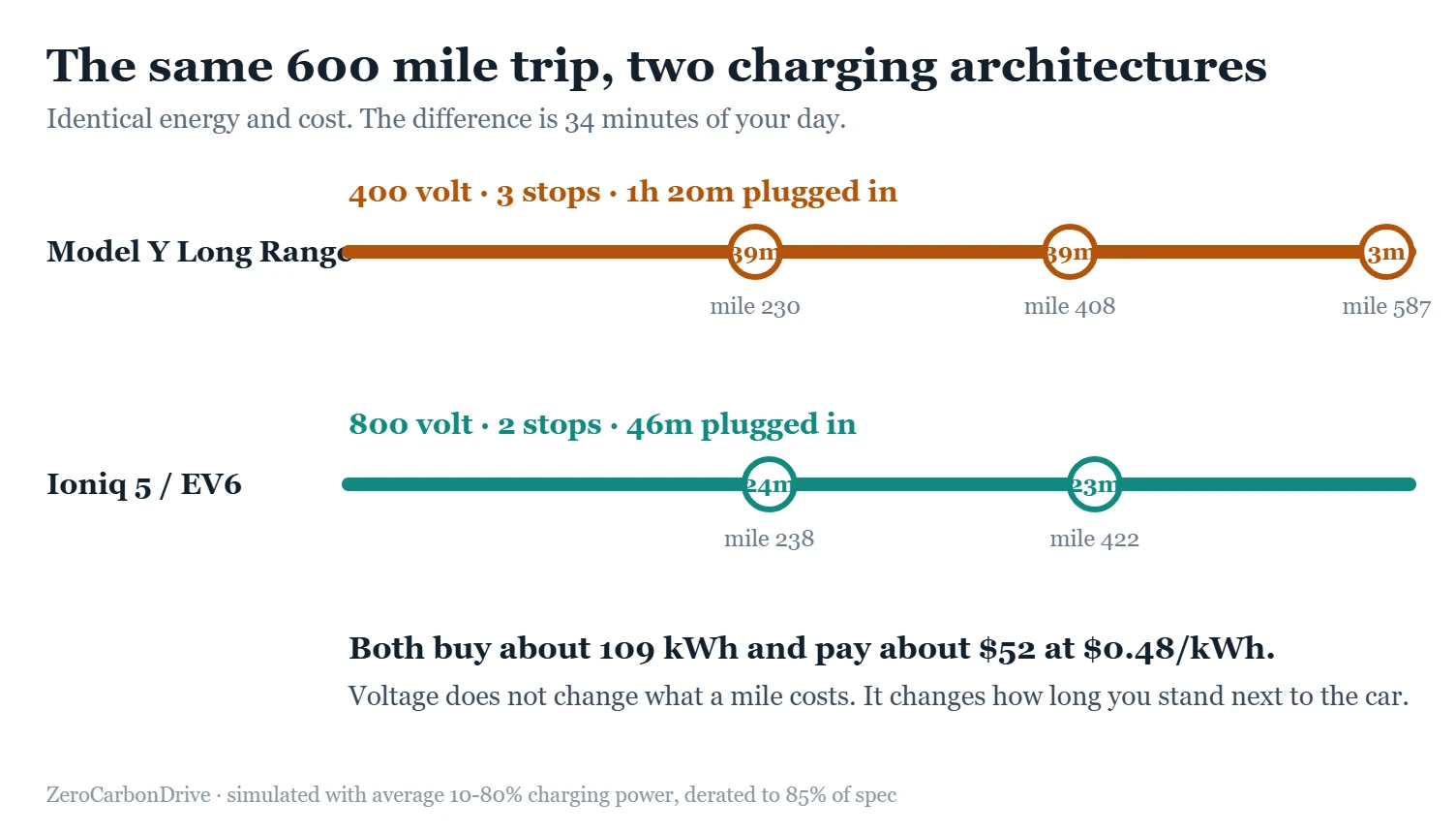
The energy and the money are effectively identical — physics does not care about voltage when it comes to how many kilowatt-hours a mile costs. What changes is 34 minutes of your day. An 800 volt pack moves the same power at roughly half the current, so cables and cells run cooler and the management system has less reason to throttle. That lets the car hold a high rate across most of the 10-to-80 window rather than only at the start.
This is the single most useful thing to know when shopping if you road trip often. Two cars with the same range can differ by half an hour per long drive, and no range figure on a window sticker tells you that.
Is a road trip actually cheaper in an EV?
Barely, and sometimes not at all. That 600 mile run costs about $52 in DC fast charging at $0.48 per kWh. A 30 MPG petrol car burns 20 gallons, which at $3.10 comes to $62. A saving of roughly $10 across ten hours of driving.
Change one input and it flips. Put the petrol figure at 38 MPG, or the DC price at $0.56, and the EV loses. This is not an argument against EVs — it is an argument about where the savings come from. EV running costs are won at home, on a residential rate, not at motorway chargers. The same 109 kWh at a US average home rate near $0.18 per kWh would cost about $19.50 rather than $52.
If almost all your charging is at home and you take two long trips a year, the road trip maths barely matters. If you live somewhere without home charging, it matters enormously — see our guide to charging an EV without a garage.
How to get your own numbers right
An EV road trip calculator is only as honest as the figures you feed it, and the defaults above are deliberately conservative. Here is where to find the real numbers for your own car.
| Field | Where to find the honest figure |
|---|---|
| Usable battery | Not the headline pack size. Manufacturers quote gross capacity; usable is typically a few kWh lower. Owner forums and charging databases publish the usable figure per model. |
| Highway efficiency | Your car’s trip computer on a motorway leg, not the EPA combined number. EPA blends city driving, where EVs do best. At 75 mph expect roughly 15-25 per cent worse than the sticker. |
| Average DC power | Divide the energy added by the time taken on a past session. Peak kW from the brochure will make the answer too optimistic. |
| Reserve | Whatever level actually makes you look for a charger. For most people that is 10-15 per cent, not 5. |
| DC price | Check your network app. Per-kWh pricing varies by state and by network, and some charge by the minute instead. |
Put this EV road trip calculator on your own site
The calculator is free to embed, with no tracking, no account and no sign-up wall. Paste this into any page:
<iframe src="https://zerocarbondrive.com/embed/ev-road-trip-calculator/" width="100%" height="900" style="border:1px solid #d8dee4;border-radius:10px" title="EV road trip charging calculator" loading="lazy"></iframe>If you would rather link than embed, that is fine too. If you spot an error in the maths, tell us and we will fix it.
Related guides
- EV charging cost calculator — the everyday version, for home and mixed charging rather than one long trip.
- EV charging costs by state — home rates for all 50 states.
- NACS adapters: what fits what — which network you can actually use on the way.
- DC fast charging, explained — why the charging curve tapers, in plain English.
Sources and assumptions
- Tesla Model Y Long Range RWD (2026) preset: 75 kWh usable, 357 mile EPA range, 10-80 per cent session averaging about 96 kW. Charging curve figures from EVKX charging curve data.
- Hyundai Ioniq 5 / Kia EV6 Long Range preset: 80 kWh usable on an 84 kWh gross pack, 800 volt architecture, 10-80 per cent in roughly 18-20 minutes on a 350 kW station. The preset uses the slower end of that range.
- Efficiency defaults are highway figures, deliberately below EPA combined ratings.
- The 85 per cent derating default is a working assumption, not a measured constant. It is exposed as a slider precisely because your conditions differ.
Frequently asked questions
Share this exact result
The link below re-opens this calculator with every figure you have entered already filled in, so whoever you send it to sees the same answer. Nothing is uploaded; the numbers travel inside the link itself.
Every figure on this page is dated and linked to its source. How we verify · Editorial policy · Report a correction
Related Posts


Leave a Comment
Your comment will be published after it has been approved. Please send comments that do not contain slang words.