
EV Depreciation Rates in 2026: How Fast Electric Cars Lose Value
Updated September 18, 2026 · 10 min read
Last updated: September 6, 2026
The short answer
EV depreciation averages 57.2% over five years — the steepest of any powertrain, against a 41.8% market average. But that number describes cars bought in 2021. In 2026 the used market flipped: EV depreciation is still severe on paper, while used EV prices actually rose through the first half of the year. If you are buying, EV depreciation is now working in your favour; if you are selling a five-year-old electric car, it is the single biggest line item in your ownership cost.
Key takeaways
- Five-year EV depreciation: 57.2%, versus 41.8% for all vehicles, 44.9% for SUVs, 35.4% for hybrids and 34.2% for trucks (iSeeCars, 950,000+ cars).
- The spread between models is enormous: 54.6% for a Tesla Model 3 against 63.1% for a Nissan LEAF.
- Dollars matter more than percentages — a Model 3 loses about $20,213 in five years; a Model S loses $58,907.
- After the federal credits ended on 30 September 2025, used Tesla prices rose 4.3% while the rest of the used EV market fell 3.6%.
- Battery health is the mechanical driver behind EV depreciation: packs lose about 2.3% of capacity per year, but heavy DC fast charging doubles that to 3.0%.
- The used EV price premium over comparable gas cars has collapsed from more than $10,000 in early 2023 to roughly $1,000.
How bad is EV depreciation in 2026?
iSeeCars analysed more than 950,000 five-year-old used cars sold between March 2025 and February 2026. The headline: the average vehicle lost 41.8% of its value in five years, a 3.8-point improvement on the previous study. Electric cars did not share in that recovery. EV depreciation came in at 57.2% — barely moved year over year, and the worst result of any powertrain category.
The gap is easier to understand as a ranking. Trucks and hybrids hold value best; electric cars sit alone at the bottom of the table.
Five-year depreciation by vehicle type
| Vehicle type | 5-year value lost | Value retained | Gap vs. market average |
|---|---|---|---|
| Electric vehicles | 57.2% | 42.8% | 15.4 points worse |
| SUVs | 44.9% | 55.1% | 3.1 points worse |
| All vehicles (average) | 41.8% | 58.2% | — |
| Hybrids | 35.4% | 64.6% | 6.4 points better |
| Trucks | 34.2% | 65.8% | 7.6 points better |
Two things drive that hybrid-versus-electric split. Hybrids ask no charging question of the second owner, and their technology has barely changed in a decade — a 2021 hybrid does what a 2026 hybrid does. An electric car bought in 2021 competes against 2026 models with more range, faster charging and, in many cases, a lower sticker price. That is the engine of EV depreciation.
Which EVs hold their value best — and which lose the most?
Averages hide the useful information. Within the same 57.2% category there is nearly a nine-point spread between the best and worst mainstream electric cars, and the dollar losses vary by a factor of three.
Best and worst EV depreciation by model (5 years)
| Model | 5-year depreciation | Average dollars lost | Verdict |
|---|---|---|---|
| Tesla Model 3 | 54.6% | $20,213 | Best mainstream retention |
| Porsche Taycan | 54.7% | $54,403 | Low % loss, huge dollar loss |
| Hyundai Kona Electric | 56.5% | $18,581 | Smallest absolute loss |
| Tesla Model S | 62.0% | $58,907 | Largest dollar loss |
| Volkswagen ID.4 | 62.1% | $28,010 | Below category average |
| Nissan LEAF | 63.1% | $17,743 | Worst percentage loss |
Notice the trap in the percentages. The Kona Electric and the LEAF post the two worst-looking retention rates, yet they cost their owners the least money, because they were cheap to begin with. The Taycan looks respectable at 54.7% and still hands its owner a $54,403 bill. When you compare EV depreciation across price classes, always convert the percentage into dollars before drawing a conclusion.
The LEAF result is also a technology lesson. It is the only mainstream electric car of that era sold with a passively cooled battery pack, and second-hand buyers have learned to discount it accordingly. If you are shopping that end of the market, our guide to the cheapest electric cars is worth reading alongside these numbers.
Why is EV depreciation steeper than for gas cars?
Five forces stack up, and none of them is “electric cars are unreliable” — that myth does not survive contact with the warranty data.
- New-car incentives reset the baseline. When a new EV carried a $7,500 credit, its effective price fell by $7,500 — and every used example had to be priced below that. Incentives depreciate the used fleet the moment they are announced.
- Rapid technical progress. Range, charging speed and software on a 2026 model make a 2021 model look dated in a way a 2021 petrol sedan does not.
- Battery uncertainty. Buyers cannot see a battery’s condition from the outside, so they price in the worst case unless the seller proves otherwise.
- Price cuts on new cars. Repeated MSRP reductions push the entire used curve down overnight, and the second owner has no defence against it.
- A thinner buyer pool. Anyone without home charging is a hesitant buyer, which narrows demand exactly where used-car volume lives.
Only the first and fourth of those are unique to electric cars, which is why EV depreciation is expected to ease as the technology matures and incentive whiplash fades.
The 2026 twist: used EV prices went up
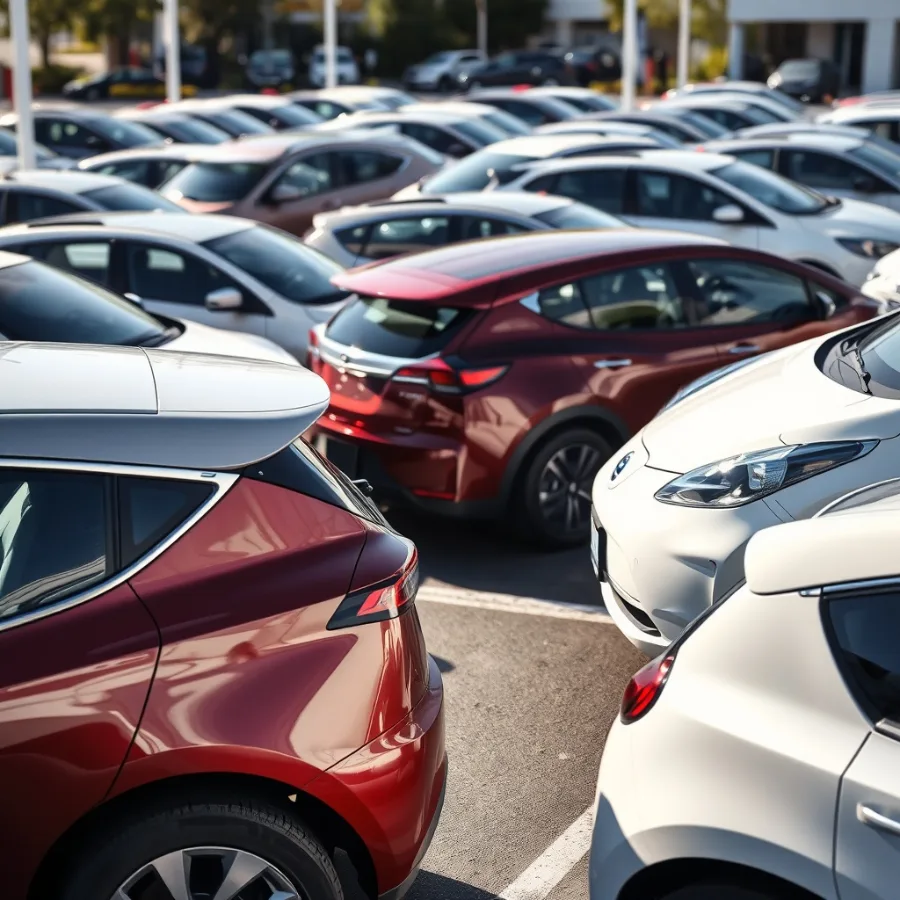
Here is the part most EV depreciation coverage misses. The 57.2% figure is a rear-view mirror — it describes cars registered in 2021 and sold in 2025-26. What the market did during 2026 was the opposite of the forecast.
Analysts expected the end of the $7,500 new-EV and $4,000 used-EV credits on 30 September 2025, plus more than 300,000 vehicles coming off lease, to crater used values. Instead prices firmed. iSeeCars, reviewing 1.7 million used cars, found the average used EV price rose 3.5% between the credit’s expiry and January 2026 — but the gain was concentrated almost entirely in one brand.
For context on the brands driving global EV prices down, see Chinese electric cars.
Used EV price change after the credits ended (Sept 2025 to Jan 2026)
| Model | Price change | Direction |
|---|---|---|
| Tesla Model X | +10.3% | Up |
| Tesla Model S | +8.5% | Up |
| Tesla Model 3 | +2.6% | Up |
| Tesla Model Y | +1.3% | Up |
| Polestar 2 | -1.9% | Down |
| Nissan LEAF | -4.6% | Down |
| Ford Mustang Mach-E | -5.1% | Down |
| Kia Niro EV | -5.2% | Down |
| Volkswagen ID.4 | -6.2% | Down |
| Hyundai Kona Electric | -6.4% | Down |
Used Tesla prices climbed 4.3% overall, from $30,040 to $31,329, while non-Tesla EVs fell 3.6%, from $24,629 to $23,738 — a near eight-point gap in trajectory. The practical reading: EV depreciation is no longer one curve. There is a Tesla curve and an everything-else curve, and the gap opened precisely when the subsidy that had been propping up non-Tesla prices disappeared.
The other structural shift is the price gap against petrol. A used EV cost more than $10,000 over a comparable used gas car in early 2023. By 2026 that premium had narrowed to roughly $1,000 — near parity for the first time, which is why used EV sales rose about 12% year over year in the first quarter even as new EV sales fell sharply.
How battery health drives EV depreciation
If EV depreciation has one mechanical cause, it is the battery — the most expensive component in the car and the one that decides how far it goes. The good news is that the fear is worse than the data.
Geotab analysed more than 22,700 electric vehicles across 21 models and found an average degradation rate of 2.3% per year, projecting 81.6% state of health after eight years. In other words, the typical EV finishes its warranty period with four-fifths of its original capacity intact. But how the car was used changes that outcome dramatically.
Battery degradation by usage pattern
| Usage pattern | Annual capacity loss | State of health at 8 years |
|---|---|---|
| Mostly AC charging (under 12% DC fast charging) | 1.5% | About 88% |
| Fleet average, all usage types | 2.3% | 81.6% |
| Heavy DC fast charging (over 40% of sessions above 100 kW) | 3.0% | About 76% |
| Hot climate | +0.4% per year | Compounds the above |
| High utilisation (over 35% daily charge cycles) | 2.3% | About 0.8% worse than light use |
The twelve-point spread between a gently charged car and a hard-fast-charged one is the difference between a used EV that sells easily and one that sits on the forecourt. This is why EV depreciation punishes cars with no service history hardest: the buyer cannot tell which row of that table your car belongs in. Our explainer on EV battery replacement cost covers what happens if a pack does fail out of warranty.
What EV depreciation actually costs you: a worked example
Percentages are abstract. Here is the five-year arithmetic on a $45,000 electric SUV bought new, at the category average of 57.2%, against the same money spent on a hybrid at 35.4%.
Five-year cost of depreciation: EV vs hybrid
| Line item | $45,000 EV | $45,000 hybrid |
|---|---|---|
| Value after 5 years | $19,260 | $29,070 |
| Depreciation cost | $25,740 | $15,930 |
| Depreciation per year | $5,148 | $3,186 |
| 5-year energy cost (12,000 mi/yr) | About $3,700 | About $6,700 |
| 5-year maintenance | Lower | Higher |
| Depreciation plus energy | $29,440 | $22,630 |
Energy and maintenance savings are real, but they do not cover a $9,810 depreciation gap over five years. That is the honest case against buying a new EV purely on running costs — and the honest case for buying a three-year-old one, where the first owner has already absorbed the steepest part of the EV depreciation curve. For the running-cost side in detail, see our breakdown of EV maintenance cost versus gas.
How to reduce EV depreciation on a car you own
You cannot change the market, but four things measurably change what a buyer will pay.
- Document battery state of health. Pull an SoH report before listing. An unverified battery is priced as a worst-case battery.
- Charge on AC at home where you can. The Geotab data shows habitual fast charging roughly doubles capacity loss, and buyers increasingly ask about charging history.
- Keep the warranty transferable and prove it. US federal rules require eight years or 100,000 miles of battery coverage, and remaining coverage is a genuine selling point.
- Sell before the warranty cliff, not after. The steepest single step in EV depreciation happens as that coverage runs out.
None of this reverses EV depreciation. It moves your car from the bottom of its model’s price band to the top, which on a $30,000 car is worth thousands.
Is a used EV the smart buy in 2026?
For a buyer, steep EV depreciation is not a warning — it is the entire opportunity. A three-year-old electric car has already surrendered the bulk of its value, still carries several years of battery warranty, and now costs roughly the same as an equivalent petrol car. The risks are concentrated and checkable: battery state of health, charging history, and whether the model uses a passively cooled pack.
For a new-car buyer the calculus differs. If you keep cars for a decade, EV depreciation matters far less than energy and maintenance, and the total picture favours electric. If you trade every three years, you are the person paying for the steep part of the curve, and leasing — where residual risk sits with the finance company — is usually cheaper. Anyone weighing new against used should also read how the market shifted after the incentive change in our guide to EV resale value.

Frequently asked questions
How much does an EV depreciate in 5 years?
Electric vehicles lose an average of 57.2% of their value over five years, according to an iSeeCars analysis of more than 950,000 five-year-old used cars sold between March 2025 and February 2026. That compares with 41.8% for the market as a whole, so EV depreciation runs roughly 15 percentage points steeper than the average car.
Which electric car holds its value best?
Among five-year-old models the Tesla Model 3 holds value best at 54.6% depreciation, followed by the Porsche Taycan at 54.7% and the Hyundai Kona Electric at 56.5%. In dollar terms the Kona Electric is the clear winner, losing about $18,581 against $54,403 for the Taycan.
Why do EVs depreciate faster than gas cars?
Four factors dominate: new-car incentives lower the effective price every used example must sit below; rapid improvements in range and charging make older models feel dated; buyers discount batteries they cannot verify; and manufacturer price cuts on new models push the whole used curve down at once. Reliability is not a significant cause of EV depreciation.
Did used EV prices fall after the tax credit ended?
Not overall. Between the credits expiring on 30 September 2025 and January 2026, average used EV prices rose 3.5%. The gain was concentrated in Tesla, up 4.3% from $30,040 to $31,329, while non-Tesla electric cars fell 3.6% from $24,629 to $23,738.
How much battery capacity does an EV lose per year?
About 2.3% a year on average, based on Geotab analysis of more than 22,700 vehicles across 21 models, leaving roughly 81.6% state of health after eight years. Cars charged mainly on AC lose about 1.5% a year, while heavy users of high-power DC fast charging lose about 3.0%.
Is it cheaper to buy a used EV than a used gas car in 2026?
They are close to parity. The used EV price premium over a comparable petrol car has narrowed from more than $10,000 in early 2023 to roughly $1,000, which is why used EV sales rose about 12% year over year in the first quarter of 2026 while new EV sales fell.
Does leasing avoid EV depreciation?
It transfers the risk rather than removing it. The lease payment is built from the residual value the finance company forecasts, so you pay for expected EV depreciation either way, but if the car is worth less than forecast at handback that loss is theirs, not yours.
Sources
- iSeeCars — Cars That Hold Their Value Best Study (2026): five-year depreciation by vehicle type and model, 950,000+ vehicles analysed.
- Geotab — EV Battery Health: Findings from 22,700 Vehicles: annual degradation rates by charging behaviour, climate and utilisation.
- Recurrent — Used EV Tax Credits and Eligibility (2026 updates): status of the federal used-EV credit after September 2025.
Every figure on this page is dated and linked to its source. How we verify · Editorial policy · Report a correction
Related Posts
Leave a Comment
Your comment will be published after it has been approved. Please send comments that do not contain slang words.