
Tesla Home Charger Guide (2026): Wall Connector, Costs and Setup
Updated September 18, 2026 · 12 min read
Last updated: August 31, 2026.
Quick answer: the best Tesla home charger for most owners is the Wall Connector — about $420-450 plus $500-1,500 installed, adding ~70 km of range per hour. The cheaper path is the Mobile Connector with a 240V outlet, and any J1772 charger also works via Tesla’s included adapter.
Key takeaways
- Three real options: Wall Connector (fastest, 48A), Universal Wall Connector (adds J1772 for mixed households), Mobile Connector + 240V outlet (budget, up to 32A).
- Every option fills a Tesla overnight; the Wall Connector’s edge is speed headroom, tidiness and multi-car load sharing.
- Installed totals commonly land at $1,000-2,000; the 30C federal credit returns 30% up to $1,000 until June 30, 2026.
- Third-party Level 2 chargers work fine with the adapter — buy Tesla-native for NACS convenience, not necessity.
- Charge to 80-90% daily (100% for LFP-pack Standard Range cars — Tesla’s own guidance differs by battery type).
- Schedule off-peak charging in the Tesla app; time-of-use rates can halve your cost per mile.
Your Three Tesla Home Charger Options Compared
| Option | Hardware cost | Max power | Range/hour (Model Y) | Best for |
|---|---|---|---|---|
| Wall Connector | ~$420-450 | 48A / 11.5 kW | ~70 km | Most Tesla households |
| Universal Wall Connector | ~$580-620 | 48A / 11.5 kW | ~70 km | Tesla + another brand at home |
| Mobile Connector + NEMA 14-50 | ~$230-300 (+outlet install) | 32A / 7.7 kW | ~50 km | Budget, renters, second home |
| Third-party J1772 Level 2 | $300-800 | Up to 48A | ~50-70 km | Mixed fleets, existing charger |
The honest framing: whichever Tesla home charger you pick, all four get a commuting Tesla to full every morning. The Tesla home charger differences are convenience (native NACS plug vs adapter), speed headroom, and software. For the general landscape beyond Tesla — amperage math, circuit sizing, what UL listing means — our Level 2 EV charger guide is the companion read.
Wall Connector In Depth: Why It Is the Default
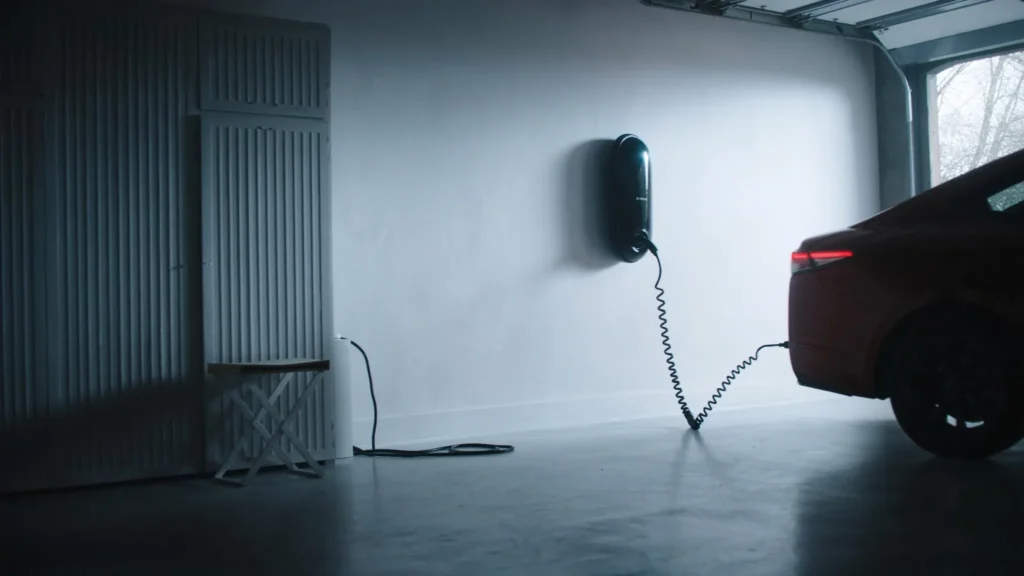
As a Tesla home charger, the Wall Connector earns its position through details rather than raw speed. It hardwires to a 60A circuit for a full 48A output — the most any current Tesla accepts on AC. The cable is 7.3 m, long enough for awkward driveways. Power sharing is built in: up to six units split one circuit automatically, which is how two-Tesla homes avoid a panel upgrade.
And because it speaks NACS natively, there is no adapter to lose or wear. The app tracks energy per charge session and applies scheduled charging without third-party hardware.
Weaknesses exist. It charges only NACS vehicles unless you buy the Universal version, its smart features live inside Tesla’s ecosystem, and hardwiring means it stays with the house when you move. If any of those matter, the comparison table above points to the alternative that fixes it.
The Budget Path: Mobile Connector Done Right
The Mobile Connector that many owners already have (bundled with older cars, ~$230 today) plus a properly installed NEMA 14-50 outlet is a legitimate Tesla home charger for a fraction of the cost. At 32A it delivers about 50 km of range per hour — a 10-80% refill in roughly five hours.
The critical detail is the outlet: daily EV duty demands an industrial-grade receptacle on a dedicated 50A circuit, professionally installed with a permit. The $10 hardware-store 14-50 is a documented melt risk under continuous load. Done properly, outlet installation runs $300-800, and the whole setup stays portable — it moves house with you, and doubles as a road-trip fallback at RV parks.
What a Tesla Home Charger Costs, All-In
| Scenario | Hardware | Install | Typical total |
|---|---|---|---|
| Wall Connector, panel nearby | $450 | $500-800 | $950-1,250 |
| Wall Connector, long run/conduit | $450 | $1,000-2,000 | $1,450-2,450 |
| Universal Wall Connector | $600 | $500-1,500 | $1,100-2,100 |
| Mobile Connector + 14-50 outlet | $230-300 | $300-800 | $530-1,100 |
| Add: panel upgrade if required | — | $1,500-4,000 | ask about load management first |
Two money notes. The federal 30C credit returns 30% of hardware+install up to $1,000 — claim it while it lasts (June 30, 2026 sunset under current law), and stack any utility rebate on top. And running costs stay tiny either way: a 60 kWh refill at home costs $8-10 at average US rates versus $25-35 at Superchargers — the per-mile numbers live on our EV statistics page. Full install detail (quotes, permits, load-sharing tricks) is in the EV charger installation guide.
Installation: The Tesla-Specific Details
Any licensed electrician can install a Tesla home charger — Tesla publishes the manual openly, and certified-installer networks simply add convenience. The Tesla-specific choices worth deciding before the visit: hardwire amperage (commission the unit at 48A only if the circuit is 60A; it configures down for smaller circuits), placement relative to the charge port (driver-side rear — a metre of cable saved daily beats aesthetics), and Wi-Fi coverage at the mounting spot for firmware updates and the app.
Commissioning takes two minutes on a phone. Permits apply exactly as with any 240V circuit; our Level 2 guide’s wiring-and-safety section covers the code details that apply to every brand.
Charging a Tesla Well: Settings That Matter
The car, not the wall unit, runs the show — set these once in the Tesla app. Daily charge limit: Tesla’s guidance differs by pack — LFP-battery cars (most Standard Range builds) prefer charging to 100% regularly, while long-range NMC packs live longest at an 80-90% daily cap. Scheduled departure warms the battery and finishes charging just before you leave, which matters in winter.
Off-peak scheduling aligns charging with cheap, cleaner overnight electricity — the grid-mix case is laid out in EV charging and grid emissions. And for battery longevity context — what degradation data actually shows across fleets — see EV battery health.
Tesla Home Charger vs Supercharging Only
| Factor | Home charging | Supercharger-only life |
|---|---|---|
| Cost per 100 km | ~$2-3 | ~$7-10 |
| Time cost | ~10 seconds of plugging daily | 20-40 min sessions, weekly+ |
| Battery wear | Gentlest possible | More fast-charge stress over years |
| Winter mornings | Preconditioned, full | Cold car, station queue risk |
| Upfront cost | $530-2,450 | $0 |
Supercharger-only ownership works — plenty of apartment dwellers prove it — but the economics repay a Tesla home charger within two to three years of average driving, and the convenience repays it immediately. For those without a driveway today, the renter strategies in EV charging at home are the bridge.
Which Generation and Where to Buy
The current (third-generation) Wall Connector is the Tesla home charger sold new; second-generation units still circulate used and work fine but lack Wi-Fi commissioning and power-sharing over Wi-Fi. Buying used is legitimate for the budget-minded — verify the cable and pins visually, and expect no warranty. New units come from Tesla directly or major retailers at essentially the same price; watch for utility marketplace discounts, which sometimes beat both. One Tesla home charger buying mistake to avoid: gray-market “Tesla compatible” chargers without UL/ETL certification. A Tesla home charger carries continuous high current for hours; certification is the line between an appliance and a hazard.
| Purchase route | Typical price | Notes |
|---|---|---|
| Tesla.com / Tesla app | $420-450 | Reference price; frequent availability |
| Major retailers | $420-480 | Occasional bundles with install |
| Utility marketplaces | $350-430 | Rebates sometimes applied at checkout |
| Used (gen 2/3) | $200-350 | No warranty; inspect before buying |
No Driveway? Tesla-Specific Renter Strategies
A Tesla home charger assumes a parking spot with power, but Tesla ownership without one is common. The workable ladder, cheapest first: a regular 120V outlet near your spot plus the Mobile Connector covers up to ~60 km of overnight range — enough for many commutes even before Level 2.
A landlord-approved NEMA 14-50 installation is the single highest-value ask a renting Tesla owner can make; the portable Mobile Connector setup leaves no fixture behind when you move. Workplace charging, where offered, replaces home charging almost entirely. And Tesla’s trip-planner integration makes a weekly Supercharger session a tolerable fallback rather than a lifestyle. The broader apartment strategies — building lobbying, shared-charger economics — are covered in our EV charging at home guide linked above.
Winter, Road Trips and Real-World Quirks
Three Tesla home charger realities the spec sheets skip. In winter, a cold-soaked battery accepts charge slowly at first — irrelevant overnight, but it makes Scheduled Departure genuinely useful.
The car warms itself on wall power, not battery power, and you leave your Tesla home charger with full range on frigid mornings. On road trips, the Mobile Connector earns its boot space — RV parks and rural rentals with 14-50 outlets turn into overnight charging stops. And after power outages, the Wall Connector resumes charging automatically; no ritual needed beyond confidence in your breaker sizing, which is one more argument for the licensed-install route.
From Order to First Charge: The Seven Steps
| Step | What happens | Time/cost note |
|---|---|---|
| 1. Pick the option | Wall Connector vs Universal vs Mobile+outlet (tables above) | 10 minutes with this guide |
| 2. Get 2-3 electrician quotes | Photos of panel + parking spot get accurate remote quotes | Spread between quotes is routinely 2x |
| 3. Confirm panel capacity | Electrician checks spare amps; asks about load management if tight | Avoids surprise upgrade costs |
| 4. Permit | Electrician usually files it | $50-250, a few days |
| 5. Install day | Mount, run circuit, breaker, test | 2-4 hours typical |
| 6. Commission | Wi-Fi setup via phone, set amperage | 2 minutes |
| 7. Configure the car | Charge limit, off-peak schedule, Scheduled Departure | Once, in the Tesla app |
Save every Tesla home charger receipt: the 30C credit claim wants hardware and installation documented, and utility rebates often ask for the permit number too.
What It Actually Costs Per Month
The running-cost math that convinces most fence-sitters: at 1,200 monthly kilometres and a typical 16 kWh/100 km real-world consumption, a Tesla draws roughly 190 kWh per month from a Tesla home charger. At an average US residential rate that is about $28; on an off-peak EV tariff, often under $18.
The same distance on gasoline at typical prices runs $110-160, and Supercharger-only would land near $60-75. Over a five-year ownership, home charging’s savings alone repay even the most expensive Wall Connector installation two to four times over — before counting a single minute of saved errand time. That arithmetic, more than any spec, is why the home unit is the first accessory most owners buy.
Common Tesla Home Charger Myths
“You must buy Tesla’s own charger.” False — the J1772 adapter in every Tesla’s glovebox makes any certified Level 2 unit a valid Tesla home charger; Tesla’s advantage is convenience, not compatibility.
“48 amps is necessary.” Rarely — a 32A setup fully recharges typical daily driving in a few evening hours. Speed headroom is comfort, not requirement.
“Home charging wears the battery.” Backwards — slow AC charging is the gentlest treatment a pack gets; it is repeated DC fast charging that adds measurable stress over years.
“Installation always needs a panel upgrade.” Usually not — load-managed commissioning at lower amps, or power-sharing hardware, lets most existing panels host a Tesla home charger without the $2,000+ upgrade.
Beyond the Supercharger network, our EV charging stations guide maps every major network, price model and finder tool.
One-Minute Recap
The whole Tesla home charger decision in five sentences: most owners should hardwire a Wall Connector at 48A if the panel allows, or run a 40A plug-in setup on a proper NEMA 14-50 if it does not. Mixed-brand households buy the Universal version; renters and movers take the Mobile Connector path. Claim the 30C credit before June 30, 2026, set the charge limit to match your battery chemistry, and schedule off-peak charging in the app. Everything else on this page is the reasoning and the tables behind those calls.
Understanding this technology helps explain a lot of everyday EV behavior — see our regenerative braking guide.
Frequently Asked Questions
Which tesla home charger is right for you?
There are two wall-mounted units and one portable one, and the choice usually comes down to a single question: does anything other than a Tesla ever need to charge at this house?
| Wall Connector | Universal Wall Connector | Third-party NACS unit | |
|---|---|---|---|
| Maximum current | 48 A, adjustable by the installer | 48 A, adjustable by the installer | Typically 48 A |
| Range added per hour | About 44 miles | About 44 miles | About 44 miles at 48 A |
| Connectors | NACS | NACS and J1772, using an adapter that docks into the side of the unit | NACS or J1772 depending on the version ordered |
| Cable | 24 ft | 24 ft, or a 13.1 ft version | Commonly 25 ft |
| Mounting | Hardwired | Hardwired | Usually hardwired; some models plug in |
| Outdoor rating | Type 3R, indoor or outdoor | Type 3R, indoor or outdoor | Varies — check before buying |
Can a non-Tesla use a Tesla home charger?
Yes, with the right unit. Tesla states plainly that the Universal Wall Connector is compatible with Tesla and non-Tesla electric vehicles, and that it supports AC charging for cars with either a NACS or a J1772 charge port through a J1772 adapter that docks into the side of the unit. That is a meaningful difference from the standard Wall Connector, which terminates in a NACS plug only.
If your household is mixed today, or might be in three years, the universal version removes a daily annoyance for a modest premium. It is also the more sellable fixture if you move — a hardwired NACS-only charger narrows the pool of buyers who see it as useful.
What the specifications do not decide
- Your car is usually the limit, not the charger. Most mainstream EVs cap AC charging at about 11.5 kW, which 48 A already supplies. See 40 amp vs 48 amp home chargers.
- Your panel may be the real constraint. A 48 A charger needs a 60 A breaker on continuous-load rules. Load management is often cheaper than a service upgrade — the numbers are in our installation cost guide.
- Cable length beats headline power. Twenty-four feet reaches most driveways; thirteen does not, and there is no adapter for a cable that will not stretch.
- The federal charger credit is gone. The 30C credit expired on 30 June 2026. Utility rebates are what is left — see the home EV charger tax credit.
Specifications above are from Tesla’s Universal Wall Connector datasheet and were last checked on 3 September 2026. There are no affiliate links on this page and no manufacturer has paid for a mention.
Which Tesla home charger should I buy?
For most Tesla owners, the Wall Connector (48A, 11.5 kW) is the default: fastest home speed, tidy install, and load-sharing for multi-Tesla homes. The Universal Wall Connector adds a built-in J1772 adapter for mixed-brand households. The Mobile Connector plus a 240V outlet is the budget path at up to 32A.
How fast does a Tesla home charger charge?
A Wall Connector at 48A adds roughly 70 km of range per hour on a Model Y/3 — a full overnight charge from near-empty. The Mobile Connector on a NEMA 14-50 outlet delivers up to 32A (~50 km/hour), still comfortably overnight for daily driving.
How much does Tesla home charger installation cost?
The Wall Connector itself is typically about $420-450 ($580-620 for the Universal). Professional installation usually runs $500-1,500 for straightforward jobs; long wiring runs or panel work push totals to $2,000+. Quotes vary widely — get two or three.
Do I need the Tesla Wall Connector, or is a regular charger fine?
Any quality J1772 Level 2 unit charges a Tesla via the included adapter at the same physical speeds. The Wall Connector\u0027s advantages are native NACS (no adapter), app integration, and 48A support; third-party units win on cross-brand flexibility.
Can a Tesla home charger power two Teslas?
Yes — up to six Wall Connectors can share one circuit via built-in power management, splitting available amps automatically. For two cars with normal commutes, even a single 48A unit charging alternately covers most households.
Is there a tax credit for a Tesla home charger?
The US federal 30C credit covers 30% of hardware and installation up to $1,000, and it expires June 30, 2026 under current law. Many utilities add their own rebates — check before installing, not after.
The Wall Connector ships fixed at 48A — if you’re weighing that against a cheaper 40A circuit, our 40 vs 48 amp EV charger guide lays out the breaker size, cost and speed tradeoffs.
Sources and Further Reading
- Tesla — Home Charging Installation Support
- US DOE — Charging at Home (AFDC)
- IRS — 30C Refueling Property Credit
Running cost is the other half of the decision: our free EV charging cost calculator shows what home charging costs where you live.
Every figure on this page is dated and linked to its source. How we verify · Editorial policy · Report a correction
Related Posts


Leave a Comment
Your comment will be published after it has been approved. Please send comments that do not contain slang words.