
40 vs 48 Amp EV Charger: Which Should You Install?
Updated September 11, 2026 · 8 min read
Quick answer: A 40 amp EV charger draws 9.6 kW and needs a 50-amp breaker with 8 AWG copper wire. A 48 amp EV charger draws 11.5 kW and needs a 60-amp breaker with 6 AWG copper wire. The real question in a 40 vs 48 amp EV charger decision usually isn’t speed — it’s whether your car can even use the extra amps. Most mainstream EVs (Tesla Model 3, Chevy Equinox EV, the 2027 Bolt) cap onboard AC charging around 11.5 kW anyway, so 48 amp matches them exactly. Older or budget EVs like the 2026 Nissan Leaf cap out lower, at 7.2 kW, and never touch the extra headroom a 48 amp circuit provides.
Key takeaways
- The jump from 40A to 48A adds 1.9 kW (9.6 → 11.5 kW) — real, but it typically saves under an hour on a normal overnight charge.
- NEC’s 125% continuous-load rule sets your breaker size directly: a 40A charger needs a 50A breaker; a 48A charger needs a 60A breaker.
- Most mainstream EVs cap onboard AC charging at 7.2–11.5 kW regardless of what the wall unit can deliver — check your owner’s manual before paying for amperage you can’t use.
- The Tesla Wall Connector (48A) and Grizzl-E Classic (40A) are fixed at one amperage; the ChargePoint Home Flex is adjustable between the two, which sidesteps the decision entirely.
- Panel capacity, not charging speed, is the more common reason an electrician recommends one over the other.
The Real Difference: Amps, Kilowatts and Charging Speed
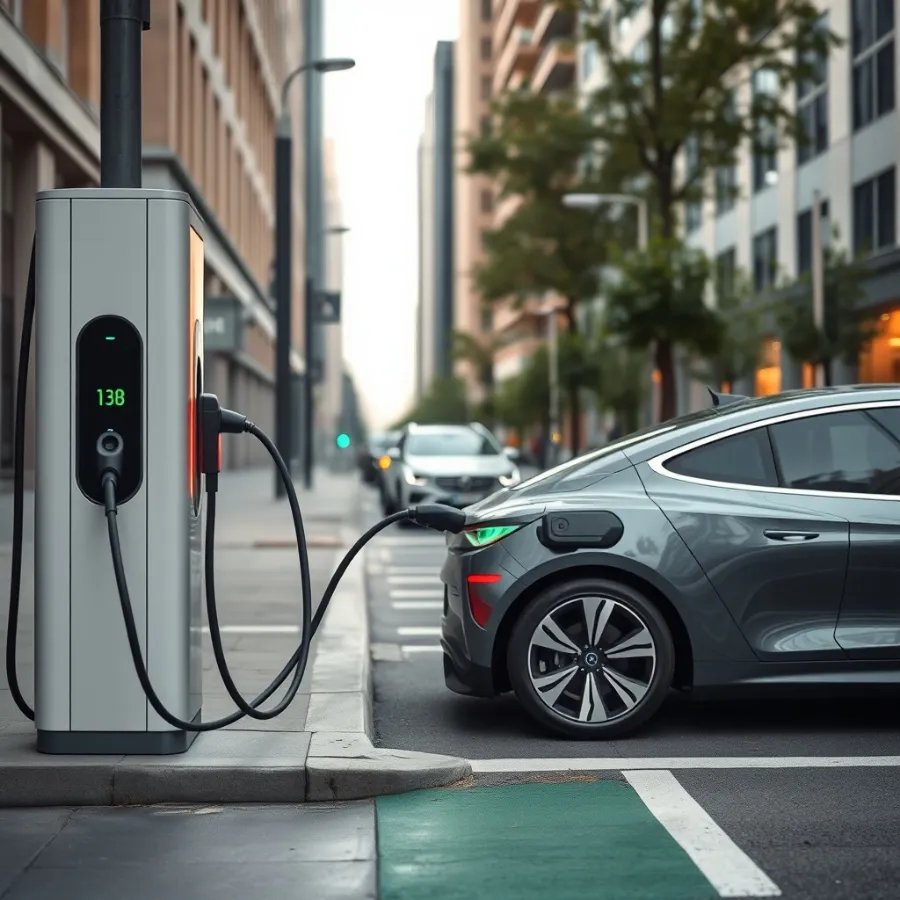
A home Level 2 charger runs on a 240-volt circuit, so its power output is simply volts × amps. That’s where the two headline numbers come from: 240V × 40A = 9.6 kW, and 240V × 48A = 11.5 kW. Tesla states its 48A Wall Connector delivers up to 44 miles of range per hour on a Model 3 — scaling that same ratio down, a 40A charger adds roughly 37 miles per hour, and a 32A charger roughly 30. Your own vehicle’s efficiency will move these numbers up or down, but the ratio between amperages holds regardless of what you drive.
| Charger amperage | Output at 240V | Approx. range added per hour* |
|---|---|---|
| 32A | 7.7 kW | ~30 miles |
| 40A | 9.6 kW | ~37 miles |
| 48A | 11.5 kW | ~44 miles |
*Scaled from Tesla’s published 44 mi/hr figure for a 48A Wall Connector on a Model 3; actual range per hour varies by vehicle efficiency.
Breaker and Wire Sizing: What 40A and 48A Actually Require
EV charging is classified as a continuous load under the National Electrical Code, because a car can pull full current for three hours or more in one session. NEC 210.19(A)(1) requires the circuit to be sized at 125% of that continuous load, and that single rule is what forces the jump from a 50A to a 60A breaker between 40A and 48A chargers.
| Charger amperage | 125% continuous load | Breaker size required | Copper wire | Aluminum wire |
|---|---|---|---|---|
| 32A | 40A | 40A | 8 AWG | 6 AWG |
| 40A | 50A | 50A | 8 AWG (6 AWG recommended on long runs) | 6 AWG |
| 48A | 60A | 60A | 6 AWG | 4 AWG |
That upgraded wire gauge is the real cost driver behind the amperage jump, not the charger itself — 6 AWG copper costs meaningfully more per foot than 8 AWG, and a 60A breaker occasionally forces a look at whether your panel has room for it. Always confirm sizing with a licensed electrician against your specific panel and run length; this table is the code-driven baseline, not a substitute for a site visit.

Popular Home Chargers by Amperage
You don’t design this from scratch — most buyers shopping for a 40 vs 48 amp EV charger pick between a handful of well-known units, and the amperage is usually fixed by the model you choose.
| Charger | Amperage | Output | Breaker needed | Notes |
|---|---|---|---|---|
| Tesla Wall Connector | 48A (fixed) | 11.5 kW | 60A | Built for Tesla, works with other EVs via adapter; 4-year warranty, longest of the major brands |
| ChargePoint Home Flex | Adjustable 16–50A | Up to ~12 kW | Set to match chosen amperage (up to 60–70A) | Works with any EV; app lets you dial to exactly 40A or 48A, removing the either/or decision |
| Grizzl-E Classic | 40A (fixed) | 9.6 kW | 50A | No smart features, rugged NEMA 4 enclosure rated to -30°C, made in Canada |
| Basic hardwired 40A EVSE (budget brands) | 40A (fixed) | 9.6 kW | 50A | Lowest-cost path to a real Level 2 circuit; no app or scheduling |
How Much Faster Is 48A? Two Real-World Charging Examples
Numbers on a spec sheet are abstract; a charging session is not. Here’s the same top-up — from 20% to 100% — run on both amperages for two illustrative battery sizes.
| Battery example | Energy to add (20%→100%) | Time at 40A (9.6 kW) | Time at 48A (11.5 kW) | Time saved |
|---|---|---|---|---|
| 62 kWh usable (compact EV) | 49.6 kWh | ~5h 10m | ~4h 19m | ~51 minutes |
| 80 kWh usable (mid-size crossover) | 64.0 kWh | ~6h 40m | ~5h 34m | ~66 minutes |
For most households charging overnight on an 8–10 hour window, both amperages finish comfortably before morning. The extra speed of 48A matters more if you sometimes need a shorter top-up during the day, or if your household runs two EVs sharing one overnight window.
Does Your Car Even Use the Extra 8 Amps?
This is the question that should decide a 40 vs 48 amp EV charger purchase before cost or panel capacity even comes up. Every EV has an onboard AC charger with its own maximum acceptance rate — feed it more amps than it can use, and the extra capacity simply goes unused.
| Vehicle | Max onboard AC charging | Effective amperage |
|---|---|---|
| Tesla Model 3 | 11.5 kW | ~48A |
| Chevrolet Equinox EV (standard) | 11.5 kW | ~48A |
| Chevrolet Equinox EV 3RS | 19.2 kW | ~80A (needs its own larger circuit) |
| Chevrolet Bolt (2027) | 11.5 kW | ~48A |
| Hyundai Ioniq 5 | ~10.9 kW | ~45A |
| Nissan Leaf (2026) | 7.2 kW | ~30A |
The pattern: most current mainstream EVs (Model 3, Equinox EV, the redesigned Bolt) land right around 11.5 kW, which is exactly what a 48A charger delivers — they’re a clean match. The Ioniq 5 falls just short of using the full 48A. The Leaf, at 7.2 kW, wouldn’t benefit from either a 40A or 48A circuit; a 32A setup already covers it. If you don’t yet own the EV, check the specific trim’s onboard charger spec before assuming you need the bigger circuit.
Installation Cost and Panel Capacity: The Real Deciding Factor
Once you’ve matched the charger to what your car can actually use, panel capacity usually breaks the tie. A 60A circuit for a 48A charger needs more spare capacity in your electrical panel than a 50A circuit for a 40A charger, and on an older 100A service already carrying central air, an electric range and a water heater, that difference can be the line between a straightforward install and a panel upgrade.
The thicker 6 AWG wire that a 48A run requires also costs more per foot than the 8 AWG a 40A run uses, though on a typical garage-length run the difference is usually modest next to the labor cost. For the full breakdown of what an installer will actually quote — permit fees, panel work, per-foot wire pricing — see our EV charger installation cost guide. Any electrician doing the work should pull your panel’s load calculation before quoting either amperage; don’t estimate spare capacity yourself from the panel label.
40 vs 48 Amp EV Charger: Which Should You Actually Choose?
Once the code requirements and your car’s real charging cap are on the table, the decision comes down to three practical situations:
- Choose 40A if: your panel is a 100A service with several other high-draw circuits already running, your EV caps AC charging below 9.6 kW (like the Leaf), budget is the deciding factor, or you always have 8+ hours to charge overnight regardless of speed.
- Choose 48A if: you have a 200A service with real spare capacity, your current or next EV can use 11+ kW (Model 3, Equinox EV, the 2027 Bolt), you want to future-proof for a car you haven’t bought yet, or you occasionally need a faster daytime top-up.
- Choose an adjustable unit if: you’re not sure yet, you expect to change vehicles, or you’d rather have an electrician set the exact amperage your panel’s load calculation allows. The ChargePoint Home Flex is built for exactly this case.
For most single-EV households with a reasonably modern panel, 48A is the safer long-term pick in the 40 vs 48 amp EV charger decision since it matches what nearly every current mainstream EV can use and adds only a modest cost over 40A. For a tight panel or a car with a lower onboard cap, 40A remains a fully capable circuit — there’s no charging penalty for “only” having 40A if your car can’t use more anyway.
Utility programmes are now the main source of charger money; our check of utility EV charger rebates found several widely quoted figures were wrong.
40 vs 48 Amp EV Charger FAQ
Is a 48 amp EV charger overkill for most cars?
Not for current mainstream EVs. The Tesla Model 3, Chevrolet Equinox EV and the redesigned 2027 Bolt all accept up to 11.5 kW on AC, which is exactly what a 48A charger delivers. It’s only overkill for cars capped lower, like the 7.2 kW 2026 Nissan Leaf.
Can a 40 amp charger circuit be upgraded to 48 amp later?
Usually, but not for free. It typically means pulling new 6 AWG wire and swapping the 50A breaker for a 60A one, and confirming the panel has spare capacity. If you might upgrade later, ask your electrician to at least run a larger conduit now, even on a 40A circuit.
What size breaker does a 48 amp EV charger need?
A 60-amp breaker. NEC’s 125% continuous-load rule sizes the circuit at 48A × 1.25 = 60A, paired with 6 AWG copper wire (or 4 AWG aluminum).
Does 48 amp charge noticeably faster than 40 amp?
Yes, but modestly. On a typical overnight top-up from 20% to 100%, 48A finishes roughly 50–65 minutes sooner than 40A, depending on battery size — useful if you need a shorter charging window, less noticeable if you always have all night.
Which chargers let me choose between 40 amp and 48 amp?
The ChargePoint Home Flex is the main adjustable option, with an app-controlled range from 16A up to 50A, so it can be set to exactly 40A or 48A. The Tesla Wall Connector and Grizzl-E Classic are each fixed at one amperage.
Do I need an electrician to install either one?
Yes. Both amperages involve a dedicated 240V circuit sized under NEC’s continuous-load rule, and a licensed electrician needs to verify your panel’s actual spare capacity before either breaker size is safe to install.
Related Guides on ZeroCarbonDrive
- Level 2 EV charger guide — the full buying guide this comparison sits inside
- Tesla home charger guide — Wall Connector setup, cost and rebates in detail
- EV charger installation costs — itemized quotes for the install side of this decision
- EV charging cost by state — what charging actually costs once the circuit is in
Sources and Further Reading
- NFPA — National Electrical Code (NFPA 70)
- U.S. DOE Alternative Fuels Data Center — Charging at Home
- U.S. Department of Energy — Electric Vehicle Charging at Home
Every figure on this page is dated and linked to its source. How we verify · Editorial policy · Report a correction
Related Posts



Leave a Comment
Your comment will be published after it has been approved. Please send comments that do not contain slang words.