
State EV Incentives 2026: What Is Left After the Federal Credits Ended
Updated September 12, 2026 · 9 min read
Last updated: 5 September 2026
There is no federal EV purchase credit in 2026 and no federal home charger credit. State programs, electric utility rebates and sales tax exemptions are the only incentives left, and in several states they are now worth more than the federal credit ever was. The catch is that state EV incentives change mid-year, run out of budget, and step down on schedules that most published guides have not caught up with.
Key takeaways
- The federal new and used clean vehicle credits ended for vehicles acquired after 30 September 2025 under Public Law 119-21.
- The federal home charger credit (Section 30C) ended for property placed in service after 30 June 2026.
- State programs did not expire with them. Connecticut, New Jersey and Colorado all still pay in 2026, on very different terms.
- Amounts step down. Colorado’s base credit fell from $3,500 in 2025 to $750 in 2026 — the same program, a fraction of the money.
- Point-of-sale beats a tax credit for most households: a rebate comes off the price at the dealer, a credit only helps if you owe enough tax.
- Seven states offer nothing at all, so the first question is whether your state has a programme before you work out how much it pays.
What actually changed at the federal level
Three separate credits ended within nine months of each other, which is why so much advice written in 2024 and 2025 is now wrong. They had different rules and different end dates, and mixing them up is the most common mistake in the current crop of incentive guides.
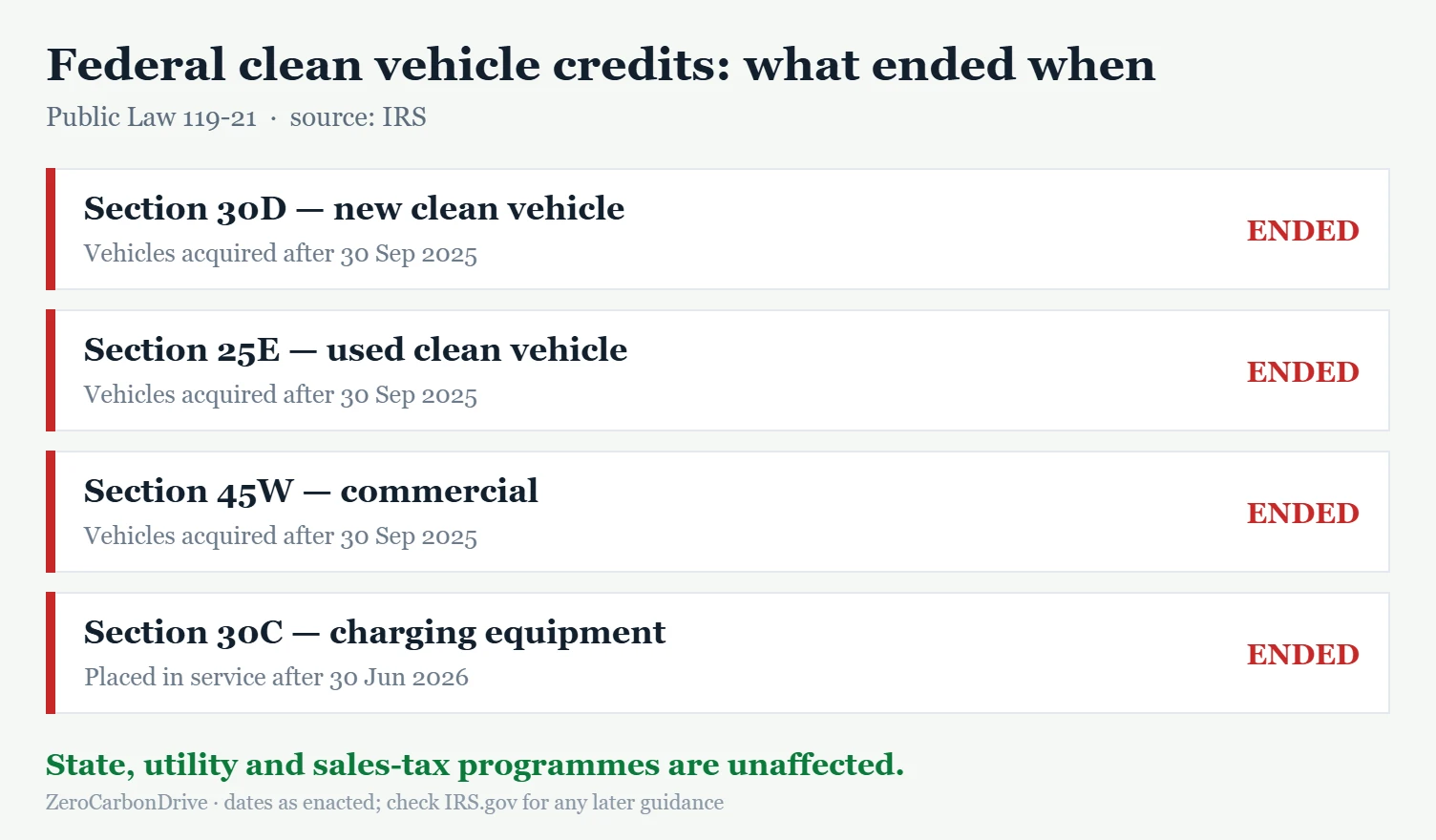
Federal clean vehicle credits: status in 2026
| Credit | What it covered | Ended | Test |
|---|---|---|---|
| Section 30D | New clean vehicle purchase | Vehicles acquired after 30 Sep 2025 | Acquired — binding written contract plus payment |
| Section 25E | Previously-owned (used) clean vehicle | Vehicles acquired after 30 Sep 2025 | Acquired |
| Section 45W | Commercial clean vehicle | Vehicles acquired after 30 Sep 2025 | Acquired |
| Section 30C | Home and business charging equipment | Property placed in service after 30 Jun 2026 | Placed in service — installed and working |
The distinction in the last column matters if you are filing for an earlier year. For the vehicle credits the IRS looks at when the car was acquired; for the charger credit it looks at when the equipment was placed in service. Our guide to the EV charger tax credit covers who can still file for a 2026 install.
One consequence is easy to miss: because the vehicle credits were tied to acquisition rather than delivery, a small number of buyers who signed and paid before 30 September 2025 could still claim on a car delivered much later. That window is now closed for anyone who did not already sign.
The three kinds of state EV incentive
State programmes are not interchangeable. They differ in when you get the money, whether you need a tax liability to benefit, and how easily the funding runs out. That structure matters more than the headline number.
How the money actually reaches you
| Type | When you get it | Needs tax liability? | Main risk |
|---|---|---|---|
| Point-of-sale rebate | At the dealer, off the price | No | Dealer must be enrolled in the programme |
| Post-purchase rebate | Weeks to months after buying | No | Application window, often 30–90 days |
| State income tax credit | When you file, the following year | Yes | Worth nothing if you owe no state tax |
| Sales tax exemption | At purchase, automatically | No | Can be repealed with little notice |
| Utility rebate | After install or purchase | No | Often requires an off-peak rate enrolment |
For a household with modest tax liability, a $1,500 point-of-sale rebate is worth more than a $3,000 non-refundable state credit. That is the single most useful thing to understand before comparing states, and it is why the ranking lists that sort purely by headline dollar amount are misleading.
Three programmes worth looking at closely
These are current as of September 2026 and each shows a different structure. They are examples of what to look for, not a substitute for checking your own state.
Verified state programmes, September 2026
| State | Programme | Amount | Cap | Structure |
|---|---|---|---|---|
| Connecticut | CHEAPR | Up to $5,000, plus Rebate Plus for income-qualified buyers | MSRP under $50,000 | Point of sale |
| New Jersey | Charge Up New Jersey | $1,500, or $4,000 with income-qualified Charge Up+ | MSRP up to $55,000 | Point of sale |
| Colorado | Innovative Motor Vehicle Credit | $750 in 2026, plus $2,500 if MSRP is under $35,000 | MSRP under $80,000 | State income tax credit |
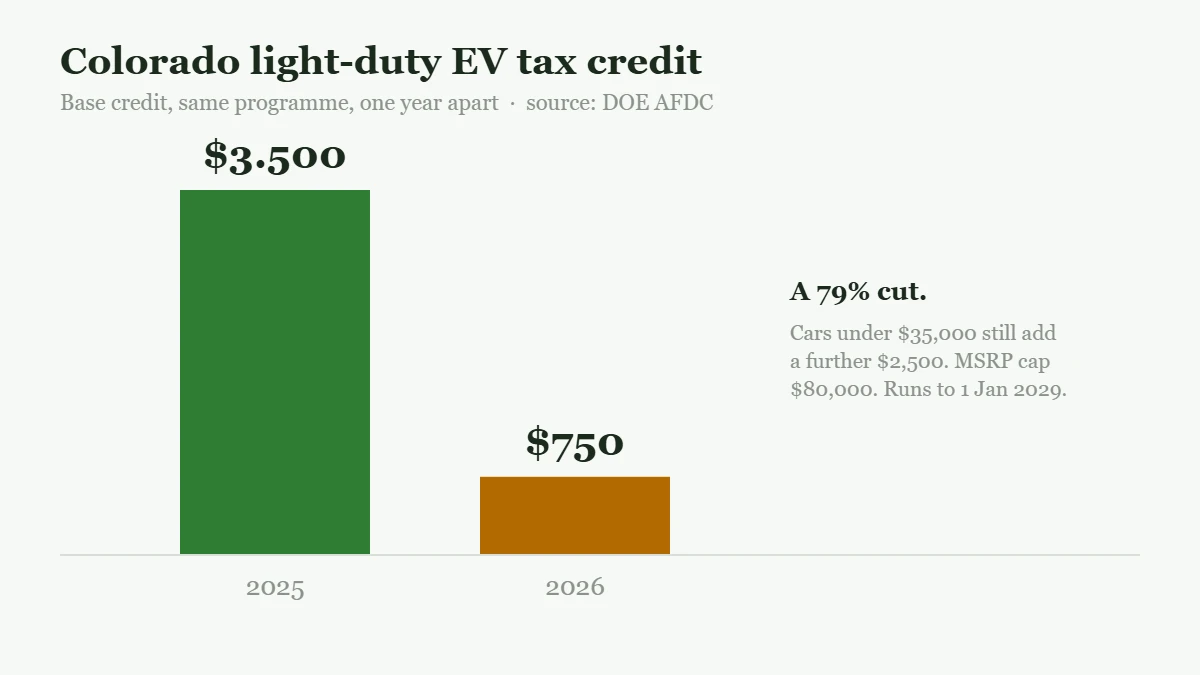
Colorado is the instructive case. The light-duty credit was $3,500 in 2025 and is $750 in 2026 — a 79% cut in one year, in a programme that is still described in plenty of articles at its old value. The credit is authorised through vehicles purchased or leased before 1 January 2029, and leases qualify provided the term is at least two years. Colorado also stacks: a car under $35,000 picks up an extra $2,500, which makes the cheaper end of the market disproportionately attractive there. Our list of the cheapest electric cars covers the models that clear that threshold.
Connecticut and New Jersey both pay at the dealer, which is worth real money to buyers who would struggle to use a credit. New Jersey layers an income-tested top-up on a flat base rebate; Connecticut sets a lower MSRP ceiling but a higher maximum. Neither requires you to wait for a tax return.
How to find your own incentive in about ten minutes
There is no single national list that is both complete and current, and any article claiming to be one is stale the week it is published. The reliable method is to check four places in order, from most authoritative to most local.
- The DOE Alternative Fuels Data Center. The federal government maintains a state-by-state database of laws and incentives covering all 50 states and DC. It cites the statute for each entry, which is what you want when a dealer tells you something different.
- DSIRE, at dsireusa.org. Maintained by NC State, filterable by ZIP code. It picks up local and utility programmes that the federal database sometimes lags on.
- Your electric utility’s own site. Search the utility name plus “EV rebate”. This is the highest-yield step and the one most people skip, because utility money is administered separately from anything the state does.
- Your state energy office. Some programmes are run here and appear on neither database until the next update cycle.
Do all four. The programmes stack in most states, and the failure mode is not claiming too much — it is claiming one and never discovering the other three.
What to check before you sign anything
Most rejected applications fail on process rather than eligibility. Five conditions account for the large majority of them.
- Whether funding is still open. Rebate programmes are budgeted annually and close when the money runs out, often months before the fiscal year ends. A programme page that is live is not the same as a programme that is funded.
- Whether pre-approval is required. Some utility rebates are void if you install or purchase first. This is unrecoverable — there is no appeal for buying in the wrong order.
- The MSRP cap, measured correctly. Caps are usually on manufacturer’s suggested retail price, not on what you paid. Options can push a car over the line even when the transaction price is under it.
- Income tests and their basis. Some use household income, some use adjusted gross income, some use a percentage of the federal poverty line, and some use where you live rather than what you earn.
- Lease rules. Colorado requires a minimum two-year term. Other programmes pay the leasing company rather than you, which means the benefit only reaches you if it is written into the lease.
Does any of this change whether an EV makes sense?
Less than the headlines suggest. A one-off incentive is real money, but the recurring economics of an electric car are set by the price of electricity against the price of petrol, and none of the 2025 and 2026 expiries moved either one. What changed is the size of the upfront gap, not the running cost that closes it over the following years.
That makes the running-cost calculation more decisive than it was when a $7,500 federal credit was doing the heavy lifting. Our EV charging cost calculator works out the annual charging bill from your own mileage, efficiency and electricity rate and compares it against petrol, and the EV charging cost by state breakdown shows how far that rate varies. For the broader trade-off, our EV vs gas cars comparison covers where each still wins.
Where the expiries genuinely bite is at the margin: households that were relying on the federal credit to bridge a gap of a few thousand dollars on a specific car. For them the state programme is no longer a bonus on top of the federal credit — it is the whole incentive, and in a state with no programme at all there is now nothing.
Frequently asked questions
Related guides
- Utility EV charger rebates in 2026 — the money left after the federal credit ended, and why the round-up lists are wrong.
- Form 1098-VLI, the vehicle loan interest statement — the form behind the car loan interest deduction, box by box.
- Was your car assembled in the US? — the assembly test that decides the loan deduction.
Is there still a federal tax credit for buying an EV in 2026?
No. The Section 30D new clean vehicle credit and the Section 25E used clean vehicle credit both ended for vehicles acquired after 30 September 2025 under Public Law 119-21. There is no announced federal replacement.
Do state EV incentives still exist after the federal credits ended?
Yes. State programmes are authorised separately and none of them expired with the federal credits. Connecticut, New Jersey and Colorado all still pay in 2026, and many states also run utility rebates and sales tax exemptions alongside.
Which states offer no EV incentives at all?
A small group of states offer neither a rebate nor a tax incentive for buying an EV. Because the list changes as legislatures act, check the Department of Energy Alternative Fuels Data Center for your state rather than relying on a published list.
Is a point-of-sale rebate better than a state tax credit?
For most households, yes. A point-of-sale rebate comes off the price at the dealer regardless of your tax position. A state income tax credit is usually non-refundable, so it is worth nothing to a household with no state tax liability, and it arrives when you file rather than when you buy.
How much is the Colorado EV tax credit in 2026?
The light-duty credit is $750 in 2026, down from $3,500 in 2025. Vehicles with an MSRP under $35,000 qualify for an additional $2,500. The MSRP cap is $80,000, leases of at least two years qualify, and the credit is authorised for vehicles purchased or leased before 1 January 2029.
Can I combine a state rebate with a utility rebate?
In most states yes, because they are funded and administered separately. Read both sets of terms though: a few programmes explicitly reduce their payment by the amount of another incentive received on the same vehicle.
What happened to the federal home EV charger credit?
Section 30C ended for property placed in service after 30 June 2026. A charger installed and working on or before that date can still be claimed on Form 8911. Anything installed afterwards depends on state and utility programmes only.
Sources and further reading
- IRS — FAQs on the modification of sections 25E, 30C, 30D and 45W under Public Law 119-21: the termination dates used throughout this article, and the distinction between the “acquired” and “placed in service” tests.
- US Department of Energy AFDC — Colorado EV and FCEV Tax Credit: the 2026 credit amount, the $35,000 and $80,000 MSRP thresholds, the two-year lease rule and the 2029 end date, with the Colorado Revised Statutes citations.
- US Department of Energy AFDC — State Laws and Incentives: the state-by-state database covering all 50 states and DC, including the Connecticut CHEAPR and Charge Up New Jersey terms quoted above.
- DSIRE — Database of State Incentives for Renewables and Efficiency: maintained by NC State, filterable by ZIP code, and the best second check for local and utility programmes.
Every figure on this page is dated and linked to its source. How we verify · Editorial policy · Report a correction
Related Posts


Leave a Comment
Your comment will be published after it has been approved. Please send comments that do not contain slang words.