
EV Charging Cost Per Mile (2026): What One Mile Actually Costs
Updated September 13, 2026 · 9 min read
Last updated: 9 September 2026. Electricity and petrol prices are pulled live from EIA on the day this page was last built; efficiency comes from the EPA model-year 2026 vehicle file.
Charging an electric car at home costs a few cents per mile: at the current US average residential electricity price and the median 2026 electric vehicle, it works out to roughly 7 cents a mile, against roughly 14 cents a mile for a petrol car doing 30 mpg at the current pump price. Two numbers set it and nothing else does — the car’s kWh per 100 miles, and the price you pay for a kWh.
Key takeaways
- Cost per mile = kWh per 100 miles ÷ 100 × your electricity rate. Two numbers, and one of them is on your bill.
- Your tariff moves the answer more than your car does: the same electric vehicle costs several times as much per mile on an expensive rate as on a cheap one.
- EPA’s kWh per 100 miles is measured at the wall, so charging losses are already inside the number — do not add them again.
- Public DC fast charging is the variable this page cannot price for you: it is commercial, site-specific and time-of-day dependent. Put your own network rate into the calculator.
- Time-of-use tariffs usually beat the flat residential average for an overnight charger, so the tables below are a ceiling for many households, not a floor.
How do you calculate EV charging cost per mile?
The arithmetic is short. Take the car’s EPA efficiency in kWh per 100 miles, divide by 100 to get kWh per mile, and multiply by the price you pay for electricity in dollars per kWh. That is the whole calculation, and it is why an electric car’s running cost is so much easier to predict than a petrol car’s.
One detail is worth stating because it is the most common error on this subject: EPA measures the electricity drawn from the wall, not the energy that reaches the battery. Charging losses are therefore already included. Adding another ten per cent “for losses” double-counts them.
The table below runs that calculation across the range of electricity rates American households actually pay, holding the car fixed at the median 2026 electric vehicle. Find the row nearest the rate on your own bill and you have your answer without any arithmetic.
| Your electricity rate | Cost per mile | Cost per 100 miles | Cost per 12,000 miles |
|---|---|---|---|
| 10 cents/kWh | 3.71 cents | $3.71 | $446 |
| 15 cents/kWh | 5.57 cents | $5.57 | $668 |
| 18.34 cents/kWh (US average) | 6.81 cents | $6.81 | $817 |
| 20 cents/kWh | 7.43 cents | $7.43 | $891 |
| 25 cents/kWh | 9.28 cents | $9.28 | $1,114 |
| 30 cents/kWh | 11.14 cents | $11.14 | $1,337 |
| 35 cents/kWh | 12.99 cents | $12.99 | $1,559 |
| 40 cents/kWh | 14.85 cents | $14.85 | $1,782 |
| 45 cents/kWh | 16.71 cents | $16.71 | $2,005 |
| 50 cents/kWh | 18.56 cents | $18.56 | $2,228 |
| 55 cents/kWh | 20.42 cents | $20.42 | $2,450 |
How much does the car itself change the answer?
Less than your tariff does, but not by nothing. The table here holds the electricity price at the US average and varies the car instead, from the most efficient rating in the 2026 model year to the least. Across that whole range the cost per mile roughly triples.
The practical reading: an efficient EV on an expensive tariff and a thirsty EV on a cheap one can land at the same cost per mile. If you are shopping on running cost, check both numbers, not one.
| Efficiency | Cost per mile | Cost per 100 miles | Cost per 12,000 miles |
|---|---|---|---|
| Most efficient 2026 EV (23.1 kWh/100 mi) | 4.24 cents | $4.24 | $509 |
| Efficient EV (30 kWh/100 mi) | 5.50 cents | $5.50 | $660 |
| Median 2026 EV (37.1 kWh/100 mi) | 6.81 cents | $6.81 | $817 |
| Electric pickup (45 kWh/100 mi) | 8.25 cents | $8.25 | $990 |
| Least efficient 2026 EV (66.5 kWh/100 mi) | 12.19 cents | $12.19 | $1,463 |
Which body styles cost the most per mile?
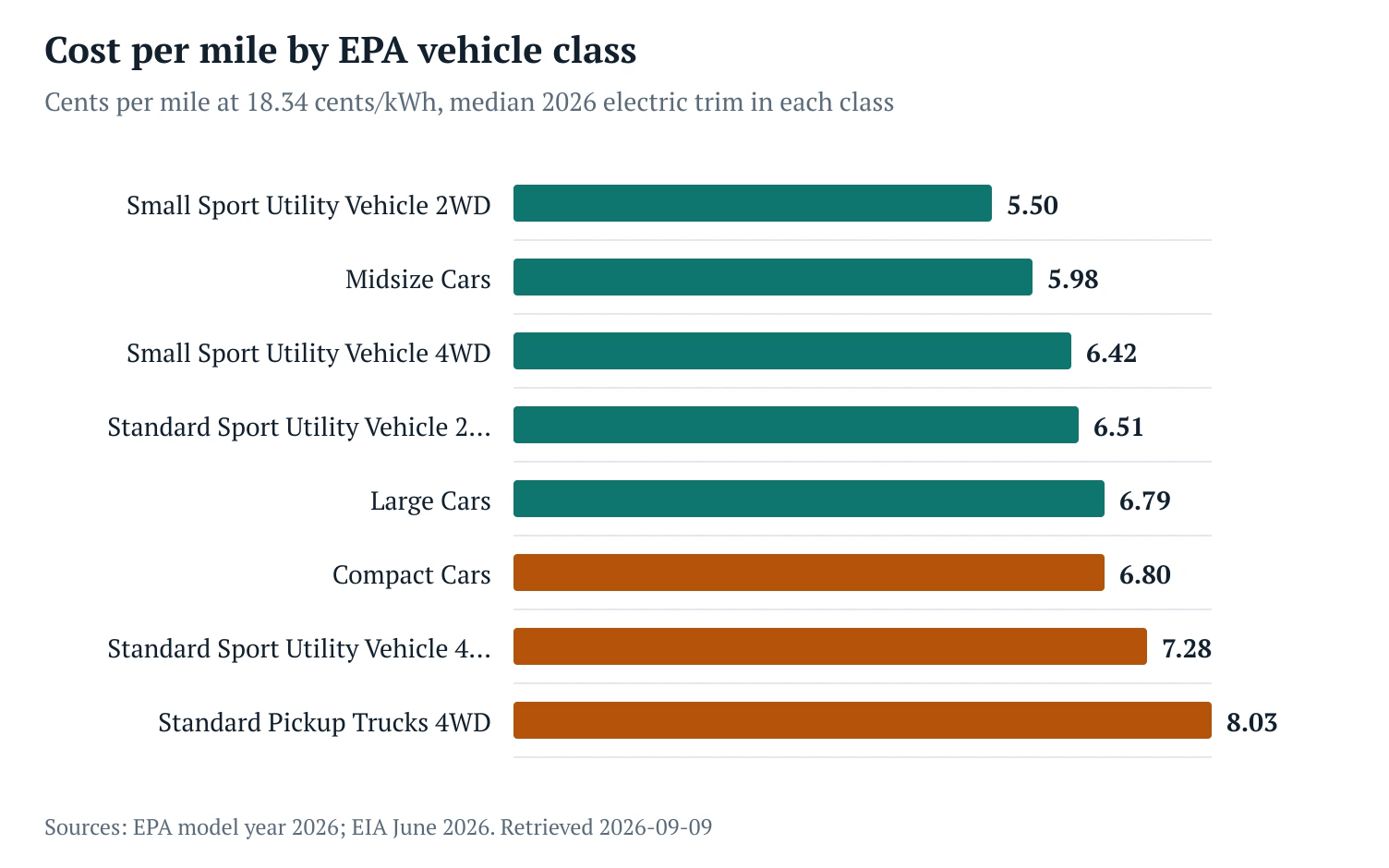
Efficiency tracks shape and mass more than badge, so grouping the 2026 fleet by EPA vehicle class shows where the money goes before you have chosen a model. The chart and table below use the median rating in each class, at the US average residential rate.
The ordering is the useful part rather than the individual figures: a class median moves as manufacturers add and drop trims, but the gap between the lightest classes at the top of the table and the four-wheel-drive pickups at the bottom is structural and will still be there next model year. Note also what the table does not show — the car classes do not sweep the top. A two-wheel-drive small crossover beats the compact car median, because frontal area and drive layout matter as much as footprint.
| EPA vehicle class | 2026 electric trims | Median efficiency (kWh/100 mi) | Cost per mile |
|---|---|---|---|
| Small Sport Utility Vehicle 2WD | 32 | 30.0 | 5.50 cents |
| Midsize Cars | 18 | 32.6 | 5.98 cents |
| Small Sport Utility Vehicle 4WD | 61 | 35.0 | 6.42 cents |
| Standard Sport Utility Vehicle 2WD | 15 | 35.5 | 6.51 cents |
| Large Cars | 29 | 37.0 | 6.79 cents |
| Compact Cars | 38 | 37.1 | 6.80 cents |
| Standard Sport Utility Vehicle 4WD | 80 | 39.7 | 7.28 cents |
| Standard Pickup Trucks 4WD | 36 | 43.8 | 8.03 cents |
What does the same mile cost in a petrol car?
The comparison below uses the current US average price for regular petrol and three fuel-economy levels, against the median 2026 electric vehicle at the average residential electricity price. Both fuel prices come from the US Energy Information Administration and are dated on this page.
This is a fuel-only comparison. It does not include insurance, depreciation, tyres, maintenance or the purchase price, and those move the total-cost answer in both directions depending on the vehicles being compared.
| Vehicle | Cost per mile | Cost per 12,000 miles |
|---|---|---|
| Median 2026 EV, home charging | 6.81 cents | $817 |
| Petrol car at 40 mpg | 10.18 cents | $1,221 |
| Petrol car at 30 mpg | 13.57 cents | $1,628 |
| Petrol car at 20 mpg | 20.35 cents | $2,443 |
What does it cost with your own car and your own rate?
The calculator takes your car’s efficiency, your electricity rate, and the share of your charging you expect to do on public fast chargers, with a separate price for that. It reports cents per mile and an annual cost, so you can put a real number against a real commute.
On the public-charging field: this page deliberately does not publish a “typical” network price. Public charging is commercially priced, differs between networks and individual sites, often changes with time of day, and frequently carries session or idle fees. Any single number would be wrong for most readers. Take the price from your own network app and enter it.
Cost per mile calculator
Your car, your electricity rate, and the share of charging you do on public fast chargers.
Defaults: the median 2026 electric vehicle at 37.1 kWh/100 mi and the US average residential rate of 18.34 cents/kWh (EIA, June 2026). The public rate is a placeholder you should replace with the price your own network charges — it is not a published average.
What else moves your real cost per mile?
Three things, in roughly this order. Tariff structure: an overnight time-of-use rate can cut the electricity price substantially against the residential average used in the table. Where you charge: a driver who does most of their charging on DC fast networks pays a multiple of the home rate. Conditions: cold weather, motorway speed and hills all push consumption above the EPA rating, and the rating is a laboratory figure, not a forecast.
What does not move it much: battery size. A larger pack means more energy per full charge, not more energy per mile — the per-mile figure depends on efficiency, and a big battery affects that only through the weight it adds.
Do charging losses make the real number higher?
Not on top of the EPA figure, because that figure is already measured at the wall socket. Losses in the charger, the cable and the battery are inside it. If you compute your own number from a home energy monitor, you are measuring the same thing EPA measures and the two are directly comparable.
Does the state you live in change the cost per mile?
Substantially, because residential electricity prices differ several-fold across the United States and the arithmetic on this page runs straight off that price. It is a large enough effect to deserve its own page rather than a row in a table here: our charging cost by state guide carries the full state-by-state breakdown at the same live EIA prices.
For the calculator below, the number you want is the rate on your own bill rather than any state average — a household on a time-of-use or dedicated EV tariff pays well under the residential average their state reports.
Is charging at work or at an apartment cheaper?
It depends entirely on how the electricity is billed. Free workplace charging is the cheapest per mile there is; a shared apartment charger billed at a commercial rate with a service margin can cost more than home charging. The calculator handles either case if you enter the actual rate you are charged.
Frequently asked questions
How much does it cost to charge an EV per mile?
At the current US average residential electricity price and the median 2026 electric vehicle, home charging works out to roughly 7 cents per mile. Your own figure depends on your tariff and your car: the same car costs several times as much per mile on the most expensive residential rates as on the cheapest.
How do I calculate my own cost per mile?
Divide your car’s EPA rating in kWh per 100 miles by 100, then multiply by your electricity rate in dollars per kWh. A car rated at 37 kWh per 100 miles on a 18 cent rate costs about 6.7 cents per mile. Charging losses are already inside the EPA rating, so do not add an allowance for them.
Is an electric car cheaper per mile than petrol?
At home, almost always. Home charging at the US average residential rate costs roughly half what a 30 mpg petrol car costs per mile at the current pump price. On public DC fast charging, or on an expensive residential tariff, the gap narrows considerably and can disappear.
Why is public charging so much more expensive?
Public networks pay commercial electricity rates including demand charges, plus hardware, maintenance, payment processing and site rent, and they price to recover all of it. Their prices also vary by network, by site and often by time of day, which is why this page asks you to enter your own rather than publishing an average.
Does cold weather change the cost per mile?
Yes. Cabin heating draws energy that does not move the car and a cold battery is less efficient, so winter consumption runs above the EPA rating. The rating is a standard laboratory test, useful for comparing cars, not a forecast of a January commute.
Does a bigger battery cost more per mile?
Only through weight. Cost per mile is set by efficiency, not by pack size. A larger battery stores more energy for a longer trip, but the energy needed to move the car one mile is what your electricity bill responds to.
Sources
- EIA Electric Power Monthly, Table 5.6.A, residential, U.S. total, June 2026, retrieved 2026-09-09
- EIA Gasoline and Diesel Fuel Update, U.S. regular, week of 08/31/26, retrieved 2026-09-09
- US EPA / DOE fueleconomy.gov vehicle web service, model year 2026, retrieved 2026-09-06
- US DOE Alternative Fuels Data Center — Charging at home, retrieved 2026-09-09
Related guides: EV efficiency ratings explained · charging cost by state · EV charging cost calculator · charging without a garage.
Every figure on this page is dated and linked to its source. How we verify · Editorial policy · Report a correction
Related Posts


Leave a Comment
Your comment will be published after it has been approved. Please send comments that do not contain slang words.