
Aviation Non-CO2 Effects: Contrails and Climate Explained (2026)
Updated September 18, 2026 · 13 min read
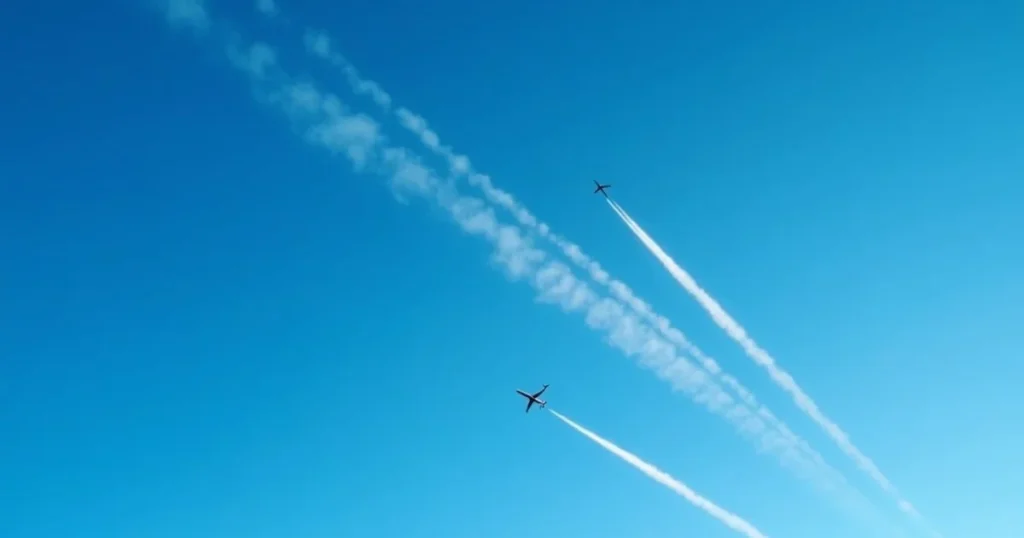
Aviation non-CO2 effects — the warming caused by contrails, nitrogen oxides, soot and water vapour rather than by carbon dioxide — account for roughly two-thirds of the climate impact of flying. Yet almost every airline climate target, carbon calculator and offset scheme still counts only the CO2. This guide explains the science behind aviation non-CO2 effects, puts numbers on each one, and looks at the routing changes, fuels and regulations that could cut them within this decade.
Key takeaways
- Two-thirds of aviation’s warming is non-CO2. The best 2018 estimate is a net aviation effective radiative forcing (ERF) of about 100.9 mW/m2, of which contrail cirrus alone contributes ~57 mW/m2.
- Contrail cirrus is the single largest term — larger than aviation’s cumulative CO2.
- A small share of flights does most of the damage. Regional studies find 2–12% of flights cause about 80% of contrail warming, so targeted rerouting is cheap and fast.
- Flight trials already work. American Airlines and Google cut contrails on treated flights by 54–62% by nudging cruise altitude.
- Regulation has started. Since 1 January 2025 airlines in the EU Emissions Trading System must monitor and report their non-CO2 effects, with the first reports due 31 March 2026.
What are aviation’s non-CO2 effects?
Burning jet fuel at cruise altitude does more than release carbon dioxide. The exhaust also contains water vapour, nitrogen oxides (NOx), soot (black carbon) particles, sulfur compounds and unburned hydrocarbons. At the low temperatures and pressures found 9–12 km up, these by-products trigger a chain of atmospheric responses that change Earth’s energy balance. Collectively they are called aviation non-CO2 effects, and the main ones are:
- Contrails and contrail cirrus — line-shaped ice clouds that form behind aircraft and can spread into cirrus sheets that trap outgoing heat.
- NOx chemistry — nitrogen oxides create ozone (a warming gas) in the short term but destroy ambient methane over longer timescales, producing a partly offsetting cooling.
- Soot and sulfate aerosols — particles that directly absorb or reflect sunlight and also seed cloud droplets and ice crystals.
- Stratospheric water vapour — a small direct greenhouse contribution from moisture injected above the tropopause.
Unlike CO2, which mixes globally and lingers for centuries, most non-CO2 effects are short-lived (hours to about a decade) and highly dependent on where and when a flight happens. That is bad news for accounting but good news for mitigation: change the flight path and you change the impact almost immediately.
How much do contrails and other non-CO2 effects warm the climate?
The reference study for aviation non-CO2 effects is the 2021 assessment by Lee and colleagues in Atmospheric Environment, which synthesised decades of modelling into a single budget for the year 2018. It reports the impact as effective radiative forcing (ERF) in milliwatts per square metre — the net change in Earth’s energy balance after fast atmospheric adjustments, which is the metric the IPCC now prefers.
| Component | CO2 or non-CO2 | ERF (mW/m2) | Share of net aviation ERF |
|---|---|---|---|
| Contrail cirrus | non-CO2 | 57.4 | ~57% |
| Carbon dioxide (CO2) | CO2 | 34.3 | ~34% |
| Nitrogen oxides (NOx), net | non-CO2 | 17.5 | ~17% |
| Stratospheric water vapour | non-CO2 | 2.0 | ~2% |
| Soot–radiation interaction | non-CO2 | 0.9 | ~1% |
| Sulfate–radiation interaction | non-CO2 | −7.4 | −7% |
| Net aviation ERF | — | 100.9 | 100% |
Three points matter here. First, the aviation non-CO2 effects add up to about 66 mW/m2, or roughly two-thirds of the net figure. Second, the confidence ranges are wide — contrail cirrus alone spans 17 to 98 mW/m2 at 90% confidence — because cloud physics is hard to model.
Third, on the older radiative-forcing (RF) basis rather than ERF, contrail cirrus is even larger, around 111 mW/m2. Whichever metric you use, aviation is responsible for approximately 3.5% of all human-caused effective radiative forcing, and most of that total is not carbon dioxide but the non-CO2 effects. For the CO2 side of the ledger, see our companion explainer on aviation and carbon emissions.
Why contrails form: the physics
A contrail (condensation trail) forms when hot, humid engine exhaust mixes with cold ambient air and the blend briefly becomes saturated with respect to water. Water condenses onto soot and sulfate particles in the exhaust, then freezes into ice crystals within a fraction of a second. Whether this happens is governed by the Schmidt–Appleman criterion, which depends on ambient temperature, humidity and pressure plus the fuel’s water-to-heat ratio.
Most contrails evaporate within minutes. The climate problem — and the reason contrails top the list of aviation non-CO2 effects — is the minority that persist. If the surrounding air is ice-supersaturated — humid enough that ice does not sublimate — the contrail survives and can spread horizontally for hours, forming a sheet of contrail cirrus that may cover thousands of square kilometres.
These ice-supersaturated regions (ISSR) are typically a few hundred metres to a couple of kilometres deep, so a climb or descent of 600–1,000 m is often enough to fly above or below them — the physical basis for contrail-aware routing.
Persistent contrails have two competing radiative effects. By day they reflect some sunlight back to space (cooling); day and night they absorb outgoing infrared radiation from the surface and re-emit it partly downward (warming). On the global average the warming wins, especially for contrails that form in the late afternoon and evening and persist through the night, when there is no offsetting sunlight reflection.
The fuel itself sets part of the threshold. Kerosene releases about 1.25 kg of water vapour and roughly 43 MJ of heat per kilogram burned; hydrogen releases about 9 kg of water per kilogram but far more energy, giving it a higher water-to-heat ratio and therefore a warmer temperature limit below which contrails can form. That is why hydrogen aircraft are expected to leave contrails across a wider band of altitudes than kerosene aircraft, even though those contrails should contain no soot.
Contrail cirrus: aviation’s biggest climate lever
Because contrail cirrus is both the largest of the aviation non-CO2 effects and the most controllable, it has become the focus of mitigation research. Its defining features:
- Short-lived. A contrail’s warming is delivered over hours to a day, versus centuries for CO2. Stop making persistent contrails and the associated forcing disappears almost at once.
- Spatially concentrated. Persistent contrails need cold, humid air, which is common over the North Atlantic, parts of Europe, the US and East Asia but rare over subtropical routes.
- Soot-sensitive. More soot particles mean more, smaller ice crystals, which makes a contrail brighter in the infrared and longer-lasting. Cleaner combustion produces fewer, larger crystals that fall out faster.
A 2025 analysis in Nature Communications refined how contrails embedded in natural cirrus are counted, but did not overturn the headline conclusion: contrail cirrus is a first-order climate forcing that current policy largely ignores. For a look at how this interacts with next-generation fuels, see how hydrogen contrails impact the climate.
NOx, soot, sulfate and water vapour
Nitrogen oxides. NOx does not warm directly. At cruise altitude it drives photochemistry that increases ozone (a potent short-lived greenhouse gas) over weeks to months, then slowly reduces the background concentration of methane over roughly a decade.
The ozone term is strongly warming (+49 mW/m2 in the 2018 budget); the methane and associated terms are cooling (about −32 mW/m2 combined), leaving a net NOx ERF near +17.5 mW/m2 with large uncertainty about the sign in some conditions. NOx is the second-largest of the aviation non-CO2 effects after contrail cirrus.
Soot (black carbon). Direct soot–radiation forcing is small (~+0.9 mW/m2), but soot’s indirect role as ice nuclei in contrails is what makes it important.
Sulfate aerosol. Sulfur in jet fuel forms sulfate particles that scatter sunlight, producing the only sizeable cooling term in the aviation budget (~−7.4 mW/m2). This creates an awkward trade-off: ultra-low-sulfur jet fuel cuts soot and contrail formation but also removes a cooling effect.
Stratospheric water vapour. Subsonic aircraft inject only a little moisture directly into the stratosphere, so this term is minor (~+2 mW/m2). It would matter far more for a return to supersonic cruise at higher altitudes.
Turning non-CO2 effects into “CO2-equivalent” is contested
Comparing a short-lived contrail with long-lived CO2 requires a common yardstick, and the choice of metric changes the answer by a factor of several. Using the standard 100-year Global Warming Potential (GWP100), aviation’s non-CO2 effects roughly double the sector’s effective CO2 impact. Using GWP20, which weights near-term warming more heavily, the multiplier is larger.
A newer metric, GWP*, tracks the rate of change of short-lived forcings and can show contrail warming shrinking rapidly if traffic through humid regions is cut, or growing steeply if it rises. There is no scientific consensus yet on which metric belongs in regulation, which is one reason the EU chose to measure non-CO2 effects for several years before attaching any price to them.
The 80/2 rule: a few flights cause most of the warming
The most policy-relevant finding of the last five years is how unevenly this component of aviation non-CO2 effects is distributed. Because persistent contrails need specific atmospheric conditions, the majority of flights on a given day produce little or no lasting contrail forcing, while a small minority passing through ice-supersaturated regions at the wrong time of day produce almost all of it.
| Region / scope | Study year | Flights causing ~80% of contrail forcing | Modelled mitigation |
|---|---|---|---|
| Japanese airspace | 2020 | ~2% | ~59–60% less contrail forcing for ~0.01–0.1% extra fuel |
| North Atlantic | 2022 | ~12% | ~80% less forcing at a small fuel penalty |
| Global | 2019 | <3% | — |
This is why contrail management is often called aviation’s cheapest climate win: you do not need to change every flight, only correctly identify and divert the few percent that matter, using weather forecasts of humidity and temperature aloft.
How to cut aviation non-CO2 effects
Four families of solution for reducing aviation non-CO2 effects are in play, at very different stages of maturity. Because contrail cirrus dominates the budget, most near-term effort targets it directly.
| Option | Mechanism | Demonstrated effect | Maturity & cost |
|---|---|---|---|
| Contrail-aware flight routing | Small altitude changes keep aircraft out of ice-supersaturated regions | 54–62% fewer contrails on treated flights in airline trials | At-scale trials 2023–2025; near-zero capital cost, minor fuel penalty |
| 100% sustainable aviation fuel (SAF) | Fewer aromatics and near-zero sulfur cut soot, so contrails have fewer, larger ice crystals | 56% fewer contrail ice crystals; 35% less soot (ECLIF3 in-flight study) | SAF is under 1% of jet fuel supply; 2–5× the price of fossil Jet A |
| Hydrogen propulsion | No soot or CO2, but combustion releases ~2.5× more water vapour per unit energy | Contrails still form but tend to be optically thinner and shorter-lived; net effect uncertain | Commercial aircraft ~2035 and later |
| Battery-electric aircraft | No combustion, so no contrails, NOx or soot in cruise | Eliminates in-flight non-CO2 effects entirely | Limited to short regional range this decade |
| Lean-burn / low-NOx combustors | Lower peak flame temperature reduces NOx formation | Incremental NOx ERF reduction | Standard on new engine programmes |
Contrail avoidance flight trials
We cover this fast-moving field in depth — trials, costs and the players behind them — in our dedicated guide to contrail avoidance.
In 2023, Google Research, Breakthrough Energy and American Airlines flew 70 test flights using AI-generated contrail forecast maps and recorded 54% fewer contrails on the routes that followed the guidance, with no meaningful increase in fuel burn.
A far larger campaign ran from January to May 2025 across roughly 2,400 US–Europe flights. On the 112 flights that actually flew the contrail-avoidance option, contrail formation fell 62% and the estimated warming from those flights dropped about 69%. Across the full pool of treatment-eligible flights the averaged reduction was more modest (roughly 12–14%), reflecting forecast error and operational constraints — the key engineering challenge now is forecast accuracy. Details of the UK trial are on Google’s research blog, and the environmental group Transport & Environment maintains a running summary of trials.
Sustainable aviation fuel and soot
The 2024 ECLIF3 in-flight study — Airbus, Rolls-Royce, the German Aerospace Center (DLR) and Neste — ran an A350 on 100% SAF in both engines while a chase plane sampled the exhaust. It measured a 56% reduction in contrail ice-crystal numbers and a 35% cut in soot particles versus conventional Jet A-1. Fewer ice crystals means a dimmer, shorter-lived contrail. Full results are summarised by DLR. This is a genuine non-CO2 co-benefit of SAF on top of its lifecycle carbon savings, though today’s SAF volumes remain tiny; see our overview of sustainable aviation fuel.
Policy: the EU starts measuring non-CO2
Under the 2023 revision of the EU Emissions Trading System (ETS) Directive, the European Commission was required to build a monitoring, reporting and verification (MRV) framework for aviation non-CO2 effects. Since 1 January 2025, aircraft operators covered by the EU ETS must monitor these effects on a per-flight basis, initially for flights within the European Economic Area and to the UK and Switzerland.
The first aviation non-CO2 effects reports, with third-party verification, are due by 31 March 2026. For 2025 data, operators use the Commission’s NEATS tool. No charge is attached yet — this phase is about building a reliable dataset before deciding whether and how to price the effects. Background is on the European Commission climate site. The CO2 side of the ledger is handled separately — through offsetting under CORSIA and fuel-switching under the EU and UK SAF mandates. For the wider regulatory picture, see our breakdown of aviation emissions by country.
What non-CO2 effects mean for electric and hydrogen aircraft
Aviation non-CO2 effects reshape how zero-carbon aircraft should be judged. A battery-electric aircraft produces no contrails, NOx or soot in cruise, so its in-flight climate impact really is close to zero — but range limits confine it to regional hops for now.
A hydrogen aircraft eliminates CO2 and soot, yet burning or fuel-celling hydrogen releases more water vapour, so contrails still form; early modelling suggests they are optically thinner and clear faster because they lack soot nuclei, but the net effect is still an open research question. Combustion of hydrogen also still produces NOx.
The upshot: comparing propulsion options on CO2 alone flatters conventional jets and ignores the aviation non-CO2 effects entirely. We compare the pathways in detail in electric vs hydrogen aircraft and hydrogen fuel cells vs solid-state batteries in aviation.
Related guides: The Non-CO2 Emission Dilemma: How Hydrogen Contrails Impact the Climate, Net Zero 2050 Climate Goals and Climate Change Extreme Weather.
The only aircraft that produces no non-CO2 effects at all is one with no exhaust: our guide to electric aircraft covers the zero-contrail designs entering service now.
The headline figures behind these effects are collected on our aviation emissions statistics page, updated as datasets refresh.
Frequently Asked Questions
Do contrails really cause global warming?
Yes. On the global average, persistent contrails and the cirrus clouds they seed trap more outgoing heat than the sunlight they reflect. In the 2018 aviation budget, contrail cirrus contributes about 57 mW/m2 of effective radiative forcing — more than aviation’s cumulative CO2. The warming is short-lived, lasting hours to a day per contrail.
What share of aviation’s climate impact is non-CO2?
Roughly two-thirds. Adding up the aviation non-CO2 effects — contrail cirrus, net NOx, water vapour and aerosol terms — gives about 66 mW/m2 of the ~101 mW/m2 net aviation effective radiative forcing for 2018, leaving CO2 at about one-third.
Can changing flight altitude reduce contrails?
Yes. Ice-supersaturated layers are usually only a few hundred metres to about two kilometres deep, so a climb or descent of 600–1,000 m can keep an aircraft out of them. Airline trials have cut contrail formation on treated flights by 54–62% this way, with little extra fuel use.
Does sustainable aviation fuel reduce contrails?
It reduces their intensity. Because SAF contains fewer aromatic compounds and almost no sulfur, it produces less soot, so contrails form with fewer and larger ice crystals that dissipate faster. The ECLIF3 flight study measured 56% fewer contrail ice crystals on 100% SAF versus conventional jet fuel.
Are aviation non-CO2 effects regulated?
Aviation non-CO2 effects are now being measured, not yet priced. Since 1 January 2025, airlines in the EU Emissions Trading System must monitor and report their non-CO2 effects per flight, with the first verified reports due 31 March 2026. No charge is attached yet.
Sources
- Lee, D.S. et al. (2021). “The contribution of global aviation to anthropogenic climate forcing for 2000 to 2018.” Atmospheric Environment. doi:10.1016/j.atmosenv.2020.117834
- Teoh, R. et al. (2020, 2022). Contrail mitigation via small-scale flight diversions, Japanese airspace and North Atlantic.
- DLR (2024). “Flying using 100% sustainable aviation fuel significantly reduces non-carbon-dioxide emissions” (ECLIF3). dlr.de
- Google Research (2025). “Blue skies” AI contrail-avoidance trial. blog.google
- European Commission, Climate Action. Aviation non-CO2 MRV under the EU ETS. climate.ec.europa.eu
- Quantification of the radiative forcing of contrails embedded in cirrus clouds (2025). Nature Communications. nature.com
Where this fits
This page is part of the zero-carbon aviation hub on ZeroCarbonDrive:
- Zero-carbon aviation hub: the four routes, and what is certified
- Contrail avoidance explained
- Aviation emissions statistics
Work it out yourself
Related tools and method notes on ZeroCarbonDrive:
Every figure on this page is dated and linked to its source. How we verify · Editorial policy · Report a correction
Related Posts
Leave a Comment
Your comment will be published after it has been approved. Please send comments that do not contain slang words.