
Solid State Battery vs Lithium Ion: 7 Key EV Breakthroughs
Updated September 18, 2026 · 20 min read
Last updated: September 1, 2026
Quick answer: A solid state battery replaces the flammable liquid electrolyte in today’s lithium-ion cells with a solid ceramic, sulfide or polymer layer. That single swap promises roughly 50–100% more energy per kilogram, much faster safe charging and far lower fire risk — but as of 2026 no mass-market EV ships with a true all-solid-state pack. First limited automotive deployments are expected in the 2027–2028 window, with mass-market pricing closer to 2030.
Key takeaways
- A solid state battery targets 350–500 Wh/kg vs ~250–300 Wh/kg for the best current lithium-ion cells.
- The hard problems are manufacturing (stack pressure, interfaces, yield), not chemistry headlines.
- “Semi-solid” packs already ship in China (NIO’s 150 kWh pack); true all-solid-state remains pilot-scale.
- For buyers: nothing on sale in 2026 requires waiting — today’s LFP and NMC packs already outlast most cars.
What Is a Solid State Battery? The Plain-English Version
Every battery moves lithium ions between two electrodes through an electrolyte. In the lithium-ion cell powering today’s EVs, that electrolyte is a liquid — excellent at moving ions, but flammable and the reason packs need heavy cooling and protective structure. A solid state battery makes the electrolyte a solid. Ions hop through a ceramic or sulfide lattice instead of swimming through liquid, which lets engineers use a pure lithium-metal anode (huge energy gain), drop most of the fire-suppression overhead, and charge harder without the plating failures explained in section 6.

The catch is that solids don’t naturally stay in perfect contact with electrodes that swell and shrink every cycle — which is why the rest of this guide spends as much time on interfaces and manufacturing as on chemistry.
Table of Contents
- 1. Executive Summary: The EV Battery Paradigm Shift & Industry Drivers
- 2. Fundamentals of Electrochemistry: Liquid vs. Solid-State Transport Mechanics
- 3. Deep Dive into Solid Electrolyte Families (Oxides, Sulfides, Polymers & Halides)
- 4. Anode Chemistry Breakthroughs: Silicon-Graphite vs. Pure Lithium-Metal Anodes
- 5. Gravimetric and Volumetric Energy Density Analysis (Wh/kg & Wh/L Benchmarks)
- 6. Fast-Charging Kinetics, Thermal Runaway Hazards, and Safety Engineering
- 7. Mechanical Degradation & Interfacial Impedance: Dendrite Growth Mechanisms
- 8. Comprehensive Technical Comparison Matrix: Solid State Battery vs Lithium Ion
- 9. Manufacturing CAPEX, Roll-to-Roll Processing, and Gigafactory Conversion Bottlenecks
- 10. Economic Analysis: Levelized Cost of Storage (LCOS) and Raw Material Supply Chains
- 11. Automotive Commercialization Timeline & OEM Strategy Roadmap (2026–2035)
- Technical References & Academic Citations
1. Executive Summary: The EV Battery Paradigm Shift & Industry Drivers
The global automotive industry is undergoing an unprecedented transformation toward full electrification, driven by stringent emissions regulations, consumer demand for extended range, and national energy security imperatives. At the absolute core of this technological transition lies the electrochemical energy storage unit. When evaluating the current state and future trajectory of traction batteries, comparing a Solid State Battery vs Lithium Ion architecture is the single most critical benchmark for automotive engineers, battery scientists, and energy policy strategists.
For more than three decades, conventional liquid-electrolyte lithium-ion cells—ranging from Lithium Nickel Manganese Cobalt Oxide (NMC) to Lithium Iron Phosphate (LFP)—have served as the foundational workhorse for electric mobility. These liquid systems have matured significantly through iterative improvements in cell design, tabless electrode architectures, cell-to-pack (CTP) integration, and cathode synthesis. However, conventional liquid lithium-ion technology is rapidly approaching its theoretical thermodynamic performance ceiling. Gravimetric energy densities for commercial liquid NMC 811 pouch and cylindrical cells are currently capped around 260 Wh/kg to 300 Wh/kg at the cell level.
To break through the 600-mile (1,000 km) real-world driving range threshold without burdening electric vehicles with excessive dead weight, automakers must transition to next-generation cell chemistries. A direct structural comparison of a Solid State Battery vs Lithium Ion cell highlights why solid-state technology is universally regarded as the ultimate paradigm shift in energy storage. By replacing volatile organic liquid electrolytes and porous polymeric separators with solid inorganic or polymeric ionic conductors, solid state batteries enable the use of ultra-high-capacity pure lithium-metal anodes. This fundamental transition dramatically increases gravimetric energy density beyond 500 Wh/kg, drastically shortens 10% to 80% fast-charging duration to under 15 minutes, and virtually eliminates the risk of catastrophic thermal runaway fires.
In this exhaustive technical guide, we present a comprehensive engineering analysis comparing a Solid State Battery vs Lithium Ion energy storage system. We evaluate ionic transport kinetics, material phase stability, interfacial degradation mechanisms, thermal management overhead, manufacturing scaling economics, and the commercialization roadmaps of global automotive OEMs driving zero-carbon mobility.
2. Fundamentals of Electrochemistry: Liquid vs. Solid-State Transport Mechanics
To fully comprehend the operational variances inherent in a Solid State Battery vs Lithium Ion comparison, it is essential to examine the underlying solid-state physics and interfacial electrochemistry governing lithium-ion transport during galvanic charge and discharge cycles.
Liquid Lithium-Ion Cell Architecture & Charge Transport
A standard commercial liquid lithium-ion cell operates based on intercalation chemistry. The cell comprises three primary functional components: a porous transition metal oxide cathode (such as $LiNi_{0.8}Mn_{0.1}Co_{0.1}O_2$), a porous graphite or silicon-graphite composite anode, and a microporous polymeric separator (typically polyolefin-based, such as polyethylene or polypropylene). The entire internal cell structure is flooded with a liquid electrolyte solution consisting of lithium hexafluorophosphate ($LiPF_6$) salt dissolved in a mixture of volatile organic carbonate solvents, including ethylene carbonate (EC), dimethyl carbonate (DMC), and diethyl carbonate (DEC).
During the charging process, an external electrical potential forces lithium ions to deintercalate from the crystal lattice of the cathode material. These positive ions ($Li^+$) solvate into the liquid electrolyte, migrate across the porous separator via diffusion and migration driven by electric field gradients, and intercalate into the layered host structure of the graphite anode. During discharge, the chemical reaction reverses spontaneously, releasing electrons through the external circuit to perform work on the EV electric motor.
While liquid electrolytes offer high room-temperature ionic conductivity ($\sigma_i \approx 10^{-2} \text{ S/cm}$), they introduce severe electrochemical and thermal liabilities:
- Volatilization and Flammability: Organic carbonate solvents exhibit low flash points and high vapor pressures, making them prone to violent combustion if exposed to oxygen or elevated temperatures.
- Parasitic Side Reactions: Continuous chemical interactions between the reactive liquid electrolyte and high-voltage cathodes lead to solid-electrolyte interphase (SEI) growth, transition metal dissolution, gas generation, and capacity fade.
- Volumetric Inefficiency: Host materials like graphite are required to store lithium intercalates safely, adding structural mass and bulk that reduce total energy capacity per unit mass.
Solid-State Electrolyte Mechanics & Interfacial Ion Hopping
In a solid state battery architecture, the liquid electrolyte and porous polymeric separator are entirely replaced by a dense solid ionic conductor. This structural transformation fundamentally alters ion transport kinetics. Instead of solvated lithium ions diffusing through a liquid medium, ion movement within a solid electrolyte occurs via point-defect mechanisms, such as interstitial hopping or vacancy migration through the rigid crystal lattice or amorphous matrix of the solid compound.
By eliminating liquid components, a Solid State Battery vs Lithium Ion cell design achieves structural robustness and opens the door for a pure lithium-metal anode. Lithium metal possesses an extraordinary theoretical specific capacity of 3,860 mAh/g and the lowest negative electrochemical potential (-3.04 V vs. standard hydrogen electrode), compared to graphite’s modest capacity of 372 mAh/g. However, facilitating high-flux ionic transport across a solid-solid interface presents substantial physical challenges, including interfacial contact loss during cycle-induced volumetric changes and localized mechanical stress concentrations.
3. Deep Dive into Solid Electrolyte Families (Oxides, Sulfides, Polymers & Halides)
Evaluating a Solid State Battery vs Lithium Ion ecosystem requires analyzing the primary solid-state electrolyte (SSE) material classes currently undergoing commercial development. Solid electrolytes are categorized into four major chemical families, each possessing distinct ionic conductivities, mechanical ductilities, chemical stabilities, and manufacturing requirements.
1. Oxide-Based Solid Electrolytes (LLZO, NASICON, Perovskite)
Oxide-based solid electrolytes represent one of the most mechanically and chemically stable SSE classes. Prominent examples include garnet-type $Li_7La_3Zr_2O_{12}$ (LLZO), NASICON-type $Li_{1+x}Al_xTi_{2-x}(PO_4)_3$ (LATP), and perovskite-type $Li_{3x}La_{2/3-x}TiO_3$ (LLTO).
- Ionic Conductivity: Moderate to high ambient conductivity ($\sigma_i \approx 10^{-4} \text{ to } 10^{-3} \text{ S/cm}$).
- Chemical & Thermal Stability: Exceptional chemical stability against elemental lithium metal and high-voltage cathodes (up to 5.0 V). Extremely high thermal breakdown thresholds exceeding 1,000°C.
- Engineering Bottlenecks: Oxide materials are inherently ceramic and brittle. Achieving low contact impedance at electrode interfaces requires high-temperature sintering processes and high continuous stack pressures during operation. High grain-boundary resistance can also facilitate lithium dendrite propagation through microcracks.
2. Sulfide-Based Solid Electrolytes (LPS, LGPS, Argyrodites)
Sulfide-based electrolytes, including thiophosphate structures such as $Li_3PS_4$ (LPS), $Li_{10}GeP_2S_{12}$ (LGPS), and halide-doped argyrodites ($Li_6PS_5Cl$), are widely regarded as the most promising candidate for high-power automotive applications.
- Ionic Conductivity: Industry-leading ambient ionic conductivity ($\sigma_i \approx 10^{-3} \text{ to } 1.2 \times 10^{-2} \text{ S/cm}$), meeting or exceeding traditional liquid organic electrolytes.
- Mechanical Behavior: Excellent mechanical ductility and low Young’s modulus allow sulfide particles to cold-compress easily, creating seamless physical contact with active cathode materials without requiring high-temperature sintering.
- Engineering Bottlenecks: Sulfides are highly reactive when exposed to ambient moisture, generating toxic hydrogen sulfide gas ($H_2S$). Consequently, cell assembly must take place in specialized ultra-dry rooms or inert gas glovebox environments, driving up manufacturing CAPEX.
3. Solid Polymer Electrolytes (SPEs – PEO Composites)
Solid polymer electrolytes typically consist of high-molecular-weight polymer matrices—such as poly(ethylene oxide) (PEO)—complexed with dissolved lithium salts ($LiTFSI$).
- Ionic Conductivity: Extremely low at ambient room temperature ($\sigma_i \approx 10^{-7} \text{ to } 10^{-5} \text{ S/cm}$). They require elevated operating temperatures (60°C to 80°C) to induce polymer chain mobility and facilitate ion conduction.
- Manufacturability: Highly flexible, low-cost, and easily integrated into existing roll-to-roll liquid battery manufacturing lines.
- Engineering Bottlenecks: Poor electrochemical stability at high operating voltages (> 4.0 V) limits compatibility with high-density nickel-rich cathodes. High temperature requirements complicate thermal management design in consumer vehicles.
4. Halide-Based Solid Electrolytes (Li3YCl6, Li3InCl6)
Halide solid electrolytes have emerged as a cutting-edge hybrid class combining key advantages of both oxides and sulfides.
- Key Characteristics: High electrochemical oxidation stability (> 4.5 V), excellent ionic conductivity ($10^{-3} \text{ S/cm}$), and high mechanical deformability. They are particularly well-suited for high-voltage nickel-rich cathode integration, though high raw material costs for rare-earth metals like yttrium and indium remain a economic hurdle.
4. Anode Chemistry Breakthroughs: Silicon-Graphite vs. Pure Lithium-Metal Anodes
The core performance advantages highlighted in any Solid State Battery vs Lithium Ion analysis stem directly from anode chemistry evolution. The anode material dictates the total volumetric energy density and mechanical expansion behavior of the battery pack.
Conventional Anodes: Synthetic Graphite and Silicon Composites
Traditional liquid lithium-ion cells rely primarily on synthetic or natural graphite anodes. To boost capacity, cell manufacturers blend varying percentages of silicon or silicon oxide ($SiO_x$) into the graphite matrix. While silicon delivers a high theoretical capacity (~4,200 mAh/g for pure silicon), it suffers from extreme volumetric expansion (> 300%) during lithiation. In liquid electrolyte cells, this massive mechanical breathing pulverizes the anode particles, continuously rupturing the Solid-Electrolyte Interphase (SEI) layer and causing rapid capacity fade and dry-out of the liquid solvent.
Anode-Free and Pure Lithium-Metal Configurations
Solid state battery architectures overcome these degradation pathways by accommodating pure lithium-metal anodes or transitioning to advanced “anode-free” cell construction:
- Lithium-Metal Foil Anodes: Pre-deposited thin lithium foils (10 µm to 50 µm thick) serve as the initial active material layer. During charge cycles, lithium plating occurs directly onto the foil surface underneath the solid electrolyte.
- Anode-Free Architecture: The cell is manufactured without any initial anode active material. During the first charge cycle, lithium ions deintercalate from the cathode, pass through the solid electrolyte, and electrochemically plate directly onto a bare metallic current collector (typically copper or stainless steel). This eliminates anode manufacturing steps, reducing cell weight, volumetric thickness, and production costs to absolute theoretical minimums.
Eliminating the host matrix (graphite) in favor of direct metallic plating fundamentally shifts the energy storage capacity of a Solid State Battery vs Lithium Ion cell, unlocking gravimetric capacities that liquid systems simply cannot achieve.
5. Gravimetric and Volumetric Energy Density Analysis (Wh/kg & Wh/L Benchmarks)
Gravimetric energy density (expressed in watt-hours per kilogram, Wh/kg) and volumetric energy density (expressed in watt-hours per liter, Wh/L) represent the foundational metrics dictating vehicle range, aerodynamic design, and chassis weight distribution. In a rigorous Solid State Battery vs Lithium Ion quantitative evaluation, energy density is the primary driver of automotive adoption.
Specific Energy (Wh/kg) = [ Nominal Cell Voltage (V) × Cell Capacity (Ah) ] / Total Cell Mass (kg)
Gravimetric Benchmarks (Wh/kg)
Commercial liquid lithium-ion cell architectures exhibit distinct energy density caps dependent on cathode chemistry:
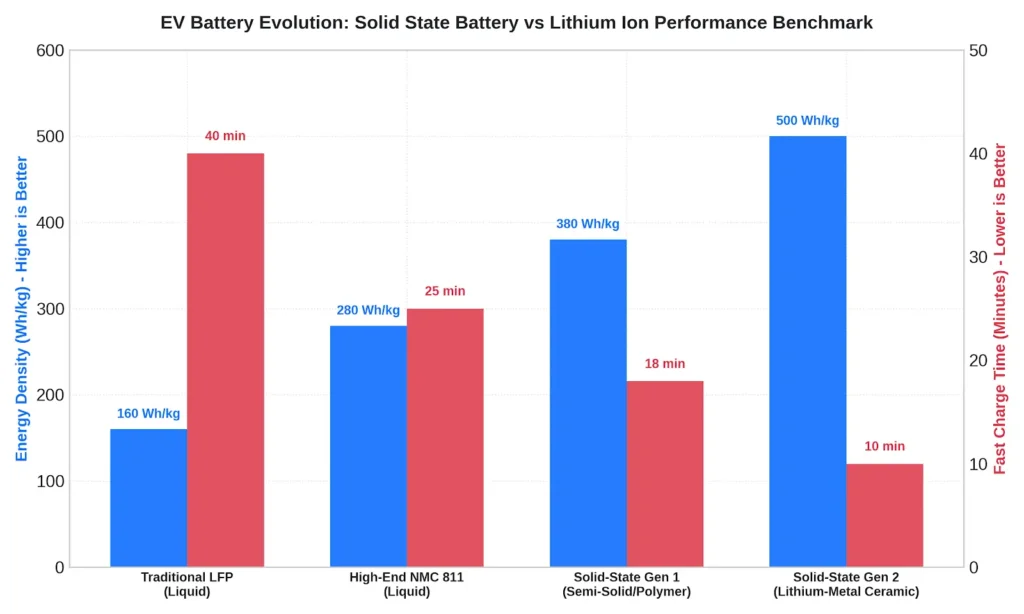
- Lithium Iron Phosphate (LFP): 160 Wh/kg to 200 Wh/kg (Cell Level). Highly durable and low-cost, but structurally heavy.
- Nickel Manganese Cobalt (NMC 811): 260 Wh/kg to 300 Wh/kg (Cell Level). State-of-the-art for high-end long-range EVs, but approaching physical limits.
- Commercial Solid-State Generation 1: 380 Wh/kg to 420 Wh/kg (Cell Level). Incorporates semi-solid or polymer-oxide hybrid electrolytes.
- Advanced Solid-State Generation 2 (Lithium-Metal): 480 Wh/kg to 550+ Wh/kg (Cell Level). Utilizes sulfide/halide solid electrolytes and pure lithium anodes.
Volumetric Benchmarks (Wh/L)
Volumetric density measures how much energy can be compressed into a given physical volume within the EV skateboard chassis:
- Liquid Lithium-Ion (NMC 811): 650 Wh/L to 750 Wh/L.
- Solid-State (Lithium-Metal): 1,000 Wh/L to 1,250 Wh/L.
This 60% to 80% improvement in volumetric density allows electric vehicle designers to either double the vehicle’s range within the existing battery tray envelope or reduce pack size significantly to decrease overall curb weight, enhancing vehicle handling, acceleration, and electrical efficiency (kWh/100 km).
6. Fast-Charging Kinetics, Thermal Runaway Hazards, and Safety Engineering
Vehicle charging convenience and operational safety under extreme conditions are paramount concerns for mass-market consumers. Analyzing a Solid State Battery vs Lithium Ion framework highlights stark operational contrasts during high C-rate fast charging and severe physical damage scenarios.
Fast-Charging Kinetics and Lithium Plating Limitations
Fast charging a conventional liquid lithium-ion cell (DC fast charging above 2C to 4C rates) presents severe electrochemical risks. At high current fluxes, lithium ion diffusion through liquid solvents and intercalation into graphite host structures can become mass-transport limited. This causes local overpotentials that drop the anode potential below 0 V vs. $Li/Li^+$, triggering lithium plating on the graphite surface.
Plated lithium is metallic and highly reactive. Over repeated fast-charging cycles, it forms microscopic, needle-like structures called dendrites. These dendrites grow across the microporous polymeric separator, eventually piercing it and causing a direct internal short circuit between the cathode and anode.
In contrast, high-quality solid electrolytes possess high shear moduli (especially oxide ceramic classes) that mechanically inhibit dendrite penetration. Furthermore, solid-state cells maintain superior thermal stability across high ionic current densities, enabling continuous high C-rate charging (10% to 80% State of Charge in 10 to 12 minutes) without accelerating thermal degradation.
Thermal Runaway Hazards & Safety Protocols
Thermal runaway in liquid lithium-ion batteries follows a dangerous cascade mechanism:
- Initial Heat Trigger: Internal short circuit, overcharging, mechanical puncture, or external heating drives cell temperature past 80°C–100°C.
- SEI Breakdown: The protective solid-electrolyte interphase layer on the graphite anode decomposes exothermically around 120°C.
- Separator Melting & Solvent Combustion: At 130°C–170°C, the polyolefin separator melts, causing widespread internal short circuits. The flammable organic liquid solvents ignite, releasing toxic oxygen, hydrofluoric acid gas, and intense thermal energy exceeding 800°C.
Solid-state electrolytes dramatically alter this safety profile. Inorganic ceramic oxides and sulfides are non-flammable and exhibit thermal breakdown thresholds exceeding 300°C to 1,000°C. Eliminating volatile liquid organic solvents fundamentally prevents explosive thermal runaway cascades, simplifying pack-level thermal mitigation hardware and reducing battery cooling system weight.
7. Mechanical Degradation & Interfacial Impedance: Dendrite Growth Mechanisms
While solid state batteries offer transformational advantages, they are not without significant engineering challenges. A complete Solid State Battery vs Lithium Ion technical evaluation must address the primary degradation modes that currently hinder mass production of solid-state systems.
1. Interfacial Impedance and Contact Loss
During discharge, lithium metal strips away from the anode interface; during charge, it replates. This continuous cyclic stripping and plating causes significant volumetric changes at the solid-electrolyte interface. Because both the electrolyte and the active materials are rigid solids, micro-voids and physical gaps form at the interface over repeated cycling. These gaps reduce active contact area, sharply increasing interfacial charge-transfer resistance (impedance) and leading to localized current hot-spots and accelerated capacity fade.
2. Electro-Chemo-Mechanical Dendrite Growth in Solid Electrolytes
Early solid-state research assumed that solid ceramic electrolytes with high shear moduli (such as LLZO with a shear modulus of ~60 GPa) would completely block lithium dendrite growth based on linear elasticity theory. However, experimental testing demonstrated that lithium dendrites can still form and propagate through solid electrolytes under specific operating regimes.
Dendrite propagation in solid electrolytes occurs along grain boundaries, surface micro-cracks, and structural voids where electric field intensity concentrates. When current densities exceed the Critical Current Density (CCD), lithium plates within the grain boundaries of the solid ceramic, generating high mechanical hoop stresses that fracture the electrolyte and lead to short circuits. Overcoming CCD limitations requires advanced interfacial engineering, such as applying ultra-thin atomic layer deposition (ALD) coatings of gold, zinc, or amorphous carbon onto the electrolyte surfaces.
8. Comprehensive Technical Comparison Matrix: Solid State Battery vs Lithium Ion
The engineering benchmark matrix below summarizes performance parameters, thermal thresholds, safety profiles, manufacturing metrics, and material characteristics comparing high-capacity liquid lithium-ion against next-generation solid-state architectures.
| Engineering Parameter | Liquid Lithium-Ion (NMC 811) | Solid-State (Sulfide/Lithium-Metal) |
|---|---|---|
| Electrolyte Medium | Liquid organic carbonates + $LiPF_6$ salt | Solid inorganic sulfide/oxide crystal matrix |
| Anode Material Chemistry | Synthetic Graphite / Silicon-Graphite blend | Pure Lithium Metal / Anode-Free Copper substrate |
| Gravimetric Energy Density | 240 – 300 Wh/kg | 450 – 550 Wh/kg |
| Volumetric Energy Density | 600 – 750 Wh/L | 1,000 – 1,250 Wh/L |
| 10% to 80% Fast-Charge Duration | 20 – 35 Minutes | 10 – 15 Minutes |
| Thermal Stability Ceiling | ~130°C – 150°C (Runaway Risk) | > 300°C – 1,000°C (Inherently Safe) |
| Operating Temperature Window | -20°C to 55°C | -30°C to 100°C+ |
| Estimated Cycle Life (80% SOH) | 1,200 – 2,000 Cycles | 1,500 – 3,000+ Cycles |
| Cell-Level Manufacturing Cost | $80 – $110 / kWh | $220 – $380 / kWh (Pilot Scale) |
| Pack Level Cooling Complexity | High (Active liquid cooling plates required) | Low (Passive thermal cooling options) |
9. Manufacturing CAPEX, Roll-to-Roll Processing, and Gigafactory Conversion Bottlenecks
The commercial competition between a Solid State Battery vs Lithium Ion system is no longer confined to university research laboratories; it is now a battle of manufacturing scale and capital expenditure (CAPEX) efficiency. Re-tooling multi-billion-dollar liquid lithium-ion Gigafactories to produce solid-state architectures presents several complex engineering hurdles.
Roll-to-Roll (R2R) Coating Compatibility
Modern Gigafactories rely on highly automated Roll-to-Roll (R2R) wet slurry coating processes. Active cathode and anode materials are mixed with solvents and binders, coated onto metallic current collector foils (aluminum and copper), passed through massive drying ovens, and calendered to achieve target porosity and density.
Integrating solid-state production requires modifying several core R2R operations:
- Dry Powder & Solvent-Free Coating: Sulfide electrolytes react violently with polar solvents. Manufacturing lines must transition to non-polar solvent slurries or dry electrostatic powder deposition methods.
- Ultra-Thin Solid Electrolyte Separator Layering: Coating continuous, pinhole-free solid electrolyte layers under 20 micrometers thick at high line speeds (> 50 meters/minute) without mechanical tearing requires extreme tension precision.
- Isostatic Pressing Hardware: Unlike liquid cells that are filled with electrolyte under vacuum, solid-state cell stacks require high-pressure continuous calendering or Warm Isostatic Pressing (WIP) at pressures exceeding 50 to 100 MPa to eliminate interfacial void spaces.
Gigafactory CAPEX & Yield Constraints
While solid-state processing eliminates liquid electrolyte injection, degassing, and long formation aging steps (which can take up to two weeks in conventional Gigafactories), early scrap rates for solid-state pilot lines remain high. Achieving high manufacturing yields (> 92%) is necessary to drive manufacturing costs down toward parity with conventional liquid lithium-ion production.
10. Economic Analysis: Levelized Cost of Storage (LCOS) and Raw Material Supply Chains
For solid state batteries to achieve mass adoption across high-volume budget EV platforms, their total pack-level cost must approach the threshold of $100/kWh. In a detailed economic breakdown of a Solid State Battery vs Lithium Ion life-cycle model, both raw material supply chains and long-term levelized costs must be evaluated.
Raw Material Supply Chain Pressures
Solid state batteries modify critical raw material dependencies:
- Lithium Intensity: Pure lithium-metal anodes require high-purity ultra-thin lithium foils. This increases total lithium metal consumption per kilowatt-hour by approximately 40% to 60% compared to graphite intercalation anodes.
- Precious Metals in SSEs: Sulfide and oxide electrolytes frequently utilize specialized precursor materials, including germanium, zirconium, lanthanum, yttrium, and indium. Scaling these raw material supply chains will require substantial mining investment to prevent material cost spikes.
Levelized Cost of Storage (LCOS) Advantages
Although initial capital cost ($/kWh) for solid-state cells is currently higher than liquid lithium-ion cells, their extended operational life (3,000+ deep cycles) and higher energy efficiency yield a lower **Levelized Cost of Storage (LCOS)** over the vehicle’s lifespan. Furthermore, removing heavy liquid cooling loops, cold-weather heating elements, and fire-suppression containment systems reduces overall vehicle-level manufacturing costs.
11. Automotive Commercialization Timeline & OEM Strategy Roadmap (2026–2035)
The transition from conventional liquid systems to solid-state powerpacks will follow a structured, phased rollout across global automotive market segments. Evaluating the commercial Solid State Battery vs Lithium Ion timeline reveals distinct implementation milestones:
Who Is Actually Closest? (Status as Reported in 2026)
| Player | Approach | Publicly stated status | Realistic EV timing |
|---|---|---|---|
| Toyota (w/ Idemitsu) | Sulfide all-solid-state | Pilot production; repeatedly targets 2027–28 launch | Limited models 2027–28 |
| QuantumScape (VW/PowerCo) | Ceramic separator, anode-free | QSE-5 B-samples shipped to automotive partners | Test fleets first, volume ~2029+ |
| Samsung SDI | Sulfide, 900 Wh/L target | Pilot line running, OEM sampling | ~2027 premium segment |
| NIO / WeLion | Semi-solid (hybrid electrolyte) | 150 kWh pack in commercial swap service — shipping today | Now (semi-solid only) |
| CATL | Condensed / semi-solid first | 500 Wh/kg cell announced for aviation first | EVs after aviation validation |
Treat every date above as a target, not a promise — this industry has slipped timelines for a decade. The pattern that matters: semi-solid chemistries reach customers years before true all-solid-state, because they reuse existing lithium-ion production lines.
Phase 1: Pilot Deployment & High-End Flagships (2026 – 2028)
During this initial phase, semi-solid and oxide/sulfide solid state batteries are deployed in low-volume, high-margin premium applications, including hypercars, flagship luxury EVs, high-altitude aerospace drones, and premium defense equipment. Cell costs range between $200/kWh and $350/kWh. Leading automakers such as Toyota, BMW, QuantumScape, and Nio are executing real-world fleet validation trials during this period.
Phase 2: Mass-Market Scaling & Cost Parity (2028 – 2032)
As dedicated solid-state Gigafactories scale up continuous production and dry-room processing yields improve, cell costs are projected to drop below $130/kWh. Solid-state packs will enter high-volume premium electric SUVs, commercial delivery vans, and long-range luxury sedans. Liquid NMC 811 cells will begin losing market share in high-performance vehicle segments.
Phase 3: Global Fleet Dominance (2032 – 2035+)
Advanced solid-state architectures utilizing lithium-metal anodes achieve full cost parity with conventional liquid cells (~$80 to $90/kWh). Solid-state technology becomes the dominant standard across long-haul commercial trucking, maritime electric vessels, urban air mobility (eVTOL), and mainstream passenger EVs. Conventional liquid LFP batteries will remain active primarily in budget, short-range urban vehicles where low initial cost takes precedence over maximum energy density.
Ultimately, comparing a Solid State Battery vs Lithium Ion future confirms that solid-state chemistry represents the definitive long-term foundation for zero-emission transportation across land, sea, and air.
Temperature tolerance is also where new chemistries promise gains over today’s cells — for how current packs behave in winter, see EV battery performance in cold weather.
Faster charging and better chemistry are converging — see our fast charging technology guide for the near-term roadmap.
What happens after a pack retires from a car is covered in our second life EV batteries guide.
For the full chemistry landscape beyond solid-state, see our advanced battery technology guide.
For the honest numbers behind hydrogen’s aviation appeal, see our hydrogen vs lithium ion energy density guide.
Quick answer to a common question: see our solid state batteries are the future page for the honest timeline.
How solid-state chemistry could close this gap is covered in our battery energy density guide.
Its aviation-specific application is covered in our battery technology for electric flight guide.
Solid State Battery FAQ
EV motor design is worth a closer look for the full picture.
manufacturing carbon footprint comparison is worth a closer look for the full picture.
Can I buy an EV with a solid state battery in 2026?
No true all-solid-state EV is on sale in 2026. The closest you can get is NIO’s 150 kWh semi-solid pack in China, which uses a hybrid electrolyte. Toyota and Samsung SDI target limited launches around 2027-28.
Is a solid state battery safer than lithium-ion?
Substantially, in principle: removing the flammable liquid electrolyte eliminates the main fuel for thermal runaway. Cells can still fail from dendrites or short circuits, but fires propagate far less easily, which is why packs need less cooling and armor.
How much more range would a solid state battery add?
Cell-level targets of 350-500 Wh/kg versus roughly 250-300 Wh/kg today translate to about 30-80% more range from the same pack weight, or the same range from a much lighter, cheaper-to-carry pack.
Why is a solid state battery so hard to manufacture?
Solids must stay in perfect atomic contact with electrodes that swell and shrink every cycle. Maintaining that interface needs stack pressure, ultra-dry production and new coating processes, so yields are low and existing gigafactory lines need costly conversion.
Should I wait for solid state batteries before buying an EV?
No. Current LFP and NMC packs routinely outlast the cars they power, and the first solid-state models will be expensive flagships. Buy on today’s needs; by the time solid state reaches mass-market pricing (around 2030), you will be shopping for your next car anyway.
What is the difference between semi-solid and all-solid-state?
Semi-solid cells keep a small amount of liquid or gel electrolyte to solve the interface-contact problem, so they can be built on existing production lines but capture only part of the energy and safety gains. All-solid-state cells eliminate the liquid entirely.
Related guides on ZeroCarbonDrive
- Electric aircraft battery technology — where 500 Wh/kg cells land first
- EV statistics 2026 — the market these cells will power
- Fast charging vs slow charging — why charging kinetics matter today
Technical References & Academic Citations
- Review vehicle battery research and testing standards at the National Renewable Energy Laboratory (NREL).
- Track global EV transition statistics and battery material forecasts through the International Energy Agency (IEA).
- Examine electrochemistry and battery materials science research in Nature Energy.
Related guides: lithium battery carbon footprint, The Latest Breakthroughs in Autonomous Vehicle News and Testing and EV Battery Manufacturing Emissions.
For where battery prices stand today across every chemistry, our EV statistics page tracks the BloombergNEF survey figures as they update.
The LFP chemistry story is inseparable from its biggest builders — our Chinese electric cars guide covers the manufacturers driving pack prices down.
Every figure on this page is dated and linked to its source. How we verify · Editorial policy · Report a correction
Related Posts


Leave a Comment
Your comment will be published after it has been approved. Please send comments that do not contain slang words.