
Hydrogen vs Lithium-Ion Energy Density: The Real 2026 Numbers

Updated September 18, 2026 · 5 min read
Last updated: September 1, 2026
Hydrogen vs lithium ion energy density, quick answer: pure hydrogen has roughly 120 MJ/kg of energy — about 3× gasoline and nearly 100× a lithium-ion cell by weight. But that number is misleading without the tank: hydrogen must be compressed or liquefied, and once you weigh the container, hydrogen’s real-world energy density falls to roughly 5-10× lithium-ion by weight, not 100×. That surviving advantage is exactly why hydrogen fuel cells are being pursued for aviation and long-haul trucking — applications where every kilogram saved matters enormously — while batteries dominate everywhere weight matters less.
Key takeaways
- Hydrogen’s headline energy density (120 MJ/kg) refers to the fuel alone — the tank and fuel-cell system eat most of that advantage.
- Volumetric density flips the comparison: hydrogen needs far more space than lithium-ion for the same energy, the opposite of its weight advantage.
- Batteries win on efficiency (roughly 85-95% wall-to-wheel vs 30-40% for hydrogen’s production-to-motion chain) and refueling infrastructure.
- Hydrogen’s system-level weight advantage only pays off where minimizing mass matters more than efficiency — aviation, shipping, heavy trucking.
The Raw Numbers: Hydrogen vs lithium ion energy density
| Measure | Pure hydrogen (gas) | Lithium-ion cell | Ratio |
|---|---|---|---|
| Gravimetric (energy per kg of fuel/cell alone) | ~120 MJ/kg (~33.3 kWh/kg) | ~0.7-0.9 MJ/kg (~0.2-0.25 kWh/kg) | Hydrogen ~130-165× by fuel weight alone |
| Gravimetric, SYSTEM level (incl. tank/fuel cell vs pack) | ~4-6 MJ/kg | ~0.6-0.8 MJ/kg | Hydrogen ~5-10× |
| Volumetric, compressed (700 bar tank) | ~4.7 MJ/L | ~1.8-2.7 MJ/L | Hydrogen ~2× — but liquid hydrogen needed for aviation’s best numbers |
| Volumetric, liquid hydrogen (cryogenic) | ~8.5 MJ/L | ~1.8-2.7 MJ/L | Hydrogen ~3-4×, at major cryogenic-system cost |
This is the single most misunderstood number in clean-transport debates. Headlines quoting “hydrogen has 100x the energy density of batteries” are citing the fuel-alone figure — true, but not what powers a vehicle. The moment you add the pressure vessel, cryogenic insulation or fuel-cell stack needed to actually use that hydrogen, the advantage collapses from ~130× to roughly 5-10×. Still meaningful, but a different conversation entirely.
Why the Container Changes Everything
A lithium-ion cell IS its own container — the chemistry and the packaging are largely the same object. Hydrogen is the opposite: the fuel is essentially weightless energy-wise, but storing it safely requires either compressing it to 350-700 bar (thick carbon-fiber tanks) or cooling it to -253°C (heavy cryogenic insulation, with unavoidable “boil-off” losses over time). Both solutions add substantial mass and volume that the raw 120 MJ/kg figure never accounts for — which is why comparing hydrogen vs lithium ion energy density honestly requires the system-level row in the table above, not the headline row.

Efficiency: The Number That Matters as Much as Density
Energy density measures how much energy you carry; efficiency measures how much of it becomes motion. Here batteries win decisively:
| Pathway | Typical wall/well-to-wheel efficiency |
|---|---|
| Grid electricity → battery → motor | ~85-95% |
| Electricity → hydrogen (electrolysis) → compression → fuel cell → motor | ~30-40% |
Making, storing and converting hydrogen back to motion loses roughly 60-70% of the original energy along the way, mostly in electrolysis and compression. This is the core reason battery-electric wins for cars and short-haul use: the density advantage hydrogen carries is not worth a 2-3x efficiency penalty when weight is not the binding constraint.
So Where Does Hydrogen’s Advantage Actually Win?
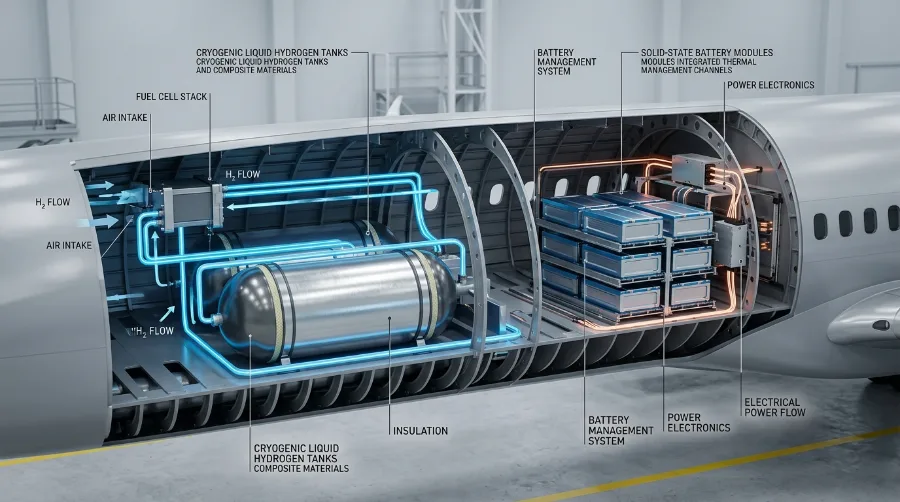
The system-level weight advantage matters enormously in exactly the applications where mass, not efficiency, is the binding constraint:
- Aviation. Every kilogram of battery an aircraft carries is a kilogram it must also lift for the entire flight — batteries scale badly for long-range flight for this reason. Hydrogen’s lighter system-level weight is why our hydrogen aviation guide and the broader electric aircraft guide both treat hydrogen as the more plausible path to long-range zero-emission flight.
- Long-haul shipping. Similar logic: batteries heavy enough for trans-ocean range would displace too much cargo capacity.
- Heavy long-haul trucking. Where payload capacity is revenue, hydrogen’s lighter fuel system can preserve more cargo weight than an equivalent-range battery pack, though this remains contested territory as batteries improve.
Everywhere else — passenger cars, city buses, short-haul delivery, most rail — the efficiency and infrastructure advantages of batteries dominate, which is exactly the pattern the real market has settled into rather than the “hydrogen vs. batteries” horse race some coverage implies.
What Changes This Comparison Going Forward
Both sides of the hydrogen vs lithium ion energy density comparison are moving targets. Battery-side, silicon-anode and eventually solid-state chemistries (see our advanced battery technology guide) will push system-level gravimetric density up meaningfully, narrowing hydrogen’s remaining edge for some applications. Hydrogen-side, better cryogenic tank engineering and higher-efficiency electrolysis could improve both the density and the efficiency side of its ledger. Neither side is likely to fully close the gap that makes each chemistry win its current niche — the more likely 2030s outcome is batteries extending their lead in cars while hydrogen holds its ground in aviation and shipping.
How this plays out for airport infrastructure specifically is covered in our charging grids vs hydrogen fueling stations guide.
The number behind that comparison is explained in our battery energy density guide.
Hydrogen vs lithium ion energy density FAQ
Is hydrogen really 100 times more energy dense than batteries?
Only measuring the fuel alone – about 130x by that narrow metric. Once you include the tank or fuel-cell system needed to actually use it, hydrogen’s real-world advantage over lithium-ion falls to roughly 5-10x by weight.
Why don’t cars use hydrogen if it has higher energy density?
Because efficiency matters more for cars than raw density: batteries convert 85-95% of electricity to motion, while the full hydrogen chain (electrolysis, compression, fuel cell) manages only 30-40%. That efficiency gap outweighs the density advantage where weight is not critical.
Is hydrogen more space-efficient than batteries?
Compressed hydrogen is roughly 2x more energy-dense by volume than lithium-ion; liquid hydrogen reaches 3-4x, but requires expensive cryogenic systems. Batteries remain more volume-efficient than uncompressed or lightly pressurized hydrogen storage.
Why is hydrogen favored for aviation specifically?
Aircraft must lift every kilogram of fuel for the entire flight, so weight matters more than efficiency. Hydrogen’s lighter system-level weight per unit of energy makes long-range zero-emission flight more physically plausible with hydrogen than with today’s batteries.
Will future batteries close the gap with hydrogen?
Partially. Silicon-anode and eventually solid-state chemistries will raise battery energy density meaningfully, but are unlikely to fully erase hydrogen’s system-level weight advantage for the most demanding applications like long-range aviation.
What is the biggest downside of hydrogen storage?
The container problem: compressing to 350-700 bar needs thick, heavy tanks, while liquefying to -253C needs cryogenic insulation and suffers ongoing boil-off losses. Both add mass and cost that the raw fuel energy density figure ignores.
Related Guides on ZeroCarbonDrive
- Hydrogen aviation explained — where this density advantage is put to work
- Solid state battery vs lithium-ion — the chemistry narrowing the gap
- Advanced battery technology — the full chemistry landscape
Sources and Further Reading
Every figure on this page is dated and linked to its source. How we verify · Editorial policy · Report a correction
Related Posts


Leave a Comment
Your comment will be published after it has been approved. Please send comments that do not contain slang words.