
Hydrogen Aviation: How Hydrogen-Powered Aircraft Take Off in 2026
Updated September 18, 2026 · 12 min read
Hydrogen aviation is the branch of zero-carbon flight that stores energy in hydrogen instead of batteries — either feeding fuel cells that drive electric motors, or burning hydrogen directly in modified turbines. Where batteries hit a hard weight ceiling around 500 km of range, hydrogen aviation promises zero-carbon flight at 1,000–3,000 km: the regional and short-haul routes that produce the bulk of aviation emissions. This guide explains how hydrogen aviation actually works, which programmes fly in 2026, the brutal infrastructure problem nobody should gloss over, and when hydrogen-powered airliners become realistic.
Key takeaways
- Hydrogen aviation splits into two technologies: fuel-cell electric propulsion (efficient, proven at small scale) and direct hydrogen combustion (powerful, further from certification).
- ZeroAvia and H2FLY have flown fuel-cell aircraft up to 19 seats; certification of the first commercial hydrogen powertrains is targeted for 2026–2027.
- Hydrogen holds three times more energy per kilogram than jet fuel — but four times less per litre, making tank volume and cryogenic storage the core engineering challenge.
- Green hydrogen supply, not aircraft technology, is the binding constraint: under 1% of world hydrogen production was green in 2024.
- Realistic timeline: retrofitted 10–20 seat aircraft by 2027, 40–80 seat regional turboprops in the early 2030s, narrow-body hydrogen airliners no sooner than 2040.
- Hydrogen aviation and battery-electric flight are complements, not rivals — batteries below ~500 km, hydrogen above, sustainable aviation fuel for long haul.
What Is Hydrogen Aviation?
Hydrogen aviation covers every aircraft concept that uses hydrogen as its onboard energy carrier. Burned or reacted, hydrogen contains no carbon, so nothing it does in flight can emit CO2. The two pathways differ sharply in maturity and character:
| Pathway | How it works | Efficiency | Best suited to | 2026 status |
|---|---|---|---|---|
| Fuel-cell electric | H2 + O2 react in a PEM stack, producing electricity for motors | 50–60% | 9–80 seat regional aircraft | Flying in demonstrators; certification underway |
| Direct combustion | Modified turbine burns H2 instead of kerosene | ~40% | Narrow-body and larger | Ground tests (CFM, Rolls-Royce); no full aircraft yet |
Fuel cells win on efficiency and produce only water vapour; combustion preserves turbine power density but still creates NOx and some contrail effects. Most credible near-term hydrogen aviation programmes therefore start with fuel cells, and every certified hydrogen powertrain expected before 2030 is a fuel-cell design.
How a Hydrogen Aircraft Works
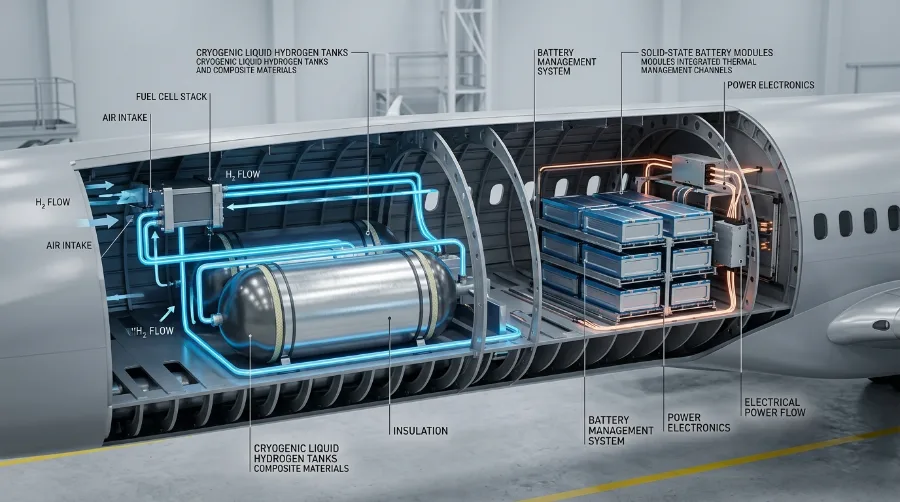
A fuel-cell aircraft is, at heart, an electric aircraft with a different energy source: motors, inverters, and propellers are shared with battery designs — a synergy covered in our electric aircraft guide. The hydrogen-specific hardware is the storage and conversion chain.
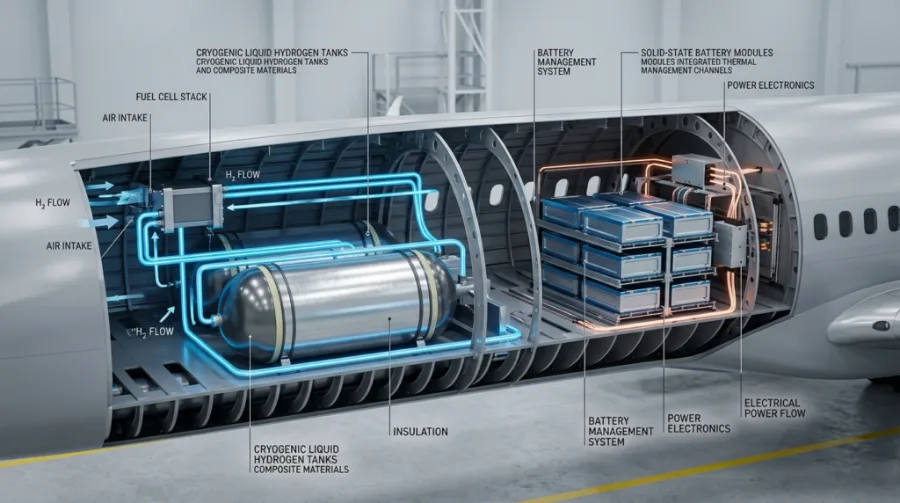
Storage is the defining problem of hydrogen aviation. Hydrogen is the lightest element: magnificent per kilogram, terrible per litre. Aircraft designers choose between compressed gas at 350–700 bar — simple but bulky — and liquid hydrogen at −253°C, which triples volumetric density at the cost of cryogenic tanks, boil-off management, and entirely new airport fuelling procedures.
| Storage method | Density (kg H2/m³) | Tank weight penalty | Used by |
|---|---|---|---|
| Compressed gas, 350 bar | ~24 | Moderate | Small demonstrators, ground vehicles |
| Compressed gas, 700 bar | ~40 | High (thick carbon-fibre vessels) | ZeroAvia ZA600 retrofits |
| Liquid hydrogen (−253°C) | ~71 | Cryogenic insulation + handling | H2FLY HY4 LH2, Airbus ZEROe studies |
In 2023 H2FLY flew the world’s first piloted liquid-hydrogen fuel-cell aircraft, doubling range over the compressed-gas version of the same airframe — the clearest proof yet that liquid storage is where serious hydrogen aviation is heading.
Hydrogen Aviation Programmes Flying in 2026
| Programme | Aircraft | Seats | Approach | 2026 milestone |
|---|---|---|---|---|
| ZeroAvia ZA600 | Dornier 228 retrofit | 9–19 | Fuel cell, gaseous H2 | Certification programme with CAA/FAA |
| ZeroAvia ZA2000 | ATR/Dash-8 class | 40–80 | Fuel cell, liquid H2 | Powertrain ground testing |
| H2FLY / Joby | HY4 and S4 derivative | 4–5 | Fuel cell, liquid H2 | LH2 eVTOL demonstrations |
| Airbus ZEROe | Concept family | 100+ | Combustion + fuel cell hybrid | Programme slowed; tech maturation continues |
| Universal Hydrogen (legacy) | Dash-8 testbed | 40 | Modular capsules | Ceased 2024 — cautionary tale on funding |
The honest reading: hydrogen aviation in 2026 is where battery aviation was around 2019 — flying demonstrators, first certification campaigns, and one high-profile bankruptcy reminding everyone that physics progress does not guarantee business survival. Airbus pushing its ZEROe service date beyond 2035 confirmed that large hydrogen airliners are a 2040s story, while sub-80-seat hydrogen aviation remains firmly on track for this decade.
Hydrogen vs Batteries vs SAF: Where Each Wins
| Criterion | Battery-electric | Hydrogen fuel cell | Sustainable aviation fuel |
|---|---|---|---|
| Practical range (2026 tech) | Up to ~400 km | 500–1,500 km | Unlimited (drop-in) |
| Energy efficiency (well-to-thrust) | ~70% | ~30–40% | ~25% (with e-fuel production) |
| In-flight emissions | None | Water vapour only (fuel cell) | CO2 (offset by feedstock) |
| Infrastructure need | Chargers + grid | H2 production, liquefaction, airport storage | None — existing fuel systems |
| Fleet applicability | Trainers, air taxis, commuters | Regional 10–80 seats | Everything, especially long haul |
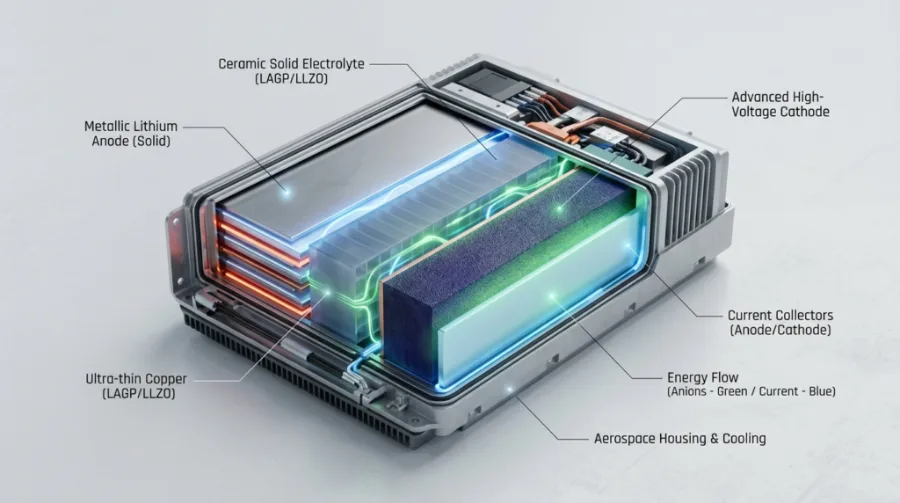
This is why serious decarbonisation roadmaps deploy all three. Batteries own the short end, hydrogen aviation takes the regional middle, and the SAF mandate handles routes neither can reach. The detailed batteries-versus-hydrogen engineering trade-off is unpacked in our comparison of hydrogen fuel cells vs solid-state batteries in aviation.
One under-appreciated climate bonus: a fuel-cell aircraft emits no soot, and soot is the main nucleus for contrail ice crystals. Hydrogen aviation therefore also shrinks the non-CO2 warming described in our guides to aviation non-CO2 effects and contrail avoidance — though water-vapour contrail behaviour from hydrogen exhaust is still being researched at cruise altitudes.
The Infrastructure Problem Nobody Should Gloss Over
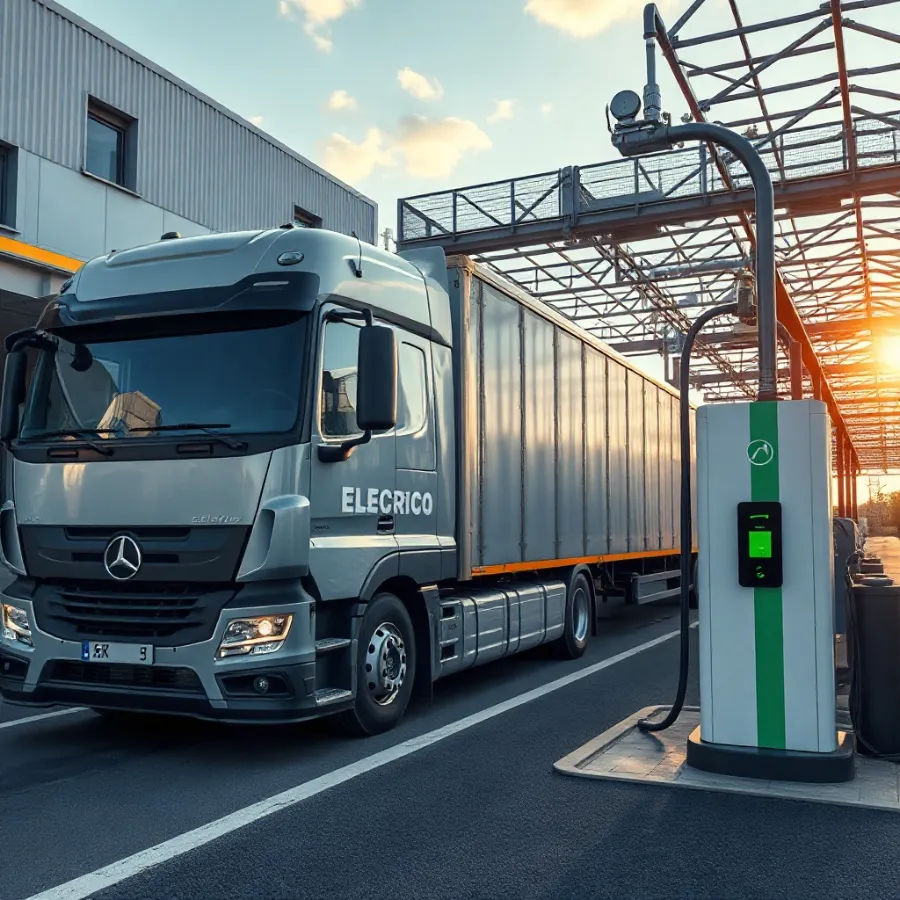
An airport that welcomes hydrogen aviation needs a supply chain that mostly does not exist yet: electrolysers or delivered green hydrogen, liquefaction plants consuming 30–40% of the hydrogen’s own energy content, cryogenic storage spheres, and trained fuelling crews operating under new safety codes. Industry estimates put the global airport investment needed for meaningful hydrogen aviation at $15–25 billion by 2040 — comparable to what EV charging networks absorbed in a decade.
The sequencing answer is hub-and-corridor: rather than converting every airport, early hydrogen aviation concentrates on fixed regional corridors — Scotland’s island routes, Norwegian coastal hops, California commuter links — where one supplied hub can fuel an entire out-and-back network. The European Clean Hydrogen Partnership funds exactly such corridor pilots, and the first scheduled hydrogen routes will almost certainly fly them.
Green Hydrogen: The Supply-Side Constraint
Hydrogen aviation is only as clean as its hydrogen. Today over 95% of world production is “grey” — made from natural gas with heavy CO2 emissions. Flying on grey hydrogen would be climate theatre.
| Hydrogen type | Made from | CO2 footprint | 2026 cost (per kg) |
|---|---|---|---|
| Grey | Natural gas reforming | ~10 kg CO2/kg H2 | $1.5–2.5 |
| Blue | Gas + carbon capture | ~2–4 kg CO2/kg H2 | $2.5–4 |
| Green | Renewable electrolysis | ~0 | $4–7 (falling) |
Green hydrogen capacity is scaling — global electrolyser deployment roughly doubles every two years — but aviation must compete with steel, shipping, and fertiliser for every kilogram. Credible forecasts see green hydrogen at $2–3/kg by 2030 in the best renewable regions, the threshold at which hydrogen aviation operating costs undercut fossil kerosene on regional routes even before carbon pricing under EU ETS and CORSIA is counted.
Operating Economics: What a Hydrogen Route Actually Costs
Consider a realistic 2028 case: a 19-seat retrofitted aircraft flying a 300 km coastal corridor six times daily. Each rotation consumes roughly 55 kg of hydrogen. At today’s green price of $5/kg that is $275 per flight in fuel — noticeably above the ~$210 of kerosene an equivalent turboprop burns. Shift the hydrogen price to $2.50/kg and the same flight costs $138, a 34% saving before any carbon costs are added to the fossil side of the ledger.
Maintenance moves the equation further. A fuel-cell powertrain has no turbine hot section — the single most expensive maintenance item in regional aviation. Operators in ZeroAvia’s launch group project 30–40% lower engine-programme costs over a powertrain’s life, offset partly by periodic fuel-cell stack replacement, which behaves like the battery line in electric aircraft accounting: predictable, schedulable, and falling in price every year.
The capital side is harsher. A hydrogen retrofit today costs $2–3 million per aircraft, and early adopters shoulder certification risk. This is why nearly every serious order book pairs aircraft purchases with government corridor funding — the same pattern that de-risked early EV fleets — and why leasing structures that separate airframe from powertrain ownership are emerging as the preferred financing model for hydrogen aviation’s first decade.
The Supply Chain Taking Shape
Behind the airframers, a dedicated industrial base is forming. Fuel-cell stacks for aviation come from PowerCell, Plug Power, and Toyota’s aviation unit; cryogenic tanks from GKN Aerospace and Ariane Group, whose space heritage maps directly onto liquid-hydrogen handling; airport fuelling systems from Linde, Air Liquide, and Chart Industries, which already run the world’s industrial hydrogen logistics. Electrolyser makers — Nel, ITM Power, Thyssenkrupp Nucera — sit at the top of the chain, and their factory expansion rates are the best single indicator of how fast hydrogen aviation can genuinely scale.
Regional clusters are visible too. Scotland pairs abundant wind power with island routes that suit 19-seat aircraft perfectly. Norway’s state airport operator plans hydrogen readiness alongside its electric-aircraft charging network. California links Central Valley solar to commuter corridors, and New Zealand — with 85% renewable electricity and thin domestic routes — has positioned itself as a full national testbed, with Air New Zealand committed to zero-emission regional aircraft from 2030.
How the First Routes Get Chosen
The selection logic is consistent worldwide: a viable early hydrogen route is short (150–500 km), thin (under 80 seats of demand), over water or terrain that road and rail cannot cross, and anchored at one airport where hydrogen supply can be concentrated. Island and fjord networks dominate every shortlist for exactly these reasons. A useful mental model: wherever a ferry is currently faster than driving, a hydrogen aircraft route probably pencils out. These corridors also concentrate maintenance, training, and safety-case learning in one place — the operational experience regulators want to see before approving expansion to busier networks.
Safety and Certification
Hydrogen’s safety reputation still carries 1937’s shadow, yet the modern engineering picture is more balanced: hydrogen disperses upward at 20 m/s rather than pooling like kerosene, ignites in a narrow vertical plume, and has decades of safe industrial handling behind it. Aviation certification authorities are writing the rulebook now — EASA’s hydrogen roadmap and the FAA’s powertrain special conditions treat fuel cells, tanks, and venting systems as new certifiable components. The first full certification of a hydrogen powertrain, expected from ZeroAvia’s ZA600 campaign, will set the template every subsequent hydrogen aviation programme follows, much as the Velis Electro’s 2020 certificate did for battery flight.

Myths vs Facts
“Hydrogen is too dangerous to fly.” The record says otherwise: industrial facilities have handled millions of tonnes safely for decades, and modern aviation tanks survive crash, fire, and gunfire testing that kerosene tanks were never asked to pass. Risk differs from kerosene — it does not exceed it; it must simply be engineered for differently, and certification authorities are doing exactly that.
“The tanks make passenger aircraft impossible.” Volume is a genuine design constraint, not a wall. Liquid storage triples density, and configurations that lengthen the rear fuselage or blend tanks into the wing keep seat counts intact on regional designs already flying as demonstrators. The constraint bites hardest above 100 seats — which is precisely why nobody credible promises a hydrogen A320 replacement before 2040.
“It’s less efficient than batteries, so it’s pointless.” True on efficiency, false on conclusion. A 30–40% well-to-thrust chain beats a battery aircraft that cannot fly the route at all. Efficiency comparisons only matter inside the envelope both technologies can serve — below 400 km batteries win and should; beyond it the comparison is hydrogen versus fossil kerosene, and hydrogen wins on carbon by a landslide.
“Airports will never adopt it.” Airports follow airlines, and airlines follow costs. The same scepticism greeted unleaded avgas, winglets, and EV ground fleets. With corridor funding flowing in Europe and mandates pulling green fuel supply, the first hydrogen-ready regional airports already exist on paper and in steel in Scotland, Norway, and the Netherlands.
The honest verdict on hydrogen aviation in 2026: the physics is settled, the engineering is maturing on schedule, the economics arrive with cheap green hydrogen around 2030 — and the single real gating factor is how fast the world builds electrolysers and airport supply. Watch that curve, and you can time the industry almost to the year.
Market Outlook: Hydrogen Aviation to 2040
| Year | Expected milestone |
|---|---|
| 2026–2027 | First certified fuel-cell powertrains; 10–19 seat retrofits enter service |
| 2028–2030 | Scheduled hydrogen routes on island/coastal corridors; LH2 airport pilots |
| 2031–2035 | 40–80 seat hydrogen turboprops; green H2 at $2–3/kg in lead markets |
| 2035–2040 | Narrow-body combustion demonstrators; hydrogen hubs at major airports |
| 2040+ | Hydrogen airliners in mainline service — if supply and airports keep pace |
Analysts project hydrogen aviation could serve a third of regional capacity by 2040 in supportive markets. The technology curve looks reliable; the supply and infrastructure curves are the ones to watch.
A note on timing for investors and planners: hydrogen aviation rewards patience over hype. The programmes that survived to 2026 share three traits — a certifiable near-term product, government corridor partnerships, and fuel supply agreements signed before aircraft orders. Universal Hydrogen’s collapse showed what happens when any leg of that tripod is missing. For airports, the practical first step costs almost nothing: reserve land for future storage, specify hydrogen-compatible fire systems in any new build, and join a corridor consortium. For regional airlines, the equivalent step is a powertrain letter of intent that locks delivery slots without capital commitment. Both moves cost little today and buy years of lead time if — more likely when — the supply curve delivers.
And for travellers wondering what hydrogen aviation will feel like: quieter than a turboprop, with water vapour trailing where exhaust used to be, on routes short enough that boarding takes longer than cruising. The revolution, when it arrives, will feel pleasantly ordinary.
For the sector-wide numbers hydrogen must ultimately bend — total CO2, warming shares, SAF volumes — see our aviation emissions statistics reference.
One honest caveat to the zero-emission story: water vapor. Our hydrogen contrails guide covers what changes in the sky when planes burn hydrogen.
The physics behind that weight advantage is broken down in our hydrogen vs lithium ion energy density guide.
For flights specifically, offsetting remains one of the few real levers — see our carbon offset transportation guide.
The ground infrastructure question is covered in our charging grids vs hydrogen fueling stations guide.
How the economics actually compare per flight is covered in our cost per flight guide.
Frequently Asked Questions
green hydrogen vs blue hydrogen is worth a closer look for the full picture.
hydrogen vehicle emissions is worth a closer look for the full picture.
Is hydrogen aviation safe?
Handled properly, yes. Hydrogen disperses upward rapidly instead of pooling, and certification rules being written now require crash-tested tanks, automatic venting, and leak detection more stringent than anything applied to kerosene systems.
When will passengers fly on hydrogen aircraft?
Small retrofitted aircraft (10–19 seats) are expected in scheduled service around 2027 on short regional corridors. Purpose-built 40–80 seat hydrogen turboprops follow in the early 2030s; hydrogen narrow-bodies are a 2040s prospect.
Why not just use batteries instead?
Weight. Beyond roughly 400–500 km, battery mass grows faster than the useful load it enables. Hydrogen carries three times the energy of jet fuel per kilogram, so hydrogen aviation extends zero-carbon range to routes batteries physically cannot serve.
Does hydrogen aviation produce contrails?
Fuel cells emit pure water vapour and no soot, which changes — and likely reduces — contrail formation, though research on hydrogen contrail behaviour at cruise altitude is ongoing. Combustion designs still produce NOx and some contrail effects.
What does hydrogen aviation cost compared with kerosene?
At 2026 green hydrogen prices ($4–7/kg) it is more expensive per flight. At the projected $2–3/kg by 2030, regional hydrogen operating costs undercut fossil kerosene — before adding the carbon costs kerosene pays under EU ETS and CORSIA.
Which countries lead hydrogen aviation in 2026?
The United Kingdom (ZeroAvia’s certification campaign and Scottish corridor plans), Germany (H2FLY’s liquid-hydrogen flights and DLR research), Norway (airport-network readiness), the Netherlands (Rotterdam and Groningen corridor pilots), and New Zealand (a full national regional testbed) form the visible front rank, with the United States and Japan close behind on fuel-cell supply.
Can existing aircraft be converted to hydrogen?
Yes — retrofits are the entire near-term strategy. Proven 9–19 seat airframes such as the Dornier 228 and Cessna Caravan take a fuel-cell powertrain in place of their turbines, keeping the certified airframe while replacing only the propulsion chain. Purpose-built hydrogen designs follow once powertrains are certified and supply corridors exist.
Sources and Further Reading
Where this fits
This page is part of the zero-carbon aviation hub on ZeroCarbonDrive:
- Zero-carbon aviation hub: the four routes, and what is certified
- Electric and hydrogen aircraft tracker
- Hydrogen contrails: how clean planes still mark the sky
Every figure on this page is dated and linked to its source. How we verify · Editorial policy · Report a correction
Related Posts
Leave a Comment
Your comment will be published after it has been approved. Please send comments that do not contain slang words.