
Battery Technology for Electric Flight (2026): The Real Constraints

Updated September 2, 2026 · 3 min read
Last updated: September 1, 2026
Quick answer: Battery technology for electric flight faces one dominant constraint that ground vehicles don’t: energy density. Today’s best automotive cells (~250-300 Wh/kg) work fine for cars but fall well short of the 400+ Wh/kg widely considered necessary for meaningfully useful electric aircraft. Three technology paths are converging on the problem — silicon-anode cells shipping today, solid-state batteries in pilot production, and aviation-specific pack engineering that squeezes more usable energy from existing chemistry.
Key takeaways
- Aviation-specific battery technology development is driven almost entirely by the energy-density constraint that doesn’t bind nearly as hard for cars.
- Aviation batteries must also handle higher discharge rates and stricter safety/thermal requirements than automotive packs, since failure modes are less forgiving in the air.
- Today’s electric aircraft are genuinely short-range because they’re built around current, not future, battery technology.
- Every major density-improving chemistry — silicon-anode, solid-state — has aviation as an explicit target market, not just automotive.
What Makes Aviation Batteries Different From Car Batteries

| Requirement | Automotive battery | Aviation battery technology |
|---|---|---|
| Energy density priority | Important but not binding | The dominant, often limiting constraint |
| Discharge rate | Moderate, steady | Higher sustained rates for takeoff/climb phases |
| Thermal management | Robust but tolerant of some variance | Stricter — thermal runaway risk is less forgiving in flight |
| Weight sensitivity | Matters for range/efficiency | Directly determines whether the mission is flyable at all |
This is why battery technology for electric flight can’t simply borrow automotive packs unmodified — the requirements diverge enough that aviation-specific engineering is a distinct discipline, even when the underlying cell chemistry is shared.
The Three Converging Technology Paths
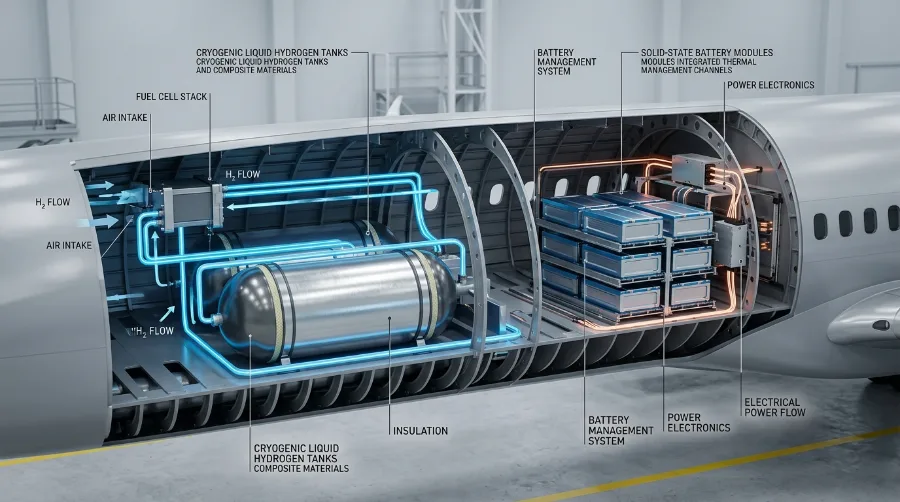
- Silicon-anode chemistry (shipping now). Blended silicon-graphite anodes deliver meaningful, if incremental, density gains over pure graphite — already in select premium automotive models and increasingly relevant to aviation-scale packs.
- Solid-state batteries (pilot production). The highest-potential leap, replacing liquid electrolyte with a solid ceramic or sulfide layer, enabling pure lithium-metal anodes and the biggest realistic density jump — full details in our solid state battery guide. Manufacturing at scale remains the bottleneck, same as for automotive applications.
- Pack-level engineering. Even without new cell chemistry, smarter thermal management, lighter structural integration, and reduced “dead weight” between cells squeeze meaningfully more usable energy density out of existing chemistry — a less glamorous but immediately actionable lever.

What This Means for Electric Aircraft Today
Every electric aircraft flying or in serious development today is built around current battery technology’s real limits, not a hoped-for future breakthrough — which is exactly why our electric aircraft guide treats today’s electric aviation as genuinely short-range. As density-improving chemistries mature and reach aviation-relevant volume, range and payload capacity will scale accordingly — but on the same multi-year timeline covered in our battery energy density guide, not overnight.
Battery Technology for Electric Flight FAQ
Why can’t planes just use car batteries?
Aviation battery technology needs much higher energy density (weight matters far more in flight), higher sustained discharge rates for takeoff and climb, and stricter thermal safety margins than automotive packs typically provide.
What is the biggest obstacle to better aviation batteries?
Energy density – today’s best automotive cells reach roughly 250-300 Wh/kg, well short of the 400+ Wh/kg widely considered necessary for meaningfully useful electric aircraft on regional routes.
Which battery technology is most promising for electric flight?
Solid-state batteries offer the biggest potential density leap, though manufacturing at scale remains years away. Silicon-anode chemistry offers smaller, nearer-term gains and is already shipping in select premium applications.
Will electric aircraft range improve as battery technology improves?
Yes, directly and proportionally – range and payload capacity for electric aircraft scale with usable energy density, which is why today’s short-range electric aircraft are built around current, not future, battery capability.
Do aviation batteries need different safety standards than car batteries?
Generally stricter ones – thermal runaway and failure modes carry higher stakes in flight than on the ground, driving more conservative thermal management and safety margins in aviation-specific battery pack design.
Are non-chemistry improvements helping aviation batteries too?
Yes – pack-level engineering like better thermal management and reduced structural weight between cells squeezes more usable energy density out of existing chemistry, a meaningful lever independent of any new battery chemistry breakthrough.
Related Guides on ZeroCarbonDrive
- Battery energy density — the specific numbers and timeline
- Solid state battery vs lithium-ion — the highest-potential chemistry leap
- Electric aircraft explained — what’s flying today at current density
Sources and Further Reading
Related Posts

Leave a Comment
Your comment will be published after it has been approved. Please send comments that do not contain slang words.