
Battery Energy Density (2026): The 400 Wh/kg Aviation Target

Updated September 2, 2026 · 4 min read
Last updated: September 1, 2026
Quick answer: Battery energy density measures how much energy a battery stores per unit of weight (Wh/kg) or volume (Wh/L). Today’s best automotive lithium-ion cells reach roughly 250-300 Wh/kg — good enough for cars, where extra weight is a manageable tradeoff. Aviation researchers widely cite 400+ Wh/kg as the practical threshold for meaningfully useful electric aircraft, because every kilogram an aircraft carries must be lifted for the entire flight. No commercial battery hits that number yet, which is exactly why hydrogen and hybrid approaches remain serious contenders for aviation specifically.
Key takeaways
- Battery energy density has roughly doubled over the past 15 years but growth has slowed as lithium-ion chemistry approaches physical limits.
- Cars tolerate lower density than aircraft because weight matters far less on the ground — 250-300 Wh/kg is already commercially sufficient.
- The oft-cited 400 Wh/kg aviation threshold isn’t arbitrary — it’s roughly where battery-electric aircraft start becoming range-competitive for meaningful routes.
- Solid-state and silicon-anode chemistries are the most credible near-to-mid-term paths toward closing the density gap.
Energy Density, Explained Simply

| Chemistry/Era | Typical energy density | Status |
|---|---|---|
| Early lithium-ion (2010s) | ~150-180 Wh/kg | Historical baseline |
| Current best automotive NMC/NCA | ~250-300 Wh/kg | Commercial, widely deployed |
| Current LFP | ~160-200 Wh/kg | Commercial, prioritizes cost/safety over max density |
| Silicon-anode (blended) | Modest gain over NMC | Shipping in select premium models |
| Aviation-viable threshold (widely cited) | 400+ Wh/kg | Not yet commercially achieved |
| Solid-state (theoretical ceiling) | Potentially 400-500+ Wh/kg | Pilot production, years from volume |
The gap between “good enough for cars” and “good enough for meaningful electric aviation” is roughly 100-150 Wh/kg — smaller than it sounds, but stubborn, because battery energy density gains have slowed as lithium-ion chemistry approaches fundamental physical limits rather than accelerating.
Why 400 Wh/kg Specifically for Aviation?
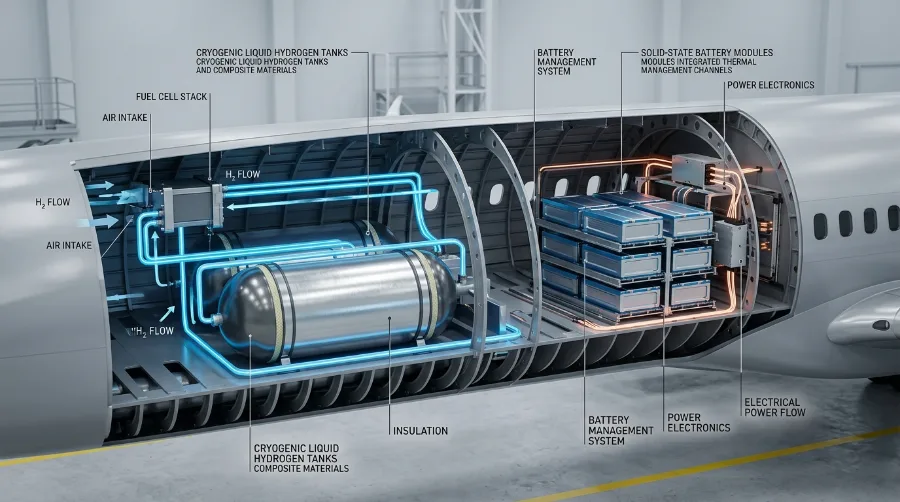
The number isn’t arbitrary marketing — it comes from basic aircraft physics. Every kilogram of battery an aircraft carries must be lifted and accelerated for the entire flight, unlike a car where extra weight mostly just means slightly more energy per mile. At current density levels (~250-300 Wh/kg), a battery pack large enough for meaningful passenger-carrying range becomes so heavy it eats unacceptably into payload and range simultaneously. Around 400 Wh/kg, the math starts working for short-to-medium regional routes — which is why our electric aircraft guide treats today’s electric aviation as genuinely short-range, and why our hydrogen vs lithium-ion density guide explains why hydrogen remains competitive for longer routes even as battery density improves.
What’s Actually Closing the Gap

- Silicon-anode chemistry (already shipping, incremental gains) — see our advanced battery technology guide for the full chemistry landscape.
- Solid-state batteries — the most credible path to a real density leap, still years from meaningful automotive or aviation volume; full details in our solid state battery guide.
- Cell packaging improvements — reducing the “dead weight” of casings and connectors between cells, a less glamorous but steadily productive lever.
- Lithium-metal anodes — a component of several next-gen approaches, offering higher theoretical capacity than today’s graphite anodes.
None of these individually promises to hit 400 Wh/kg overnight, but the combined trajectory across multiple approaches is why aviation researchers remain cautiously optimistic about battery-electric flight eventually reaching regional-route viability, even if the timeline keeps sliding.
The economics of using it depend heavily on route length — see our cost per flight guide.
How this affects aircraft specifically is covered in our battery technology for electric flight guide.
Battery Energy Density FAQ
What is battery energy density?
A measure of how much energy a battery stores per unit of weight (Wh/kg, gravimetric) or volume (Wh/L, volumetric). Higher density means more range for the same weight or size – the key metric for both EVs and electric aircraft.
What is the current best battery energy density?
Today’s best commercial automotive lithium-ion cells reach roughly 250-300 Wh/kg. This is sufficient for cars but falls short of the widely cited 400+ Wh/kg threshold considered necessary for meaningfully useful electric aircraft.
Why does aviation need higher density than cars?
Aircraft must lift every kilogram of battery for the entire flight, making weight far more costly than on the ground. Cars tolerate lower density because extra weight mostly just costs slightly more energy per mile, not flight viability.
Will solid-state batteries reach the 400 Wh/kg aviation target?
Potentially – solid-state chemistry has a theoretical ceiling that could reach or exceed 400-500 Wh/kg, but the technology remains in pilot production and is likely years from the manufacturing volume needed for aviation applications.
Is battery energy density improving quickly?
More slowly than in the 2010s – density roughly doubled over about 15 years, but lithium-ion chemistry is approaching physical limits, which is why next-generation chemistries like solid-state are seen as necessary for further major gains.
Why not just use hydrogen instead of waiting for better batteries?
Many aviation programs are pursuing hydrogen precisely because of this density gap – hydrogen’s system-level weight advantage over batteries grows with aircraft size, making it a credible parallel path rather than a fallback.
Related Guides on ZeroCarbonDrive
- Advanced battery technology — the full chemistry landscape
- Hydrogen vs lithium-ion energy density — the aviation-specific comparison
- Electric aircraft explained — what’s flying today at current density levels
Sources and Further Reading
Related Posts


Leave a Comment
Your comment will be published after it has been approved. Please send comments that do not contain slang words.