
Cost per Flight (2026): Battery vs Hydrogen Aviation Economics
Updated September 2, 2026 · 4 min read
Last updated: September 1, 2026
Quick answer: Cost per flight for battery-electric aircraft is currently lower than hydrogen on a per-energy basis — electricity is cheaper and more efficient to convert to thrust than producing, compressing and converting hydrogen. But battery aircraft are limited to short routes today, while hydrogen’s infrastructure cost is currently the bigger factor holding back its operating economics, not the fuel itself. Neither technology has displaced jet fuel’s cost-per-mile at commercial scale yet.
Key takeaways
- Per unit of energy delivered to the propeller, battery-electric currently beats hydrogen on cost, thanks to fewer conversion losses.
- Hydrogen’s cost disadvantage today comes mostly from production and infrastructure, not the fundamental energy economics.
- Battery aircraft’s cost advantage only applies to the short routes they can actually fly — the comparison isn’t apples-to-apples for longer distances.
- Both remain more expensive than jet fuel on a pure cost-per-mile basis at current scale, though the gap is narrowing.
Why the Comparison Isn’t Simple

Comparing cost per flight for battery vs hydrogen aircraft requires separating two different questions: which is cheaper per unit of energy delivered, and which is cheaper for a GIVEN mission. The two technologies aren’t actually competing for the same flights today — battery-electric serves short hops where its weight penalty stays manageable, while hydrogen targets the longer, larger-aircraft missions where its weight advantage starts to matter. A fair cost comparison has to account for this: cheaper energy on a route you can’t fly isn’t actually cheaper in practice.
The Energy Cost Comparison
| Pathway | Typical efficiency (source to thrust) | Cost driver |
|---|---|---|
| Grid electricity → battery → motor | ~85-95% | Electricity price + battery amortization |
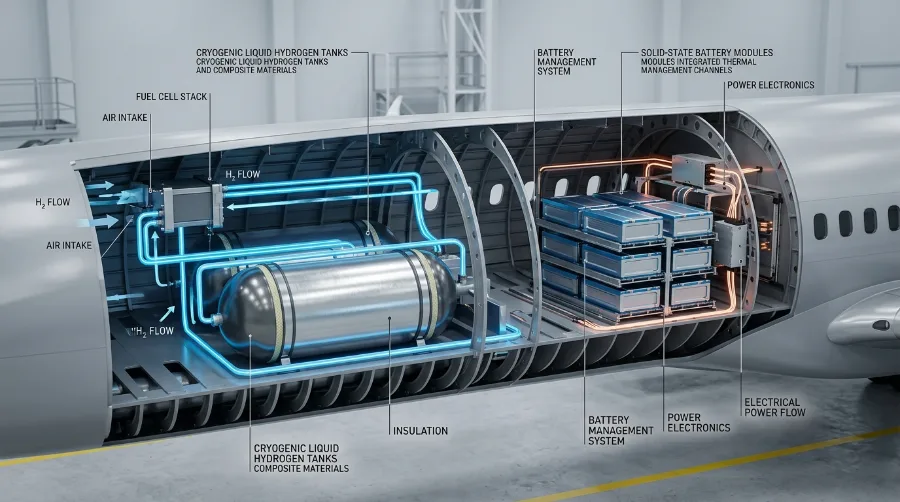
| Electricity → hydrogen production → compression → fuel cell → motor | ~30-40% | Production losses dominate, plus new infrastructure cost |
This efficiency gap is the core reason battery-electric currently wins on pure energy cost — hydrogen loses roughly 60-70% of the original energy in production and conversion, a cost battery-electric simply doesn’t pay. Our hydrogen vs lithium-ion energy density guide covers the same efficiency tradeoff from the density angle.
Why Hydrogen Might Still Win on Real Missions
The energy-cost comparison above favors batteries, but it answers the wrong question for many real routes. For a mission a battery-electric aircraft simply cannot fly — because the pack would be too heavy for the required range — hydrogen’s higher per-unit-energy cost is irrelevant; it’s the only zero-emission option available at all. This is the practical resolution to the “cost per flight” question: for short hops, battery-electric wins on cost AND capability; for longer or heavier missions, hydrogen is the only zero-emission contender regardless of its cost disadvantage on paper.
Where This Leaves the Economics Today
Neither technology has yet matched jet fuel’s cost per mile at commercial scale — both remain premium options justified by emissions goals and, increasingly, by regulatory pressure and route-specific advantages rather than pure cost competitiveness. The trend lines favor both technologies improving: battery costs keep falling, and hydrogen production and infrastructure costs should fall as scale increases — following the same cost curve renewable electricity generation followed a decade earlier.
Cost per Flight FAQ
Is battery-electric or hydrogen cheaper per flight?
Per unit of energy, battery-electric currently costs less due to fewer conversion losses. But the two technologies serve different route types today, so a fair cost-per-flight comparison depends heavily on the specific mission being flown.
Why is hydrogen more expensive than batteries for aviation?
Mainly conversion losses – producing, compressing and converting hydrogen back to thrust loses roughly 60-70% of the original energy, versus 5-15% for battery-electric. New infrastructure costs add further expense on top of this efficiency gap.
Does either technology beat jet fuel on cost yet?
Not at commercial scale – both battery-electric and hydrogen aviation remain more expensive than jet fuel per mile today, justified currently by emissions goals rather than pure cost competitiveness, though both cost curves are trending favorably.
Why would anyone choose hydrogen if it costs more?
Because for longer or heavier routes, battery-electric aircraft simply cannot fly the mission at all due to weight limits. Hydrogen’s cost disadvantage is irrelevant when it’s the only zero-emission option physically capable of the flight.
Will hydrogen costs come down over time?
Most analysts expect so, as production scales and infrastructure matures, following a similar cost curve to renewable electricity generation a decade earlier. Current costs reflect an early, low-volume industry more than a fundamental ceiling.
What is the biggest cost factor for hydrogen aviation right now?
Infrastructure – production, compression, storage and delivery systems at airports mostly don’t exist yet and must be built from scratch, a much larger current cost driver than the fundamental energy economics of hydrogen itself.
Related Guides on ZeroCarbonDrive
- Hydrogen vs lithium-ion energy density — the weight side of this same tradeoff
- Charging grids vs hydrogen fueling stations — the infrastructure cost driver
- Electric aircraft explained — where battery-electric wins today
Sources and Further Reading
Related Posts


Leave a Comment
Your comment will be published after it has been approved. Please send comments that do not contain slang words.