
Hydrogen Fuel Cells vs Solid-State Batteries in Aviation: 2026
Updated September 18, 2026 · 11 min read
The global commercial aviation sector contributes approximately 2.5% of anthropogenic carbon dioxide (CO2) emissions, but its complete climate impact—when accounting for non-CO2 radiative forcing agents such as persistent contrails, water vapor loops, and nitrogen oxides (NOx)—exceeds 3.5% of total global warming. As international air transport bodies align under the ICAO Long-Term Aspirational Goal (LTAG) to achieve net-zero carbon operations by 2050, radical architectural deviations from classical kerosene combustion engines are imperative. Analyzing Hydrogen Fuel Cells vs Solid-State Batteries in Aviation provides the technical baseline for selecting next-generation clean powertrains.
While Sustainable Aviation Fuels (SAF) serve as a drop-in bridge technology for existing turbine infrastructure, their lifecycle carbon intensity, limited land-use scalability, and high production costs prevent them from serving as the sole long-term solution. Consequently, direct electrification via advanced electrochemical batteries and indirect electrification via fuel cells represent the two foundational pillars of clean flight. Evaluating Hydrogen Fuel Cells vs Solid-State Batteries in Aviation requires examining fundamental thermodynamics, gravimetric constraints, system-level energy densities, cryogenic containment parameters, and total lifecycle efficiencies.
Understanding Hydrogen Fuel Cells vs Solid-State Batteries in Aviation is crucial for aerospace engineers designing zero-emission aircraft. This rigorous technical analysis evaluates both technological trajectories to establish their optimal flight envelopes, economic viability, and regulatory compliance targets through 2050.
1. Executive Summary & Thermodynamics of Flight Decarbonization
Aerospace engineering is inherently dictated by weight metrics. Unlike terrestrial electric vehicles, where structural battery weight primarily impacts rolling resistance and tire wear, an aircraft must continuously expend lift-generating energy to carry its propulsion source. The classical Breguet Range Equation governs the relationship between aerodynamic efficiency, specific fuel consumption, and takeoff mass fraction:
Range = (V / c) * (L / D) * ln(Winitial / Wfinal)
Where V represents cruise velocity, c is specific fuel consumption, L/D is the lift-to-drag ratio, and W denotes aircraft operational mass parameters. When evaluating Hydrogen Fuel Cells vs Solid-State Batteries in Aviation, the core thermodynamic divergence emerges from mass behavior during flight:
- Hydrocarbon / Hydrogen Combustion & Fuel Cells: Aircraft mass continuously decreases as fuel is oxidized, lowering wing loading and reducing cruise power requirements over time.
- Electrochemical Battery Systems: Aircraft mass remains constant throughout the entire flight profile (Winitial = Wfinal), forcing the airframe to carry depleted battery mass during landing phases.
To overcome this structural disadvantage, battery electric systems must achieve significantly higher efficiency to offset the static mass penalty. Assessing Hydrogen Fuel Cells vs Solid-State Batteries in Aviation reveals how mass loss during flight favors fuel cells on longer air routes.
2. Physics of Gravimetric & Volumetric Energy Density
The primary engineering bottleneck in zero-emission aviation is mass-to-energy conversion performance. Jet A-1 kerosene yields a high gravimetric energy density of approximately 11,900 Wh/kg (42.8 MJ/kg) and a volumetric density of 9,500 Wh/L. Mapping Hydrogen Fuel Cells vs Solid-State Batteries in Aviation requires comparing these baseline metrics against usable motor shaft power.
Gravimetric Limits of Solid-State Batteries
Advanced solid-state lithium-metal batteries utilize solid ceramic, sulfide, or polymer electrolytes to replace liquid organic solvents. Replacing conventional graphite anodes with pure metallic lithium increases theoretical cell capacities. Current laboratory-bench solid-state cells reach 450–500 Wh/kg at the cell level. In the ongoing debate over Hydrogen Fuel Cells vs Solid-State Batteries in Aviation, battery pack integrations lower system energy density to 350–400 Wh/kg.
Gravimetric Limits of Liquid Hydrogen (LH2)
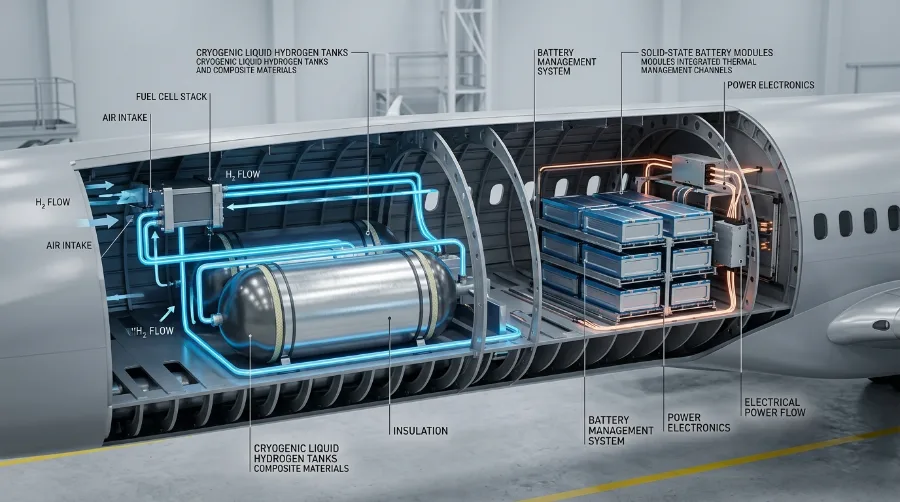
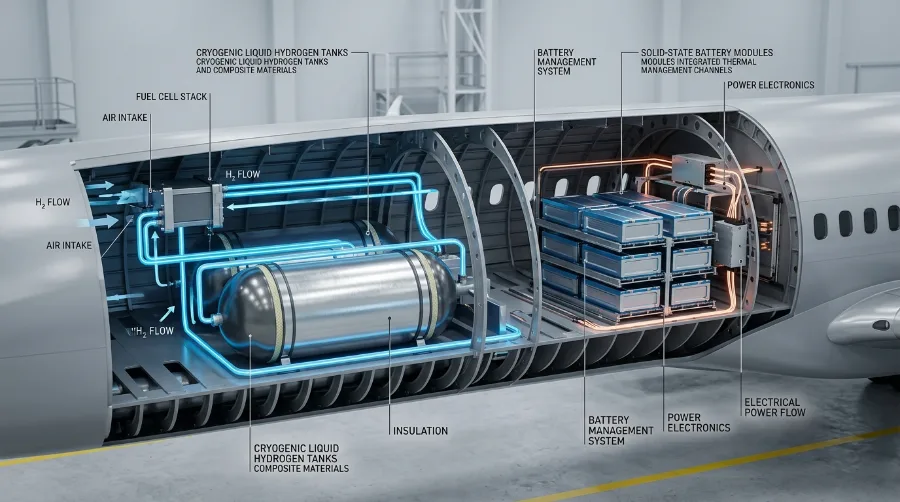
Molecular hydrogen boasts an exceptional gravimetric energy density of approximately 33,300 Wh/kg (120 MJ/kg)—nearly three times that of jet fuel. Storage requires cryogenic liquefaction at -253°C (20 Kelvin), yielding a volumetric density of 2,360 Wh/L. Comparing Hydrogen Fuel Cells vs Solid-State Batteries in Aviation shows that hydrogen system-level energy densities land between 1,500 Wh/kg and 2,500 Wh/kg once cryogenic tanks and fuel cell balance-of-plant (BoP) are included.
3. Hydrogen Fuel Cells vs Solid-State Batteries in Aviation: Comparative Analysis
Evaluating Hydrogen Fuel Cells vs Solid-State Batteries in Aviation demands a head-to-head architectural analysis across critical operational parameters.
| Parameter | Solid-State Batteries (SSB) | PEM Hydrogen Fuel Cells (LH2) | Conventional Jet A-1 (Baseline) |
|---|---|---|---|
| Cell / Fuel Energy Density | 450 – 550 Wh/kg | 33,300 Wh/kg (Pure H2) | 11,900 Wh/kg |
| System Pack Energy Density | 350 – 400 Wh/kg | 1,500 – 2,500 Wh/kg (Incl. Tank) | 9,800 Wh/kg (System level) |
| Volumetric Density (System) | 800 – 1,100 Wh/L | 800 – 1,200 Wh/L | 9,500 Wh/L |
| Powertrain Conversion Efficiency | 85% – 92% (Tank-to-Wheel) | 50% – 60% (Fuel Cell-to-Shaft) | 35% – 40% (Thermal Turbine) |
| Well-to-Wake Energy Efficiency | 70% – 75% | 25% – 35% (via Electrolysis) | 80% – 85% (Fossil Extracted) |
| Optimal Aircraft Payload / Range | Urban Mobility / Commuter (<400 km) | Regional Commuter (400–2,000 km) | Long-Haul Intercontinental (>5,000 km) |
| Refueling / Recharging Latency | 30 – 45 mins (Megawatt Charger) | 15 – 25 mins (Cryogenic Dispensing) | 15 – 20 mins |
| Non-CO2 Atmospheric Impacts | Absolute Zero | Water Vapor Emission (Contrail Risk) | High NOx, Soot, and Contrails |
Studies examining Hydrogen Fuel Cells vs Solid-State Batteries in Aviation show that while batteries yield unmatched turnaround efficiency, fuel cells win on range scalability.
4. Proton Exchange Membrane Fuel Cells (PEMFC) & Cryogenic Storage
Implementing fuel cell technology in commercial aircraft architecture requires scaling Proton Exchange Membrane Fuel Cells (PEMFC) or High-Temperature PEMFCs (HT-PEMFC) to multimegawatt outputs while reducing stack mass.
Electrochemical Conversion Dynamics
PEMFCs generate electrical energy by splitting gaseous hydrogen at the anode into protons and electrons. Protons migrate across a solid polymer membrane (typically perfluorosulfonic acid / Nafion) to the cathode, while electrons flow through an external load circuit to power electric propulsors. Analyzing Hydrogen Fuel Cells vs Solid-State Batteries in Aviation highlights that fuel cell stack power density must reach 3.0 to 4.0 kW/kg to remain competitive.
Anode: 2H2 → 4H+ + 4e– | Cathode: O2 + 4H+ + 4e– → 2H2O
Cryogenic Storage and Airframe Thermal Management
Integrating liquid hydrogen tanks poses severe aerodynamic design challenges. Research into Hydrogen Fuel Cells vs Solid-State Batteries in Aviation indicates that LH2 tanks require four times the volume of kerosene per unit of energy, forcing non-integral cryogenic pressure vessels to be housed within the fuselage.
- Vacuum-Insulated Pressure Vessels: Tanks utilize double-walled carbon-fiber-reinforced polymer (CFRP) structures with multi-layer vacuum insulation (MLI) to maintain thermal stability at -253°C.
- Thermal Heat Sinks: Cold energy extracted from liquid hydrogen during re-vaporization cools high-power electric motors and electronics.
5. Advanced Solid-State Electrochemistry and Thermal Runaway Safety
Solid-state batteries represent the technological evolution of lithium chemistry, engineered to eliminate volatile liquid organic solvents and drastically enhance safety metrics under extreme aerospace conditions.
Solid Electrolyte Formulations
Solid-state chemistry replaces conventional separator-liquid systems with solid ion-conducting membranes categorized into three main chemical families:
- Sulfide-Based Electrolytes (e.g., Li10GeP2S12): Offer exceptional ionic conductivity at room temperature (~10-2 S/cm).
- Oxide-Based Ceramics (e.g., Garnet-type LLZO): Highly chemically stable and non-flammable up to 1,000°C.
- Polymer Composites (PEO-based): Provide flexible mechanical compliance and simple processing.
Engineers analyzing Hydrogen Fuel Cells vs Solid-State Batteries in Aviation note that solid electrolytes elevate thermal degradation thresholds beyond 500°C, completely eliminating catastrophic cell fires.
6. Infrastructure Logistics: LH2 Refueling vs Megawatt Charging Systems (MCS)
Deploying clean aircraft at scale requires complete overhauls of airport ground support equipment, fuel delivery networks, and electrical power grid connections. Comparing Hydrogen Fuel Cells vs Solid-State Batteries in Aviation reveals vast differences in ground infrastructure demands.
Megawatt Charging System (MCS) for Battery Fleets
Operating battery-electric aircraft on rapid commercial turnaround cycles demands charging architectures exceeding historical terrestrial standards:
- Voltage & Current Targets: MCS charging stations operate at up to 1,250 Volts and continuous current rates up to 3,000 Amperes, delivering peak power rates of 3.75 MW per single connector.
- Grid Infrastructure Stress: Charging a regional fleet of ten 30-passenger battery-electric aircraft simultaneously requires over 40 MW of dedicated grid capacity.
Cryogenic Liquid Hydrogen Fuel Infrastructure
Refueling hydrogen fuel cell aircraft presents unique fluid dynamics challenges. Dispensing LH2 at rates exceeding 100 kg/min requires automated, vacuum-jacketed dry-break couplers equipped with helium purging systems to prevent atmospheric moisture freeze-out.
7. Techno-Economic Analysis (TEA) & Levelized Cost of Flying (LCOF)
The operational adoption of clean aircraft will ultimately be determined by total economics: balancing initial capital expenditure (CAPEX) against ongoing maintenance, electricity, and fuel operating expenses (OPEX).
Financial models reviewing Hydrogen Fuel Cells vs Solid-State Batteries in Aviation evaluate total expenditure per Available Seat Kilometer (ASK):
LCOF = (CAPEXAircraft + Sum[OPEXEnergy + Maintenance + Replacements]) / Total Seat-Kilometers
- Energy Conversion Efficiency: Battery-electric systems convert green electricity to propulsive thrust at an overall Well-to-Wake efficiency of 70%–75%. Liquid hydrogen systems yield a net efficiency of 25%–35%, requiring nearly three times as much renewable electricity input per flight hour.
- Powertrain Maintenance Lifecycle: When assessing Hydrogen Fuel Cells vs Solid-State Batteries in Aviation, fuel cell stacks require re-stacking after 5,000–10,000 operational hours, whereas solid-state batteries are engineered for 2,000 to 4,000 deep discharge cycles.
8. Regulatory Frameworks: FAA Part 25 & EASA Special Conditions
Commercial entry into service requires absolute compliance with established airworthiness regulations. When certifying Hydrogen Fuel Cells vs Solid-State Batteries in Aviation, the Federal Aviation Administration (FAA) and European Union Aviation Safety Agency (EASA) mandate rigorous safety thresholds.
EASA SC-VTOL & SC-E19
Under EASA’s Special Condition frameworks, electric propulsion units and high-voltage energy storage systems must demonstrate catastrophic failure rates below 10-9 failures per flight hour for transport-category commercial service.
FAA Advisory Circulars for Cryogenic Systems
Hydrogen integration expands existing FAA Part 25 specifications to address material embrittlement and uncontained boil-off gas venting during ground delays.
9. Strategic Roadmap (2026–2050)
Understanding Hydrogen Fuel Cells vs Solid-State Batteries in Aviation allows industry analysts to map out clean flight adoption across distinct commercial phases:
- Phase 1 (2026 – 2032) | Commuter Aviation: Solid-state batteries (400–500 Wh/kg) will dominate 4 to 19-passenger regional commuter routes under 400 kilometers (250 miles).
- Phase 2 (2032 – 2040) | Regional Turboprops: Liquid hydrogen fuel cells will become the primary architecture for 40 to 80-passenger regional aircraft operating routes between 400 and 1,800 kilometers.
- Phase 3 (2040 – 2050+) | Long-Haul Aviation: In the long-term roadmap for Hydrogen Fuel Cells vs Solid-State Batteries in Aviation, narrowbody jets will rely on direct hydrogen combustion turbofans with solid-state batteries powering auxiliary systems.
Ultimately, analyzing Hydrogen Fuel Cells vs Solid-State Batteries in Aviation proves that both technologies are complementary rather than mutually exclusive in achieving net-zero flight.
10. Flight Programs and Milestones (2024–2026)
The debate over Hydrogen Fuel Cells vs Solid-State Batteries in Aviation is no longer confined to laboratories. On the hydrogen side, ZeroAvia has flown its 600 kW fuel cell powertrain on a Dornier 228 testbed and holds pre-orders for ZA600 conversions targeting certification late this decade, while H2FLY completed the world's first piloted flight powered by liquid hydrogen in its HY4 demonstrator, cutting tank mass roughly in half versus gaseous storage. Airbus continues cryogenic tank and fuel cell nacelle testing under its ZEROe programme, though it pushed its hydrogen airliner target beyond 2035, citing infrastructure and certification timelines.
On the battery side, Eviation's Alice and several eVTOL developers including Joby and Archer fly today on high-density lithium-ion packs, with solid-state cells sampling from suppliers such as QuantumScape, Solid Power and Factorial at the 400+ Wh/kg level the sector has waited for. Regional operators have signed conditional orders for 19–30 seat battery-electric aircraft, betting that cell energy density improves roughly 5–8% per year through 2030.
The scoreboard so far matches the physics: batteries win the sub-500 km missions on simplicity and efficiency, hydrogen wins range — and both camps quietly hedge by designing airframes that can swap energy systems as the technologies mature.
11. Climate Accounting Beyond the Tailpipe
Zero carbon at the exhaust does not mean zero climate impact. Hydrogen combustion and fuel cells emit water vapour at altitude, and water vapour can form contrails; early modelling suggests hydrogen contrails may be optically thinner yet more frequent than kerosene ones — a trade-off we analyse in our guide to aviation non-CO2 effects and the emerging practice of contrail avoidance. Battery-electric aircraft sidestep contrails entirely but inherit the carbon intensity of the grid that charges them and the upstream footprint of cell manufacturing.
Policy will referee this accounting. Flights inside Europe already pay for CO2 under the EU ETS, and since 2025 airlines must report non-CO2 effects per flight — data that will eventually differentiate a hydrogen aircraft's contrail profile from a kerosene one's. Until zero-emission platforms scale, the interim decarbonisation burden falls on mandated sustainable aviation fuel in the existing fleet.
Investors and fleet planners weighing Hydrogen Fuel Cells vs Solid-State Batteries in Aviation should treat the two technologies as complementary rather than competing bets. The commuter segment rewards battery simplicity today; the regional segment rewards hydrogen energy density tomorrow. Airlines that structure orders, maintenance contracts and airport infrastructure with both pathways in mind preserve optionality while certification timelines settle — and this comparison will be re-run every few years as cell chemistry, electrolyser costs and hydrogen logistics all move.
Related guides: Why Commercial Aviation Timelines Are Shifting Toward Hydrogen Fuel Cells, Can Hydrogen Fuel Cells Eliminate Carbon Emissions in Heavy Trucks? and How Do Electric Aircraft Motors Compare to Hydrogen Fuel Cells?.
For the full picture of where these power systems fly today — from certified trainers to commercial air taxis — see our complete electric aircraft guide.
For the full industry picture — programmes, infrastructure, green hydrogen supply, and timelines to 2040 — see our complete guide to hydrogen aviation.
How these cells compare against today’s lithium-ion packs in EVs: our solid state battery vs lithium-ion guide.
Frequently Asked Questions
Which is better for aviation: hydrogen fuel cells or solid-state batteries?
Neither wins outright. Solid-state batteries suit commuter and regional routes under roughly 500 km thanks to superior round-trip efficiency and simpler systems, while hydrogen fuel cells carry far more energy per kilogram and become the practical choice for 40–80 seat regional aircraft flying 400–1,800 km.
What energy density do solid-state batteries need for aviation?
Roughly 400–500 Wh/kg at pack level makes 19-seat commuter aircraft viable on short routes. Current aviation-grade lithium-ion sits near 250–300 Wh/kg; leading solid-state cells are sampling at 400+ Wh/kg with production scaling expected through 2030.
Why is liquid hydrogen preferred over compressed hydrogen for aircraft?
Liquid hydrogen at −253°C roughly doubles the stored energy per unit tank mass versus 700-bar compressed gas, which is decisive on aircraft where every kilogram of structure displaces payload. The price is cryogenic complexity: vacuum-insulated tanks, boil-off management and specialised refuelling.
When will hydrogen or battery-electric airliners enter service?
Battery-electric commuter aircraft (9–19 seats) are expected in commercial service in the late 2020s. Hydrogen fuel cell regional aircraft target the early-to-mid 2030s, and larger hydrogen airliners are unlikely before 2035–2040.
Do hydrogen aircraft produce contrails?
Yes — hydrogen powertrains emit two to three times more water vapour per unit energy than kerosene. Their contrails are expected to be thinner but potentially more frequent, which is why contrail avoidance routing is likely to matter even in a zero-carbon fleet.
Strategic References & Academic Citations
- Analyze international transportation decarbonization strategies at ZeroCarbonDrive.
- Read our technical analysis on Electric Aircraft Battery Technology to review cell chemistry metrics.
- Examine operational emissions data in our analysis of Diesel vs Electric Emissions.
- Review international aviation environmental targets via the International Civil Aviation Organization (ICAO).
- Access US airworthiness certification requirements at the Federal Aviation Administration (FAA).
- Track European clean aviation technology developments via the European Union Aviation Safety Agency (EASA).
- Review hydrogen propulsion research at the National Aeronautics and Space Administration (NASA).
Every figure on this page is dated and linked to its source. How we verify · Editorial policy · Report a correction
Related Posts


Leave a Comment
Your comment will be published after it has been approved. Please send comments that do not contain slang words.