
EV vs Gas Car Cost (2026): The Same Car, Both Ways

Updated September 18, 2026 · 8 min read
Last updated: 10 September 2026. Vehicle figures are the EPA model-year 2026 file; electricity and petrol prices are pulled live from EIA on the day this page was last built.
Comparing an electric car with a petrol car usually means comparing two different vehicles. It does not have to: a dozen 2026 models are sold in both forms, and in every one of those pairs the electric version costs substantially less to fuel at current US average prices — typically less than half. The fuel gap is the part of the comparison that is measurable and citable; purchase price, insurance and depreciation vary too much between individual deals to be settled by a table.
Key takeaways
- Compare the same nameplate. An Equinox EV against an Equinox removes every difference except the powertrain.
- At current US average prices, home charging costs roughly half what petrol costs per mile, and often much less.
- EPA publishes its own annual fuel cost and five-year saving for every vehicle; both are on this page next to our live-price figures.
- The gap tracks how much fuel the combustion version uses: a 17 mpg muscle car or pickup saves far more per year than a 27 mpg crossover.
- This page compares fuel only, model by model. Purchase price, insurance and depreciation are not included, because no citable 2026 source covers them for every model — for the wider decision, see our overall EV versus petrol comparison.
Which 2026 cars are sold as both an EV and a petrol car?
More than most people realise. The EPA’s model-year 2026 file contains the same nameplate in both forms for a range of vehicles: mainstream crossovers, a full-size pickup, a muscle car and several premium models. That makes a fair comparison possible, because everything except the powertrain is held roughly constant — the same body, the same size, the same class of buyer.
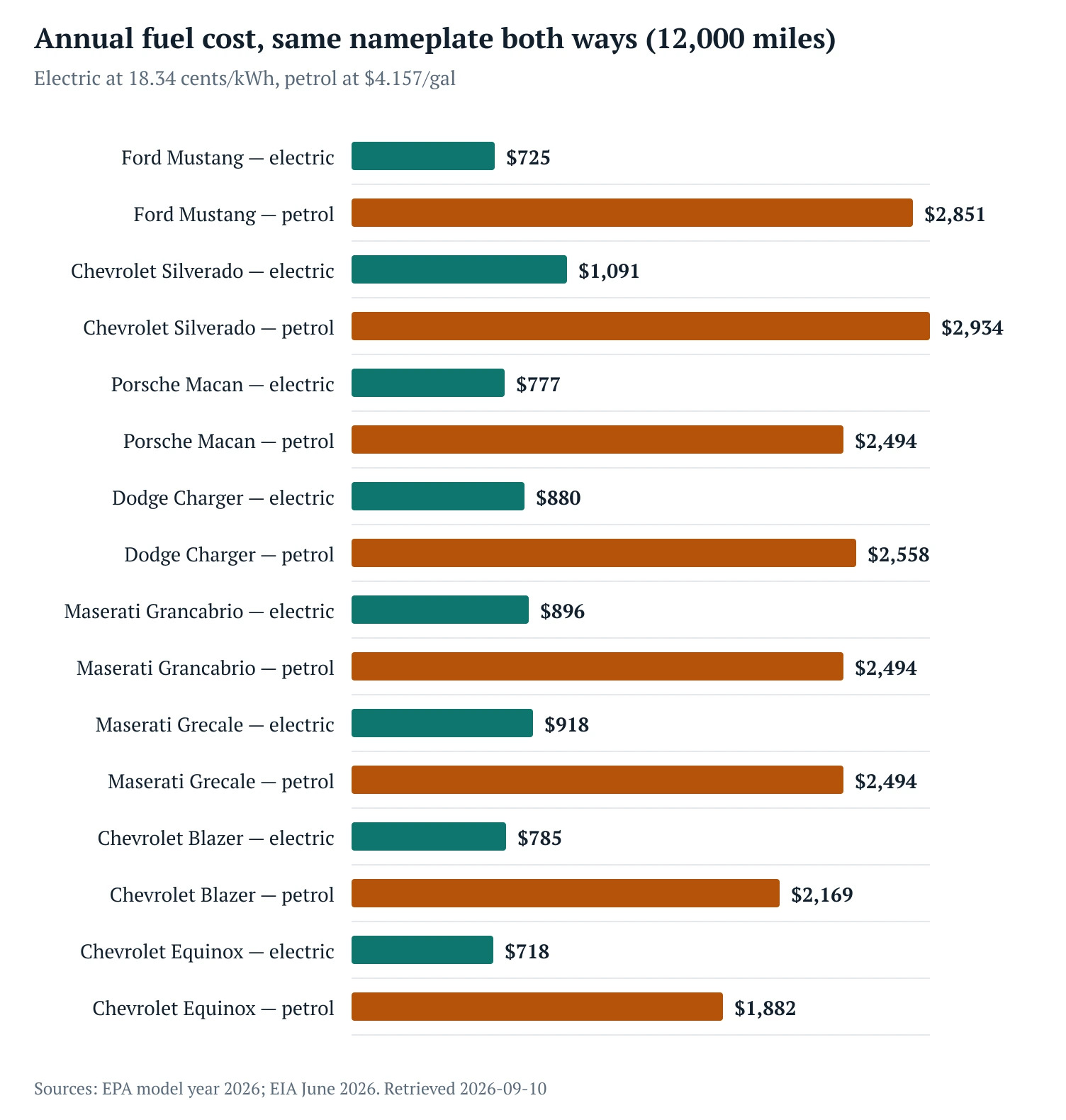
The table below pairs them. For each nameplate it takes the median rated efficiency of the electric versions and the median of the petrol versions, then prices 12,000 miles of driving at the current US average residential electricity price and the current US average price for regular petrol. Where the petrol counterpart is a hybrid rather than a conventional engine, the table says so, because that is a different comparison and it would be misleading to hide it.
| Model | Electric (kWh/100 mi) | Combustion (mpg) | Counterpart type | Electricity / year | Fuel / year | Difference |
|---|---|---|---|---|---|---|
| Ford Mustang | 32.9 | 17.5 | petrol | $725 | $2,851 | $2,125 |
| Chevrolet Silverado | 49.6 | 17.0 | petrol | $1,091 | $2,934 | $1,844 |
| Porsche Macan | 35.3 | 20.0 | petrol | $777 | $2,494 | $1,717 |
| Dodge Charger | 40.0 | 19.5 | petrol | $880 | $2,558 | $1,678 |
| Maserati Grancabrio | 40.7 | 20.0 | petrol | $896 | $2,494 | $1,598 |
| Maserati Grecale | 41.7 | 20.0 | petrol | $918 | $2,494 | $1,576 |
| Chevrolet Blazer | 35.7 | 23.0 | petrol | $785 | $2,169 | $1,383 |
| Chevrolet Equinox | 32.6 | 26.5 | petrol | $718 | $1,882 | $1,165 |
| MINI Countryman | 35.9 | 27.0 | petrol | $791 | $1,848 | $1,057 |
| Mercedes-Benz CLA250 | 29.0 | 29.5 | hybrid | $638 | $1,691 | $1,053 |
| Lexus ES | 28.8 | 45.0 | hybrid | $633 | $1,109 | $476 |
| Kia Niro | 30.0 | 51.0 | hybrid | $660 | $978 | $318 |
How big is the fuel-cost gap, model by model?
The chart shows annual fuel cost for each pair at 12,000 miles a year. Two things stand out. The gap is proportionally similar across most of the list, because it is driven by the price of energy rather than by the individual vehicle. And in absolute dollars the gap is biggest where the petrol version drinks the most — the full-size pickup saves more per year than the compact crossover, even though the electric pickup is itself the least efficient EV in the pair list.
That is the practical reading for anyone weighing this up: the case for switching is strongest for the vehicle you would otherwise buy in its thirstiest form, and weakest against an efficient hybrid.
What does the EPA itself say each car costs to run?
EPA publishes an estimated annual fuel cost for every vehicle it rates, and a five-year figure showing how much that vehicle saves or costs against the average new vehicle. Those figures use EPA’s own assumed fuel prices and its own assumed 15,000 miles a year, so they will not match the arithmetic above — but they come straight from the agency, and they are a useful second opinion on the same question.
The table below lists them for the electric side of each pair. Read them as EPA’s own published numbers rather than as a forecast of your bill; your mileage, your tariff and your local petrol price all move the real answer.
| Model | EPA annual fuel cost | EPA five-year saving vs the average new vehicle |
|---|---|---|
| Ford Mustang | $750 | $7,250 |
| Chevrolet Silverado | $1,100 | $5,500 |
| Porsche Macan | $800 | $7,000 |
| Dodge Charger | $900 | $6,500 |
| Maserati Grancabrio | $900 | $6,500 |
| Maserati Grecale | $950 | $6,250 |
| Chevrolet Blazer | $800 | $7,000 |
| Chevrolet Equinox | $750 | $7,250 |
| MINI Countryman | $825 | $6,875 |
| Mercedes-Benz CLA250 | $650 | $7,750 |
| Lexus ES | $650 | $7,750 |
| Kia Niro | $700 | $7,500 |
What does five years of fuel cost either way?
The calculator takes your annual mileage, the efficiency of each car you are choosing between, and the two fuel prices, and reports five-year totals. The default figures are the median 2026 electric vehicle against a 30 mpg petrol car at the prices EIA published this week.
If you cannot charge at home, change the electricity rate to your public network’s price and watch the answer move: that single input matters more to the comparison than the choice of car.
EV vs petrol five-year fuel cost
Two cars, your mileage, your prices. Fuel only — this does not include purchase price, insurance or depreciation.
Defaults: the median 2026 electric vehicle at 37.1 kWh/100 mi, the US average residential rate of 18.34 cents/kWh (EIA, June 2026) and US regular petrol at $4.157/gal (EIA, week of 09/07/26). If you cannot charge at home, replace the electricity rate with your public network’s price.
What this comparison leaves out, and why
Four things move the total cost of ownership and are not on this page: purchase price, insurance, maintenance and depreciation. Each is real and each can be larger than the fuel gap. None of them has a source for 2026 that covers every model in the table above, and this site does not publish figures it cannot cite. Where we have covered them with sourced data, the links below go there.
One structural point is worth making anyway. The federal purchase incentives that shaped this comparison for years are gone: the clean-vehicle credits ended on 30 September 2025 and the charging-equipment credit does not apply to property placed in service after 30 June 2026. Any comparison that still assumes $7,500 off the electric side is describing a market that no longer exists.
| Vehicle | Per year | Over five years |
|---|---|---|
| Median 2026 EV (37.1 kWh/100 mi), home charging | $817 | $4,085 |
| Petrol car at 40 mpg | $1,247 | $6,236 |
| Petrol car at 30 mpg | $1,663 | $8,314 |
| Petrol car at 20 mpg | $2,494 | $12,471 |
Does the comparison change if you cannot charge at home?
Substantially. Public DC fast charging is commercially priced and can cost several times the residential rate, which is enough to erase most of the fuel advantage. This is the single biggest reason the honest answer to “is an EV cheaper” is “it depends where you charge”, and it is why the calculator lets you set the electricity price yourself.
Is a hybrid the cheaper middle ground?
On fuel alone a good hybrid closes much of the gap: at 45 to 50 mpg the fuel bill approaches what an inefficient EV costs to charge at an expensive residential rate. The pairs table shows this directly, because several of the petrol counterparts in the 2026 file are hybrids rather than conventional engines.
Frequently asked questions
Is an EV really cheaper than a gas car?
On fuel, at home, almost always: at current US average prices home charging costs roughly half what petrol costs per mile for the same nameplate. On total cost it depends on purchase price, insurance and depreciation, which vary far too much between individual deals to be settled by a national average.
How much does it cost to fuel an EV for a year?
At the current US average residential electricity price, the median 2026 electric vehicle costs a few hundred dollars a year at 12,000 miles. The exact figure for each model in the comparison table is calculated on this page at the prices EIA published this week.
Which comparison is fair — Model 3 against Camry?
Not especially. Different size, different class, different price. The fair comparison is the same nameplate in both forms, and the 2026 model year offers a dozen of them, which is what the first table on this page uses.
Do EV tax credits still make the comparison better?
No. The federal clean-vehicle credits ended on 30 September 2025 and the 30C charging-property credit does not apply after 30 June 2026. State and utility programmes still exist, but any comparison assuming a $7,500 federal discount is out of date.
Does an EV cost less to maintain?
It has fewer serviceable parts — no oil changes, no exhaust, less brake wear thanks to regeneration — but tyres tend to wear faster on the heavier vehicle. This page does not put a number on it because there is no single citable source covering every model in the table; the linked maintenance guide covers what is measurable.
What if I charge mostly on public fast chargers?
Then the fuel advantage narrows sharply and can disappear. Public networks price commercially, often several times the residential rate. Put your own network price into the calculator on this page and the comparison will tell you the truth for your situation.
Sources
- US EPA / DOE fueleconomy.gov vehicle web service, model year 2026, retrieved 2026-09-06
- EIA Electric Power Monthly, Table 5.6.A, residential, U.S. total, June 2026, retrieved 2026-09-10
- EIA Gasoline and Diesel Fuel Update, U.S. regular, week of 09/07/26, retrieved 2026-09-10
- IRS — Alternative Fuel Vehicle Refueling Property Credit (30C), retrieved 2026-09-10
Related guides: the overall EV versus petrol comparison · what one mile costs to charge · EV efficiency ratings · EV maintenance costs · EV depreciation.
Every figure on this page is dated and linked to its source. How we verify · Editorial policy · Report a correction
Related Posts


Leave a Comment
Your comment will be published after it has been approved. Please send comments that do not contain slang words.