
EV vs Hybrid Cars (2026): Which Costs Less Per Mile, With EPA Data

Updated September 18, 2026 · 11 min read
Last updated: 6 September 2026. Every car figure below is the official EPA label value for model year 2026 from fueleconomy.gov’s public vehicle web service (1172 rated vehicles). Energy prices are U.S. averages from the Energy Information Administration: 18.34 cents per kWh for home electricity (June 2026) and $4.071 per gallon of regular gasoline (week of 31 August 2026). Nothing is estimated or manufacturer-claimed; plug in your own prices where they differ.
Quick answer: on energy alone, an EV vs hybrid comparison is not close. At U.S. average prices the median 2026 electric car (35.6 kWh per 100 miles) costs about $6.53 per 100 miles to charge at home, a typical full hybrid (the median of the 20 most efficient 2026 hybrids, 44 mpg) costs about $9.25 per 100 miles in gasoline, and the median non-hybrid gasoline car (22 mpg) costs about $18.50. A hybrid only matches the EV’s running cost if home electricity costs about 26 cents per kWh or more, which on EIA’s May 2026 state averages is true only in Hawaii, California, New York, Alaska and most of New England (see the state table).
A plug-in hybrid sits in between and depends almost entirely on how much of your driving fits inside its electric range (median for 2026: 30 miles). The tables below rank every 2026 hybrid, plug-in hybrid and EV from the same EPA dataset.
Key takeaways
- EV vs hybrid running cost at U.S. average prices: median EV $6.53 per 100 miles vs a typical full hybrid $9.25; the gap is $2.72 per 100 miles, or about $326.30 a year at 12,000 miles.
- The most efficient 2026 hybrid, the Toyota Prius, is rated 57 mpg; the most efficient EV, the Lucid Air, uses 23.1 kWh per 100 miles. Even so the hybrid costs more per mile at average prices.
- Plug-in hybrid vs hybrid: 3 of the 29 2026 plug-in hybrids have 40 miles or more of EPA electric range, enough to cover a typical commute without burning fuel; below that, most of your miles run on the engine.
- Hybrids win on price of entry, no charging needed and long trips without planning; EVs win on running cost, maintenance and home refuelling. Which matters more depends on where you park at night.
EV vs hybrid: what the two actually are
A hybrid (HEV) pairs a petrol engine with a small battery and motor that recover braking energy and let the engine run at its most efficient point. It never plugs in; every mile is ultimately paid for in gasoline, just fewer gallons of it. A plug-in hybrid (PHEV) adds a bigger battery, typically 10 to 25 kWh, that you charge from a socket; it drives electrically for a few dozen miles and then behaves like a hybrid. A battery electric car (EV) has no engine at all. EPA rates each of them on the same laboratory cycles, which is why one dataset can compare all three.
The distinction matters because “hybrid” is used loosely in showrooms. EPA’s hybrid flag covers both mild hybrids (a 48-volt starter-generator that adds a few mpg to an otherwise conventional car) and full hybrids like a Prius or a RAV4 Hybrid, which can drive on the motor alone. The ranking below sorts them out by result rather than by marketing: the full hybrids sit at the top, the mild ones at the bottom. The dataset holds 140 hybrid, 29 plug-in hybrid and 128 electric models for model year 2026.
EV vs hybrid cost per 100 miles: hybrid, plug-in hybrid and EV compared
The cleanest comparison is energy cost per 100 miles at the same national average prices, using the median model of each type. Your numbers move with your local electricity rate (the EV charging cost by state table has all 50) and your local pump price.
| Powertrain (2026 median model) | EPA efficiency | Energy per 100 mi | Cost per 100 mi | Cost per year (12,000 mi) |
|---|---|---|---|---|
| Gasoline car (non-hybrid) | 22 mpg | 4.55 gal | $18.50 | $2,220.55 |
| Full hybrid (median of the top 20) | 44 mpg | 2.27 gal | $9.25 | $1,110.27 |
| All EPA-flagged hybrids incl. mild hybrids (median) | 25 mpg | 4.00 gal | $16.28 | $1,954.08 |
| Plug-in hybrid, engine mode | 24 mpg | 4.17 gal | $16.96 | $2,035.50 |
| Plug-in hybrid, electric mode | 56 kWh/100 mi | 56 kWh | $10.27 | $1,232.45 |
| Electric car | 35.6 kWh/100 mi | 35.6 kWh | $6.53 | $783.97 |
Two break-even numbers make the EV vs hybrid table portable. The median EV costs the same per mile as the median hybrid when home electricity reaches about 26 cents per kWh; below that the EV is cheaper to run. Seen from the other side, the hybrid matches the EV when regular gasoline falls to about $2.87 a gallon. In September 2026 the U.S. averages are 18.3 cents and $4.07, so the EV leads on running cost in most states, and loses only where power is unusually expensive or fuel unusually cheap.
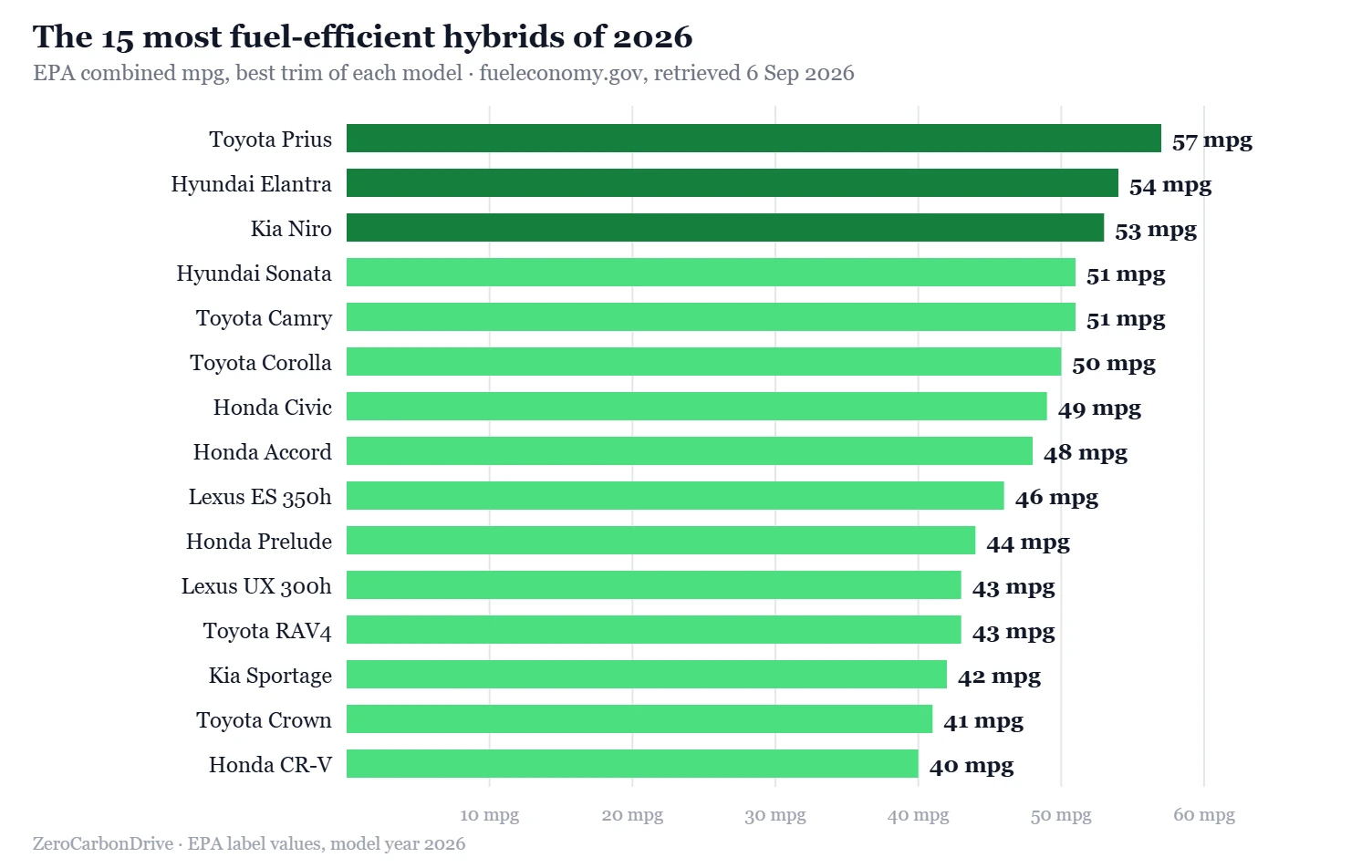
The most efficient hybrids of 2026
One row per model, using the trim with the highest EPA combined mpg. Cost per 100 miles uses the same regular-gasoline price as above; cars that require premium fuel will cost a little more.
| # | Hybrid (best-mpg trim) | EPA combined mpg | Cost per 100 mi | CO2 g/mi (tailpipe) |
|---|---|---|---|---|
| 1 | Toyota Prius Prius | 57 | $7.14 | 155 |
| 2 | Hyundai Elantra Elantra Hybrid Blue | 54 | $7.54 | 165 |
| 3 | Kia Niro Niro FE | 53 | $7.68 | 167 |
| 4 | Hyundai Sonata Sonata Hybrid Blue | 51 | $7.98 | 175 |
| 5 | Toyota Camry Camry HEV FF LE | 51 | $7.98 | 173 |
| 6 | Toyota Corolla Corolla Hybrid | 50 | $8.14 | 176 |
| 7 | Honda Civic Civic 4Dr | 49 | $8.31 | 181 |
| 8 | Honda Accord Accord Hybrid | 48 | $8.48 | 184 |
| 9 | Lexus ES 350h ES 350h | 46 | $8.85 | 191 |
| 10 | Honda Prelude Prelude | 44 | $9.25 | 203 |
| 11 | Lexus UX 300h UX 300h | 43 | $9.47 | 204 |
| 12 | Toyota RAV4 RAV4 | 43 | $9.47 | 205 |
| 13 | Kia Sportage Sportage Hybrid FWD | 42 | $9.69 | 209 |
| 14 | Toyota Crown Crown Hybrid AWD | 41 | $9.93 | 214 |
| 15 | Honda CR-V CR-V FWD | 40 | $10.18 | 223 |
| 16 | Lexus NX 350h NX 350h | 40 | $10.18 | 220 |
| 17 | Ford Escape Escape AWD HEV | 39 | $10.44 | 225 |
| 18 | Ford Maverick Maverick HEV FWD | 38 | $10.71 | 234 |
| 19 | Hyundai Tucson Tucson Hybrid Blue | 38 | $10.71 | 234 |
| 20 | Mazda CX-50 CX-50 4WD | 38 | $10.71 | 233 |
Plug-in hybrid vs hybrid: which one is worth it?
A plug-in hybrid is two cars in one, and it is only better than a plain hybrid if you use the first one. Charged every night and driven inside its electric range, a PHEV runs on electricity at roughly EV cost ($10.27 per 100 miles for the median 2026 PHEV) and burns no fuel at all. Driven without charging, it is a heavier, more expensive hybrid: the median 2026 PHEV is rated 24 mpg on its engine against 44 mpg for a typical full hybrid, because it is carrying a battery it is not using.
So the deciding number is your daily distance against the car’s EPA electric range. EPA’s own “utility factor” estimates the share of miles a typical driver would cover electrically for a given range; for a 40-mile PHEV it is a little over half, for a 20-mile PHEV closer to a third. If you can charge at home or at work and most days are shorter than the electric range, the plug-in hybrid vs hybrid question answers itself in the PHEV’s favour. If you cannot charge, buy the hybrid and keep the difference.
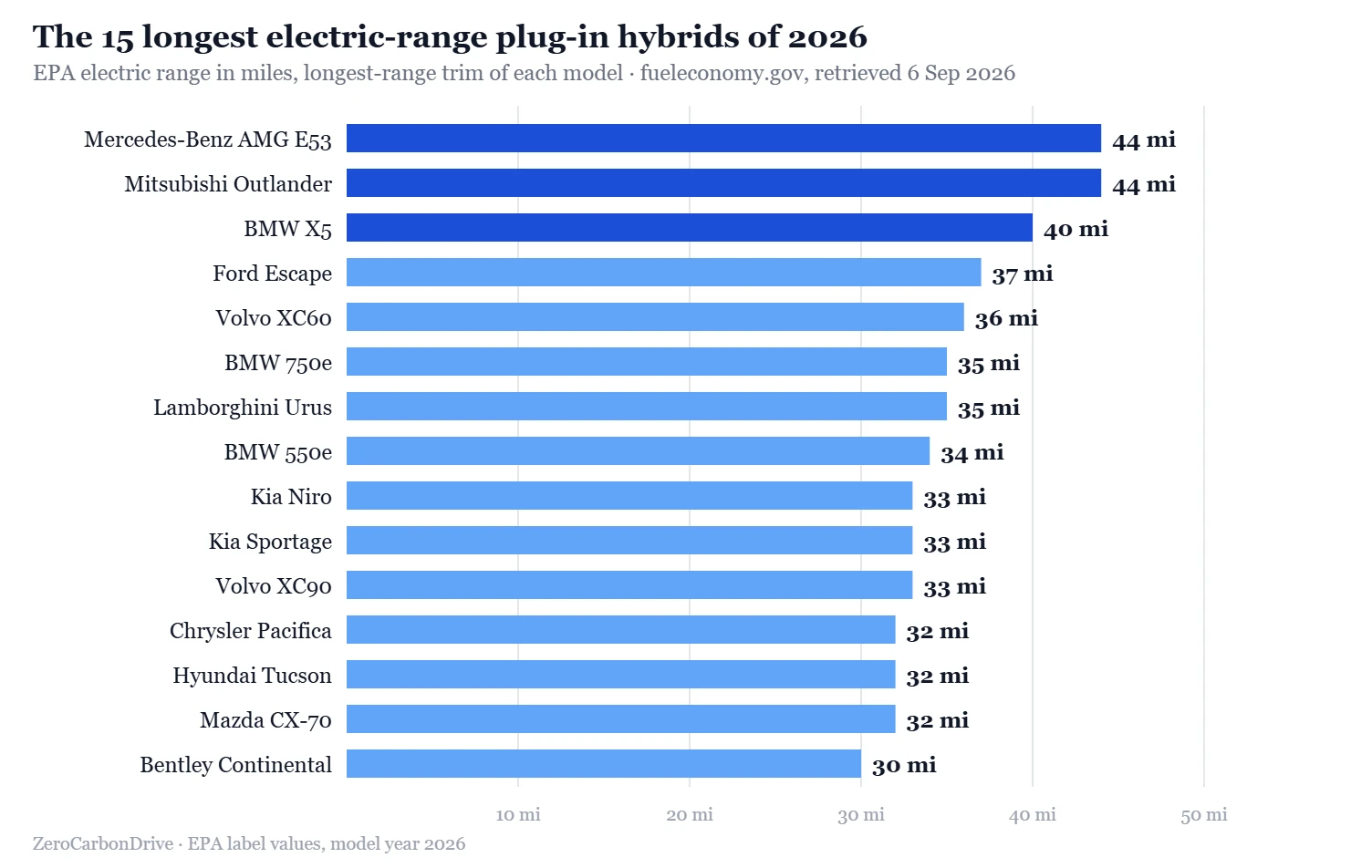
| # | Plug-in hybrid (longest-range trim) | EPA electric range (mi) | Electric mode kWh/100 mi | Engine mode mpg | EPA utility factor |
|---|---|---|---|---|---|
| 1 | Mercedes-Benz AMG E53 AMG E53 Hybrid 4matic Plus | 44 | 56 | 24 | 71% |
| 2 | Mitsubishi Outlander Outlander PHEV | 44 | 47 | 27 | 71% |
| 3 | BMW X5 X5 xDrive50e | 40 | 56 | 22 | 68% |
| 4 | Ford Escape Escape FWD PHEV | 37 | 33 | 40 | 66% |
| 5 | Volvo XC60 XC60 T8 AWD | 36 | 50 | 28 | 64% |
| 6 | BMW 750e 750e xDrive Sedan | 35 | 48 | 24 | 64% |
| 7 | Lamborghini Urus Urus SE | 35 | 70 | 20 | 64% |
| 8 | BMW 550e 550e xDrive Sedan | 34 | 49 | 25 | 63% |
| 9 | Kia Niro Niro Plug-in Hybrid | 33 | 31 | 48 | 62% |
| 10 | Kia Sportage Sportage Plug-in Hybrid | 33 | 43 | 36 | 61% |
| 11 | Volvo XC90 XC90 T8 AWD | 33 | 55 | 27 | 61% |
| 12 | Chrysler Pacifica Pacifica Hybrid | 32 | 41 | 30 | 61% |
| 13 | Hyundai Tucson Tucson Plug-in Hybrid | 32 | 44 | 35 | 60% |
| 14 | Mazda CX-70 CX-70 SC 4WD | 32 | 54 | 26 | 61% |
| 15 | Bentley Continental Continental GT | 30 | 64 | 19 | 67% |
| 16 | Bentley Flying Spur Flying Spur | 30 | 64 | 19 | 67% |
| 17 | BMW XM XM Label | 30 | 72 | 14 | 59% |
| 18 | Kia Sorento Sorento Plug-in Hybrid | 30 | 45 | 33 | 59% |
| 19 | BMW M5 M5 Sedan | 29 | 55 | 14 | 58% |
| 20 | Lincoln Corsair Corsair AWD PHEV | 27 | 44 | 33 | 55% |
Same car, three powertrains: what the hybrid version actually saves
Several 2026 nameplates are sold as a gasoline car, a hybrid and sometimes a plug-in hybrid, which makes them the cleanest EV vs hybrid test case short of an electric version. Comparing within one nameplate removes size and body-style effects and shows what the hybrid hardware itself buys you.
| Nameplate | Gasoline version | Hybrid version | Plug-in version | Hybrid saves per year (12,000 mi) |
|---|---|---|---|---|
| Hyundai Elantra | 31 mpg · $13.13 | 54 mpg · $7.54 | — | $671.20 |
| Hyundai Sonata | 32 mpg · $12.72 | 51 mpg · $7.98 | — | $568.74 |
| Honda Accord | 32 mpg · $12.72 | 48 mpg · $8.48 | — | $508.87 |
| Toyota Corolla | 35 mpg · $11.63 | 50 mpg · $8.14 | — | $418.73 |
| Kia Sportage | 28 mpg · $14.54 | 42 mpg · $9.69 | 33 mi electric · $7.89/100 mi on battery | $581.57 |
| Hyundai Palisade | 21 mpg · $19.39 | 34 mpg · $11.97 | — | $889.46 |
| Hyundai Santa Fe | 24 mpg · $16.96 | 36 mpg · $11.31 | — | $678.50 |
| Toyota Grand Highlander | 24 mpg · $16.96 | 36 mpg · $11.31 | — | $678.50 |
| Kia Sorento | 26 mpg · $15.66 | 37 mpg · $11.00 | 30 mi electric · $8.25/100 mi on battery | $558.60 |
| Toyota Highlander | 24 mpg · $16.96 | 35 mpg · $11.63 | — | $639.73 |
| Kia Carnival | 21 mpg · $19.39 | 32 mpg · $12.72 | — | $799.66 |
| Hyundai Tucson | 28 mpg · $14.54 | 38 mpg · $10.71 | 32 mi electric · $8.07/100 mi on battery | $459.14 |
| Subaru Crosstrek | 29 mpg · $14.04 | 36 mpg · $11.31 | — | $327.55 |
| Subaru Forester | 29 mpg · $14.04 | 35 mpg · $11.63 | — | $288.78 |
| Toyota Tundra | 20 mpg · $20.35 | 22 mpg · $18.50 | — | $222.05 |
Three drivers, three answers
The EV vs hybrid choice follows from three facts: where you park, how far you drive on a normal day, and how often you drive far. Here is the arithmetic for three typical cases, all at national average prices and 12,000 miles a year.
1. Home charger, 30-mile commute. Every mile can be charged at home overnight. EV: $783.97 a year in electricity. Hybrid at 44 mpg: $1,110.27 in fuel. The EV saves about $326.30 a year on energy before maintenance, and a home charger pays for itself within a few years on that saving alone.
2. Home charger, but one 300-mile trip a month. A plug-in hybrid charged nightly covers roughly 55% of miles electrically (EPA utility factor for a 30-to-40-mile range) and the rest on its engine. For the median 2026 PHEV (56 kWh per 100 miles electric, 24 mpg on the engine) that is about $1,593.82 a year, more than the hybrid, because the median plug-in is a heavy luxury car with a thirsty engine. A compact one changes the answer: the Kia Niro (31 kWh per 100 miles, 48 mpg) comes in near $833.22. The EV costs $783.97 but needs a charging stop on each trip; our EV road trip calculator shows how long. The hybrid costs $1,110.27 and never plans a stop. The PHEV is the compromise if the trips genuinely bother you and you pick an efficient one; if they do not, the EV still wins.
3. Street parking, no charger. The EV would depend on public fast charging at around 45 cents per kWh, which puts it at about $16.03 per 100 miles, above the hybrid’s $9.25. Here the hybrid is the honest recommendation, and a plug-in hybrid you cannot plug in is the worst of the three. Our apartment EV charging guide covers the workplace and right-to-charge routes that change this answer.
Beyond energy: what else separates an EV from a hybrid
| Factor | Hybrid | Plug-in hybrid | Electric car |
|---|---|---|---|
| Refuelling | Any gas station, 5 minutes | Home charging plus gas stations | Home charging; public fast charging on trips |
| Maintenance | Engine service plus brake wear reduced by regeneration | Engine service, less often if driven electrically | No oil, plugs, belts or exhaust; tyres and cabin filters remain (EV maintenance cost) |
| Cold weather | Small mpg loss | Electric range drops, engine covers the gap | Range drops 20 to 35 percent in hard winter (EV driving range) |
| Federal purchase credit (2026) | None | None (30D ended 30 September 2025) | None (30D ended 30 September 2025); some state incentives remain |
| Resale | Strong | Mixed | Weaker so far; see EV depreciation rates |
| Tailpipe CO2 (EPA, median model) | 204 g/mi (median of the top 20 hybrids) | 159 g/mi in engine mode, 0 in electric mode | 0 g/mi; grid emissions vary by state |
If you are choosing between the two cheapest routes into electrification, the cheapest electric cars of 2026 list shows what an entry-level EV actually costs, and the longest range electric cars table shows how far each one goes on a charge.
These tables may be reproduced with a link to this page (CC BY 4.0). Data: U.S. EPA / DOE fueleconomy.gov vehicle web service and U.S. EIA, retrieved 6 September 2026.
EV vs hybrid: FAQ
Is an EV or a hybrid cheaper to run?
At U.S. average prices the median 2026 EV costs about $6.53 per 100 miles to charge at home and the median hybrid about $9.25 in gasoline, so the EV is cheaper by roughly $326.30 a year at 12,000 miles. The hybrid only matches it where home electricity costs about 26 cents per kWh or more, or where the EV depends on public fast charging.
Plug-in hybrid vs hybrid: which should I buy?
Buy the plug-in hybrid only if you can charge it almost every night and most of your days fit inside its EPA electric range (median 30 miles for 2026 models). Then it runs on electricity at about $10.27 per 100 miles. If you cannot charge, a plain hybrid is lighter, cheaper and rated 44 mpg against the median PHEV’s 24 mpg in engine mode.
What is the most fuel-efficient hybrid in 2026?
By EPA combined rating, the Toyota Prius at 57 mpg, followed by the Hyundai Elantra (54 mpg) and the Kia Niro (53 mpg).
Which plug-in hybrid has the longest electric range in 2026?
The Mercedes-Benz AMG E53, rated at 44 miles of EPA electric range, followed by the Mitsubishi Outlander (44 miles) and the BMW X5 (40 miles). 3 of the 29 2026 plug-in hybrids reach 40 miles or more.
Does a hybrid still make sense if I cannot charge at home?
Yes, and it is usually the better choice. An EV that relies on public fast charging at around 45 cents per kWh costs about $16.03 per 100 miles, more than the median hybrid’s $9.25. A plug-in hybrid you never plug in is the worst option of the three.
Where do these numbers come from?
Vehicle figures are EPA label values from the fueleconomy.gov vehicle web service (model year 2026, 1172 rated vehicles), retrieved on 6 September 2026. Prices are EIA U.S. averages: residential electricity 18.34 cents per kWh (June 2026) and regular gasoline $4.071 per gallon (31 August 2026). We refresh the page when EPA adds 2026 ratings and when prices move materially.
Sources
- fueleconomy.gov vehicle web service (U.S. EPA / DOE), model year 2026, retrieved 6 September 2026
- EIA Electric Power Monthly, Table 5.6.A, average residential price, U.S. total, June 2026
- EIA Gasoline and Diesel Fuel Update, U.S. regular, week of 31 August 2026
- Plug-in Hybrids and How Vehicles Are Tested, fueleconomy.gov
Related guides: hybrid car emissions · plug-in hybrid emissions · EV charging cost calculator · all calculators and reference tables.
Every figure on this page is dated and linked to its source. How we verify · Editorial policy · Report a correction
Related Posts
Leave a Comment
Your comment will be published after it has been approved. Please send comments that do not contain slang words.