
V2G Technology Explained: V2L, V2H and What Each One Costs
Updated September 18, 2026 · 6 min read
Last updated: 3 September 2026
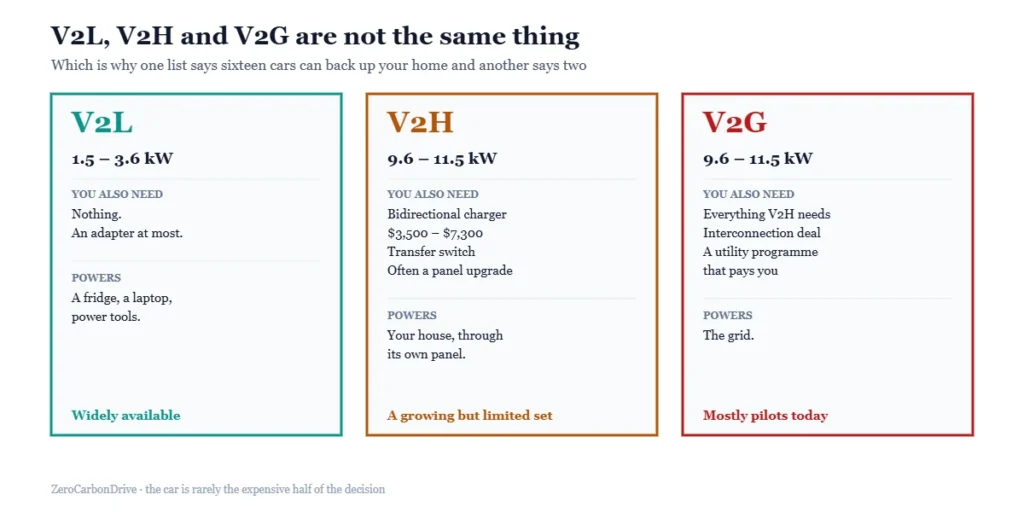
V2L, V2H and V2G are three different things, and almost every published list mixes them up. That is why you will find one page claiming sixteen cars can back up your home and another claiming two. Both can be accurate — they are counting different capabilities. V2G technology in the strict sense, selling power back to the grid, is still the rarest of the three.
Key takeaways
- V2L is a socket on the car, roughly 1.5-3.6 kW. It runs a fridge or power tools. No home hardware, no permits, no utility involvement.
- V2H feeds your home’s electrical panel at around 9.6-11.5 kW. It needs a bidirectional charger, a transfer switch and often a panel upgrade.
- V2G technology lets the utility draw from your battery. It needs all of the V2H hardware plus a utility programme you are eligible to join.
- The car is rarely the bottleneck. The bidirectional charger alone typically runs $3,500 to $7,300 before installation.
- Manufacturer announcements often describe capability the hardware to use has not shipped yet. Buying on a press release is how people end up waiting years.
The three terms, precisely
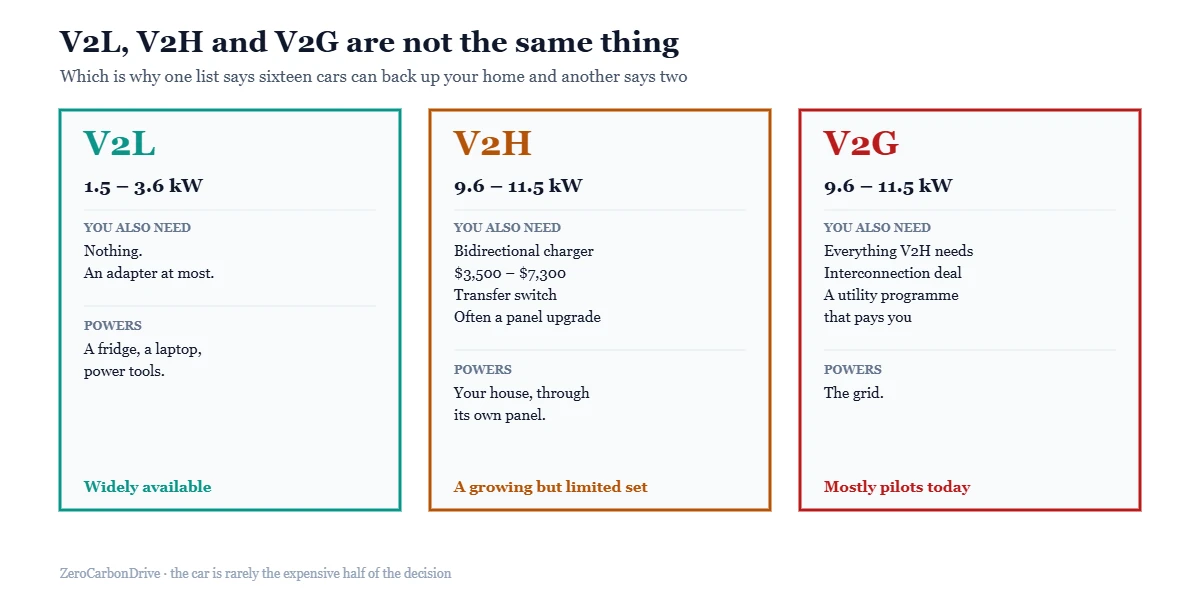
| V2L | V2H | V2G | |
|---|---|---|---|
| What it powers | Individual appliances plugged into the car | Your house, through its own panel | The grid |
| Typical power | 1.5-3.6 kW | 9.6-11.5 kW | 9.6-11.5 kW |
| Home hardware needed | None — an adapter at most | Bidirectional charger, transfer switch, often a panel upgrade | Everything V2H needs |
| Anyone else involved? | No | An electrician and your permitting authority | Also your utility, and a programme you qualify for |
| Realistically available today | Widely | On a growing but limited set of cars | Rarely, and mostly through pilots |
Why the model counts disagree so wildly
Search this subject and you will meet flatly contradictory numbers. One widely shared list says sixteen US models support whole-home backup across nine brands. Another states that as of February 2026 there were fifty-four models with V2L and only two with official V2G or V2H capability.
Neither is necessarily lying. They are counting different things:
- Count every car with a socket you can plug a kettle into and you get a large number, because V2L is nearly standard on some platforms.
- Count only cars where the manufacturer formally supports powering a house, with its own hardware and no warranty argument, and the number collapses.
- Count cars enrolled in a live utility programme that pays you to export, and it collapses further still.
So the useful question is never “does this car have bidirectional charging”. It is “which of the three, with whose hardware, and is that hardware actually on sale”. Ask it that way and the marketing claims sort themselves out quickly.
What powering your home actually costs
This is the part the capability lists leave out. The car is usually not the expensive half. A bidirectional charger typically runs $3,500 to $7,300 before installation, and you will normally also need a transfer switch and, quite often, a service panel upgrade on top.
Set against that, a large truck battery is a genuinely serious backup source — a 131 kWh extended-range pack can carry a typical home for around three days. Whether that is worth five figures of hardware depends entirely on how often your power goes out. In a region with one brief outage a year, it is a hard case to make. Where storms take the grid down for days, the arithmetic changes completely.
Compare it honestly against a home battery or a generator before committing. An EV that has to leave for work is not available to power the house while it is gone.
Where the vehicles stand
Grouped by what the manufacturer actually supports rather than by what the brochure implies. Note how few reach the V2G technology tier compared with the V2L one.
| Capability | Examples, as of September 2026 |
|---|---|
| V2L, widely available | Hyundai and Kia E-GMP cars — Ioniq 5, Ioniq 6, EV6, EV9, Genesis GV60 — carry a 3.6 kW vehicle-to-load socket as standard. Many other models offer something similar. |
| V2H, manufacturer supported | Ford F-150 Lightning, through Intelligent Backup Power. GM’s Ultium vehicles paired with GM Energy hardware — Silverado EV, Sierra EV, Blazer EV, Equinox EV, Hummer EV and the electric Cadillacs. Volvo EX90. |
| Announced, hardware pending | Rivian R1T and R1S Gen 2 have announced V2H, waiting on Rivian’s own bidirectional charger. Toyota’s first bidirectional model is expected with the 2027 Highlander EV. |
| V2G, in practice | Mostly utility pilots rather than open programmes. BMW’s iX3 arriving in spring 2026 is built to the ISO 15118-20 standard that V2G needs; Toyota has been piloting V2G with Oncor in Texas. |
Treat any table like this, including ours, as perishable. Check the manufacturer’s current documentation for the exact model year and trim before you buy on the strength of it.
What V2G technology still needs before it pays you
Selling power back is the version people find most exciting and the one furthest from most driveways. Four things all have to line up, and any one of them missing stops it.
- A car that supports export, not just V2L, for your specific model year and trim.
- A bidirectional charger that speaks the right protocol. ISO 15118-20 is the standard the industry has converged on.
- An interconnection agreement with your utility, of the kind solar exporters need.
- A programme that actually pays, open to residential customers in your territory — which today usually means a pilot with limited places.
If you want the deployment side in more depth, we cover it in the V2G infrastructure guide, and the head-to-head framing in V2G vs V2H.
Related guides
- NACS adapters: what fits what — the connector question, which is separate from the direction of the flow.
- What charger installation actually costs — including the panel upgrade that V2H frequently forces.
- Utility EV charger rebates — worth checking before you pay for bidirectional hardware.
- How fast EVs lose value — relevant if you are buying a truck mainly as a backup battery.
Sources and caveats
- Power bands, hardware requirements and bidirectional charger costs are drawn from current vendor and installer documentation, checked 3 September 2026.
- The contradictory model counts quoted above come from two separate published round-ups current in 2026; we have reproduced them to show why they differ, not to endorse either.
- Vehicle capability changes by model year and trim. Confirm with the manufacturer before purchase — we have deliberately not published a definitive count, because any such count is out of date on publication.
Frequently asked questions
What is the difference between V2L, V2H and V2G?
V2L is a socket on the car delivering roughly 1.5-3.6 kW to appliances, needing no home hardware. V2H feeds your home panel at about 9.6-11.5 kW and needs a bidirectional charger, a transfer switch and often a panel upgrade. V2G exports to the grid and additionally requires a utility programme.
Why do lists of bidirectional EVs contradict each other?
Because they count different capabilities under one label. Counting cars with a V2L socket gives a large number; counting cars the manufacturer formally supports for powering a home gives a small one; counting cars in a live paying V2G programme gives a smaller one still.
What does it cost to power my house from my EV?
The bidirectional charger alone typically runs $3,500 to $7,300 before installation, plus a transfer switch and often a service panel upgrade. The vehicle is usually not the expensive part of the decision.
How long can an EV power a home?
It depends on the pack and your consumption. A large extended-range truck battery of around 131 kWh can carry a typical household for roughly three days. A smaller car battery gives correspondingly less, and the car cannot power the house while it is out being driven.
Which EVs can power a home today?
Manufacturer-supported vehicle-to-home is available on the Ford F-150 Lightning, GM Ultium models paired with GM Energy hardware, and the Volvo EX90. Others such as Rivian have announced the capability while the matching home hardware is still pending.
Is V2G technology available to ordinary drivers yet?
Rarely. Beyond the car, it needs a compatible bidirectional charger on ISO 15118-20, an interconnection agreement, and a utility programme that pays residential customers — which today mostly means limited pilots.
Should I buy an EV instead of a home battery for backup?
Only after comparing them honestly. An EV has a far larger battery than a typical home unit, but it is not always parked at home, and the bidirectional hardware costs as much as a modest home battery. How often your power actually fails should decide it.
Every figure on this page is dated and linked to its source. How we verify · Editorial policy · Report a correction
Related Posts

Leave a Comment
Your comment will be published after it has been approved. Please send comments that do not contain slang words.