
Battery Buffered EV Charging in 2030: Hidden Grid Crisis
Updated September 14, 2026 · 9 min read
Battery Buffered EV Charging: The Hidden Infrastructure Behind Ultra-Fast EV Networks
Battery Buffered EV Charging is rapidly becoming one of the biggest technologies in the future of electric mobility as charging infrastructure struggles to keep pace with rising EV adoption, ultra-fast charging demand, and aging electrical grids.
Across Europe, China, the United States, India, and the Middle East, governments and charging companies are racing to expand electric vehicle infrastructure. EV sales continue reaching record levels, but behind the optimism surrounding next-generation electric mobility, a major infrastructure bottleneck is becoming increasingly difficult to ignore.
Modern electrical grids were never designed for millions of electric vehicles charging simultaneously at ultra-high power levels.
That challenge is pushing the industry toward battery buffered EV charging systems.
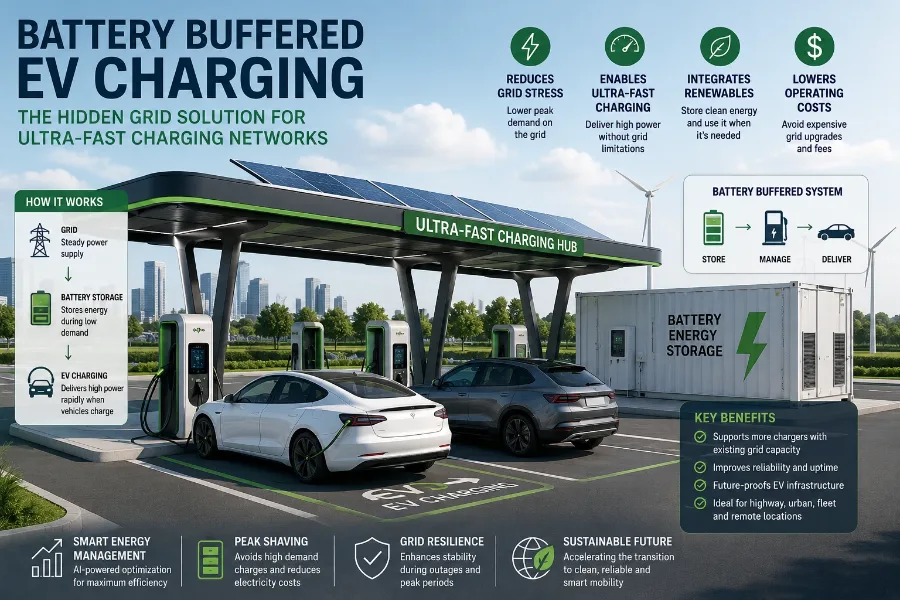
Instead of relying entirely on direct grid power during charging sessions, these systems store electricity inside on-site battery energy storage units and release it rapidly when EVs require fast charging. The charging station effectively becomes its own intelligent energy buffer.
For utilities, this reduces peak demand pressure.
For drivers, it enables faster and more reliable charging.
For investors, it may become one of the most valuable infrastructure sectors of the entire future mobility economy.
Why Battery Buffered EV Charging Matters
Traditional EV charging stations depend heavily on direct electrical grid capacity. That works reasonably well for lower-power charging systems, but the situation changes dramatically once charging speeds exceed 150 kW, 250 kW, or even megawatt-level charging infrastructure.
A single ultra-fast EV charger can consume as much electricity as multiple residential homes combined. A large charging hub with dozens of high-power chargers may behave more like a small industrial facility than a typical roadside charging station.
This creates enormous pressure on local distribution grids.
Grid upgrades are expensive, slow, and often delayed by permitting requirements, utility coordination, and infrastructure limitations.
Battery buffered EV charging solves part of this problem by allowing charging stations to:
- draw electricity steadily from the grid
- store electricity during lower-demand periods
- reduce sudden peak demand spikes
- support ultra-fast charging sessions
- improve charging reliability
- integrate renewable electricity more effectively
Instead of forcing the grid to instantly supply massive amounts of electricity when several vehicles arrive simultaneously, the battery system absorbs much of the pressure.
This makes charging infrastructure more flexible and easier to deploy.
How Battery Buffered EV Charging Works
A battery buffered EV charging station typically combines three core systems:
- grid connection infrastructure
- battery energy storage systems
- high-power charging equipment
The grid supplies electricity to the site gradually. The battery storage system stores that energy. When EVs arrive for charging, the station can discharge electricity rapidly into vehicles without creating the same level of immediate stress on the local grid.
This approach changes the economics and engineering of charging infrastructure deployment.
In a conventional ultra-fast charging setup, every surge in charging demand directly impacts the utility grid.
In a battery buffered system, the battery absorbs and smooths those fluctuations.
Advanced charging hubs may also integrate:
- solar canopies
- smart charging software
- AI-driven energy management
- dynamic electricity pricing
- thermal management systems
- predictive load balancing
As EV charging evolves, charging stations are becoming more than simple power delivery points. They are evolving into intelligent distributed energy platforms.
Why Ultra-Fast Charging Creates Grid Pressure
Ultra-fast charging is one of the biggest selling points for modern electric vehicles. Automakers understand that reducing charging time is critical for improving EV adoption.
However, from a grid engineering perspective, ultra-fast charging introduces serious infrastructure challenges.
When multiple vehicles charge simultaneously at high power levels, electricity demand spikes dramatically within seconds.
Older distribution networks struggle to handle these sudden fluctuations efficiently.
This becomes especially problematic in:
- highway charging corridors
- urban charging hubs
- fleet depots
- remote travel routes
- commercial logistics centers
- electric truck charging stations
Battery buffered EV charging reduces these peak demand spikes by storing electricity in advance and delivering it during charging sessions.
That allows operators to deploy high-speed charging stations in locations where direct grid upgrades would otherwise be extremely expensive or delayed.
China and the Race for Flash Charging
China currently leads much of the global EV infrastructure race, particularly in battery manufacturing, charging deployment, and electric mobility scale.
Chinese automakers and battery companies are aggressively pursuing ultra-fast charging systems capable of reducing charging times to only a few minutes.
BYD, CATL, NIO, and other Chinese companies understand that charging convenience strongly influences consumer confidence.
Battery buffered EV charging fits naturally into this strategy because flash charging infrastructure requires intelligent local energy management.
Without on-site battery storage, ultra-fast charging networks would place enormous stress on local grids.
China’s advantage extends beyond manufacturing capacity.
The country can coordinate:
- battery production
- charging infrastructure
- grid planning
- industrial policy
- renewable energy deployment
- EV manufacturing
more rapidly than many competing markets.
This ecosystem coordination may allow China to dominate future charging infrastructure development during the late 2020s.
Europe’s EV Charging Infrastructure Problem
Europe has some of the world’s strongest EV adoption markets, including Norway, Germany, the Netherlands, France, and the United Kingdom.
However, charging infrastructure deployment remains uneven across the region.
Many European cities face difficult grid expansion challenges because older urban infrastructure was never designed for large-scale electric transportation demand.
Battery buffered EV charging may help solve one of Europe’s biggest infrastructure problems: deploying high-speed chargers in locations where grid upgrades take too long.
In several European countries, charging operators face long waiting periods for major utility approvals and transmission upgrades.
Battery-buffered systems reduce the required size of direct grid connections by smoothing demand fluctuations.
This improves deployment flexibility and lowers infrastructure pressure.
For Europe, charging reliability matters enormously because driver confidence strongly affects long-term EV adoption rates.
United States Highway Charging Expansion
The United States faces a different challenge. EV adoption is growing rapidly, but charging coverage remains inconsistent across states and regions.
California continues leading EV infrastructure investment, yet large portions of the country still require major charging expansion.
Long-distance EV travel depends heavily on reliable highway charging corridors.
Battery buffered EV charging systems could become especially valuable in rural or semi-rural locations where electrical infrastructure remains limited.
Instead of waiting years for utility upgrades, operators can deploy buffered charging systems capable of supporting high-speed charging with reduced grid strain.
This becomes even more important for electric truck infrastructure.
Heavy-duty electric trucks require enormous amounts of electricity compared with passenger EVs.
Fleet depots and logistics hubs may create serious electricity demand spikes if charging is not managed intelligently.
Battery buffered charging systems help stabilize these charging loads while improving operational flexibility.
India and Emerging EV Markets
India represents one of the most important long-term EV growth markets in the world.
Electric two-wheelers, commercial fleets, buses, and urban delivery systems are expanding rapidly across major Indian cities.
However, grid reliability still varies significantly by region.
Battery buffered EV charging may become a critical solution for emerging markets where charging demand rises faster than transmission modernization.
Distributed charging hubs combining:
- solar generation
- battery storage
- smart charging software
- load balancing systems
could help accelerate EV infrastructure deployment while reducing grid stress.
This approach may prove especially effective for commercial fleets and urban transportation systems.
Middle East Smart Charging Opportunities
The Middle East presents a unique opportunity for next-generation EV infrastructure development.
Countries such as Saudi Arabia and the UAE are investing aggressively in smart cities, clean energy projects, autonomous transportation, and future mobility ecosystems.
Battery buffered EV charging aligns naturally with these initiatives.
High solar potential allows charging stations to integrate photovoltaic canopies with battery storage systems.
During daylight hours, solar electricity can charge on-site batteries. Later, the stored energy can support EV charging demand.
Extreme temperatures remain a technical challenge because battery cooling and thermal management become increasingly important in desert environments.
Still, the region’s strong investment capacity and modern infrastructure planning may allow the Middle East to become a showcase market for premium smart charging networks.
Battery Buffered EV Charging Comparison Table
| Charging Model | Main Advantage | Main Limitation |
| Traditional Fast Charging | Simple grid connection | High peak demand pressure |
| Battery Buffered EV Charging | Supports ultra-fast charging with lower grid stress | Higher initial infrastructure cost |
| Solar Integrated Charging | Uses renewable electricity on-site | Dependent on weather conditions |
| Depot Smart Charging | Optimized for fleet scheduling | Requires advanced management software |
| Megawatt Charging Systems | Supports heavy-duty EV transport | Extremely high infrastructure demand |
Investment Trends and Market Growth
Battery buffered EV charging is quickly becoming more than a technical solution. It is emerging as a major infrastructure investment category.
Charging operators are under pressure to expand rapidly while controlling operational costs. Utilities are under pressure to maintain grid stability. Automakers are under pressure to make EV ownership feel more convenient.
Battery buffered infrastructure sits directly at the intersection of these pressures.
Investors are closely watching:
- ultra-fast charging demand growth
- battery cost reductions
- grid upgrade delays
- fleet electrification
- charging utilization rates
- government infrastructure incentives
By 2030, battery buffered EV charging could become a standard feature for premium high-power charging networks worldwide.
Related Future Mobility Articles
Explore how battery innovation is reshaping electric transportation:
How Battery Technology Is Transforming Electric Flight
Discover advanced sustainable material systems:
Learn more about next-generation aviation technologies:
Top Sustainable Aircraft Technologies in 2026
External Resources
The International Energy Agency Global EV Outlook provides detailed EV adoption and charging infrastructure analysis.
InsideEVs regularly covers EV charging technology and electric mobility developments.
Electrek publishes EV charging, battery technology, and clean transportation news.
Related guides: The Future of EV Charging Infrastructure in 2030: Revolutionary Smart Charging Networks, The Current Battery Density Crisis and the Tesla Plane Project, The Hidden Costs of EV Ownership: Insurance, Maintenance, and Charging Fees Explained
Frequently Asked Questions
What is battery buffered EV charging?
Battery buffered EV charging uses on-site battery storage systems to support high-power electric vehicle charging while reducing direct stress on the electrical grid.
Why is battery buffered charging important?
It allows operators to deploy ultra-fast charging stations more efficiently in locations where grid upgrades may be expensive or delayed.
Can battery buffered charging support renewable energy?
Yes. These systems can store electricity from solar panels or the grid and release it during charging demand peaks.
Will battery buffered EV charging become common?
Battery buffered EV charging is expected to become increasingly common at high-power charging hubs during the late 2020s.
Why do automakers care about charging infrastructure?
Reliable charging infrastructure improves consumer confidence and makes EV ownership more practical for long-distance travel and daily use.
Final Industry Outlook
Battery Buffered EV Charging may become one of the hidden foundations of the future mobility economy.
Consumers will notice faster charging speeds and improved station reliability.
Utilities will notice smoother electricity demand curves.
Charging operators will gain more flexibility in deployment planning.
As electric vehicles, autonomous transportation systems, fleet electrification, and AI-driven mobility continue expanding, charging infrastructure must become smarter and more resilient.
The countries and companies that solve the grid challenge behind ultra-fast charging will gain a major strategic advantage in the clean transportation industry.
By 2030, the most successful charging networks may not simply be the ones with the fastest chargers. They will likely be the networks that combine speed, energy storage, software intelligence, renewable integration, and grid flexibility into one seamless infrastructure platform.</p
Sources and Further Reading
Every figure on this page is dated and linked to its source. How we verify · Editorial policy · Report a correction
Related Posts



Leave a Comment
Your comment will be published after it has been approved. Please send comments that do not contain slang words.