
Electric Car Efficiency (2026): kWh per 100 Miles for Every EV, and What It Costs You
Updated September 13, 2026 · 9 min read
Last updated: 8 September 2026. Efficiency ratings are the EPA model-year 2026 vehicle file; the electricity price is pulled live from EIA on the day this page was last built.
Electric car efficiency is measured in kilowatt-hours per 100 miles, and across the 2026 model year the range is wide: the most efficient car rated by the EPA uses about 23 kWh per 100 miles, the least efficient more than 66. The median electric vehicle sits near 37 kWh per 100 miles, which means the difference between an efficient and an inefficient EV is roughly a doubling of what you pay for electricity to drive the same distance.
Key takeaways
- Efficiency is measured in kWh per 100 miles; lower is better. MPGe is the same number rescaled, using EPA’s 33.7 kWh per gallon equivalent.
- The gap across one model year is roughly 3× between the best and the worst rated electric vehicle.
- Vehicle class explains much of it: full-size electric pickups have the worst median rating of any class, small two-wheel-drive SUVs and midsize cars the best.
- Wheel size alone moves the rating measurably — the same car with larger wheels is rated less efficient in the EPA file.
- Efficiency, not battery size, sets your running cost. Battery size sets how far you go between charges.
What does electric car efficiency actually measure?
For a petrol car you divide distance by fuel. For an electric car the EPA does the same thing in reverse and reports kWh per 100 miles: the electricity drawn to cover a fixed distance. Lower is better, which is the opposite of the mpg habit and the single most common source of confusion on this subject.
The same test also produces MPGe, where EPA treats 33.7 kWh as the energy in one gallon of petrol. MPGe is useful for comparing an EV against a petrol car on a window sticker; kWh per 100 miles is the number that multiplies directly by your electricity rate, so it is the one to use when you are working out a cost.
One caveat that matters and is usually left out: these are laboratory ratings from a standard test cycle. They are excellent for comparing cars against each other, because every car faces the same test. They are not a promise about your commute, your climate or your right foot.
| Vehicle | kWh / 100 mi | MPGe | EPA range (mi) | Cost per 100 mi |
|---|---|---|---|---|
| Lucid Air Pure RWD with 19 inch wheels | 23.1 | 146 | 420 | $4.24 |
| Tesla Model 3 Standard RWD | 24.3 | 139 | 321 | $4.46 |
| Tesla Model Y Standard RWD (18in Wheels) | 24.3 | 138 | 321 | $4.46 |
| Tesla Model 3 Premium RWD | 24.6 | 137 | 363 | $4.52 |
| Lucid Air Touring AWD with 19 inch wheels | 25.2 | 134 | 431 | $4.62 |
| Tesla Model Y Long Range RWD | 25.2 | 134 | 357 | $4.63 |
| Toyota bZ (energy capacity 191 Ah) | 25.5 | 131 | 314 | $4.68 |
| Subaru Uncharted | 25.7 | 129 | 308 | $4.71 |
| Tesla Model Y Standard RWD (19in Wheels) | 25.7 | 131 | 303 | $4.71 |
| Toyota bZ (energy capacity 200 Ah) | 25.8 | 130 | 236 | $4.74 |
| Lucid Air Pure RWD with 20 inch wheels | 26.1 | 129 | 372 | $4.79 |
| Tesla Model 3 Premium AWD | 26.4 | 128 | 346 | $4.84 |
| Lucid Air G Touring XR AWD with19 inch wheels | 26.4 | 128 | 512 | $4.85 |
| Tesla Model Y Standard AWD | 26.5 | 127 | 294 | $4.86 |
| Lexus RZ 350e FWD (18 inch wheels) | 26.6 | 126 | 301 | $4.88 |
Which 2026 electric cars are the most efficient?
The table above lists the most efficient electric vehicles in the EPA’s model-year 2026 file, with their rated range and what 100 miles of driving costs at the current US average residential electricity price. The pattern is consistent: aerodynamic sedans and small crossovers lead, and they lead by a wide margin over anything tall or heavy.
Notice how often the same nameplate appears with different figures once you look past this list. That is not noise — it is wheels, drive layout and battery choice. A larger wheel on the identical car is a measurably worse efficiency rating, which is a real and rarely mentioned consequence of an options list.
How much does efficiency differ by vehicle class?
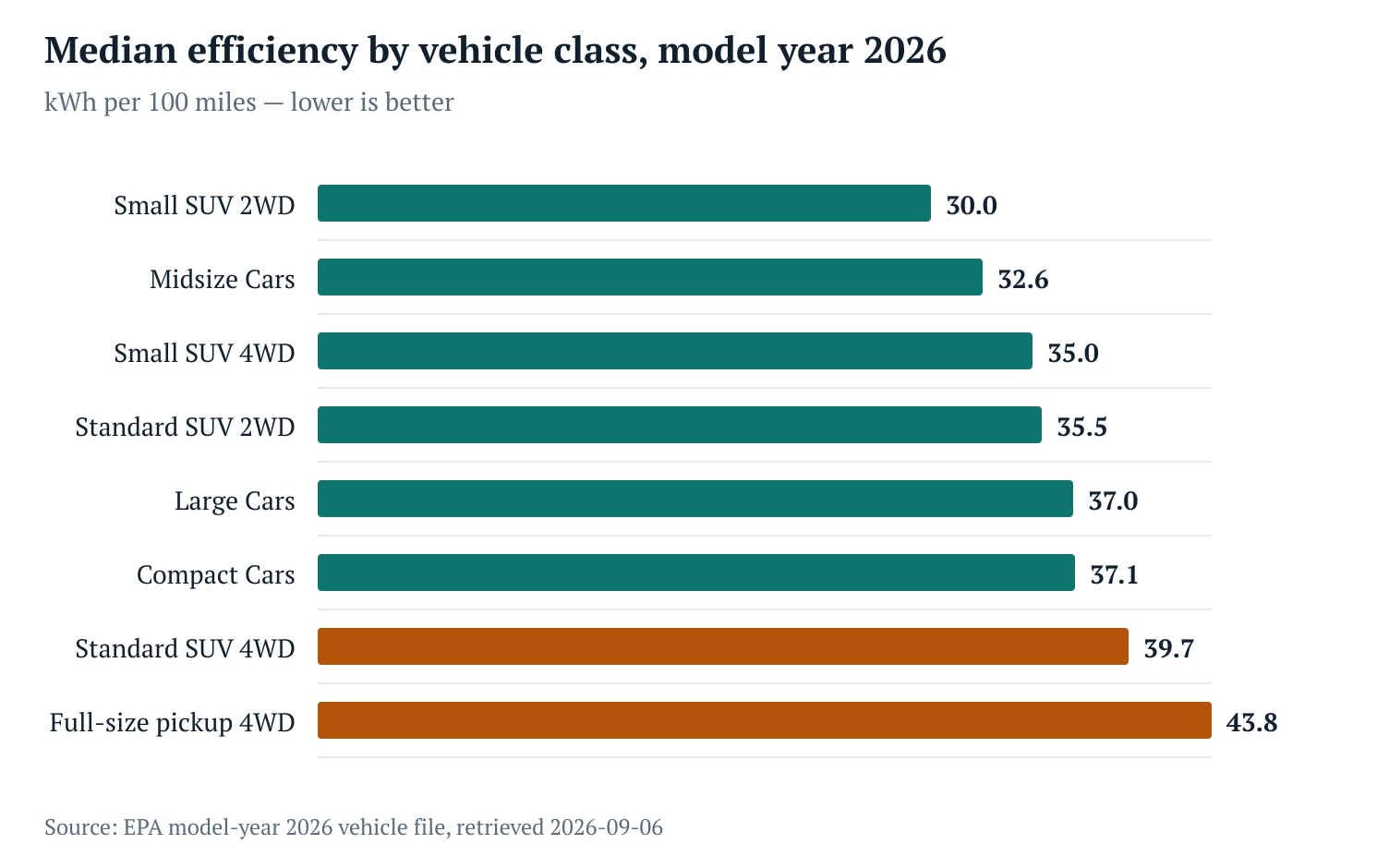
Class explains more of the spread than brand does. The chart above and the table here give the median rated efficiency for each EPA vehicle class in the 2026 file, along with what 100 miles costs at the current average residential rate. A full-size electric pickup is not badly engineered because it uses far more energy than a compact car; it is pushing a much larger hole through the air and carrying far more mass.
This is why comparing an electric pickup against a compact EV tells you nothing useful. Compare within the class you actually intend to buy, and the differences that remain are the ones you can act on.
| Vehicle class | Rated EVs | Median kWh / 100 mi | Cost per 100 mi |
|---|---|---|---|
| Small Sport Utility Vehicle 2WD | 32 | 30.0 | $5.50 |
| Midsize Cars | 18 | 32.6 | $5.98 |
| Small Sport Utility Vehicle 4WD | 61 | 35.0 | $6.42 |
| Standard Sport Utility Vehicle 2WD | 15 | 35.5 | $6.51 |
| Large Cars | 29 | 37.0 | $6.79 |
| Compact Cars | 38 | 37.1 | $6.80 |
| Standard Sport Utility Vehicle 4WD | 80 | 39.7 | $7.28 |
| Standard Pickup Trucks 4WD | 36 | 43.8 | $8.03 |
What does a difference in efficiency cost per year?
Efficiency turns into money through one multiplication: kWh per 100 miles, times miles driven, times your electricity rate. The calculator below does it with your own numbers, and it is worth entering the rate from your own bill rather than a national average — residential rates vary by more than a factor of three across the United States.
Enter an efficiency rating from either table above and your real annual mileage. The distance between the top and the bottom of the 2026 model year is not a rounding error; over a few years of ownership it is a meaningful sum.
Electric car running-cost calculator
Enter an efficiency rating from the tables above, your annual mileage and the rate from your own electricity bill.
Defaults: the median 2026 electric vehicle at 37.1 kWh/100 mi, the US average residential rate of 18.34 cents/kWh (EIA, June 2026) and US regular petrol at $4.071/gal (EIA, week of 08/31/26). Home charging; public fast charging costs more per kWh.
How does that compare with a petrol car?
The honest comparison is cost per 100 miles, using each fuel at its current price. The table below puts the median 2026 electric vehicle next to petrol cars at three common fuel-economy levels, with both prices pulled from the US Energy Information Administration on the day this page was built.
Two caveats keep this fair. Home charging at a residential rate is the cheapest electricity a driver buys; public DC fast charging costs considerably more per kWh, so a driver who cannot charge at home should not expect the home-charging figure. And this compares fuel only — not insurance, depreciation, maintenance or purchase price.
| Vehicle | Consumption | Cost per 100 mi |
|---|---|---|
| Most efficient 2026 EV (Lucid Air Pure RWD with 19 inch wheels) | 23.1 kWh/100 mi | $4.24 |
| Median 2026 EV | 37.1 kWh/100 mi | $6.81 |
| Least efficient 2026 EV (Bugatti Rimac Nevera R) | 66.5 kWh/100 mi | $12.19 |
| Petrol car at 40 mpg | 2.5 gal/100 mi | $10.18 |
| Petrol car at 30 mpg | 3.3 gal/100 mi | $13.57 |
| Petrol car at 20 mpg | 5.0 gal/100 mi | $20.35 |
What actually makes one electric car more efficient than another?
Mass and frontal area dominate. Every kilogram has to be accelerated and every square metre of frontal area has to be pushed through the air, and at motorway speed the aerodynamic term grows with the square of velocity. This is why the efficiency table sorts almost cleanly by body shape.
After that come the smaller effects, and the EPA file shows them because the same model appears with different equipment: wheel and tyre choice, drive layout, and the presence of a heat pump for cabin heating. None of these individually rivals the difference between a saloon and a pickup, but together they explain why two versions of the same car can differ by several kWh per 100 miles.
Does cold weather change these numbers?
Yes, and the EPA rating does not capture it. Heating the cabin draws energy that does not move the car, and a cold battery is less willing to accept and release charge. The rating remains the right tool for comparing two cars, because both are measured the same way; it is simply not a forecast of a January commute.
Is a bigger battery less efficient?
Not directly, but a bigger battery is heavier, and mass costs energy. In the EPA file the long-range version of a given model is usually rated slightly worse per 100 miles than the standard-range version, while going further on a charge. Range and efficiency are separate questions, and conflating them is the most common mistake in EV shopping advice.
Frequently asked questions
What is a good kWh per 100 miles for an electric car?
Anything under about 30 kWh per 100 miles is efficient by 2026 standards and the median electric vehicle sits near 37. Full-size electric pickups have the worst median of any class, and their least efficient trims pass 50. Compare within the class of vehicle you intend to buy rather than across classes, because body shape and mass dominate the result.
Is MPGe the same as electric car efficiency?
It is the same measurement expressed differently. EPA converts using 33.7 kWh as the energy content of one gallon of petrol, so a higher MPGe and a lower kWh per 100 miles mean the same thing. Use kWh per 100 miles when you want a cost, because it multiplies directly by your electricity rate.
Which 2026 electric car is the most efficient?
In the EPA model-year 2026 file the most efficient ratings belong to the Lucid Air Pure on 19-inch wheels and the rear-wheel-drive Tesla Model 3 and Model Y, all close to 23 to 25 kWh per 100 miles. The exact order changes as EPA adds trims through the model year, and the table on this page is rebuilt from the current file.
Does efficiency or battery size matter more?
Efficiency sets what you pay to drive a mile; battery size sets how far you go before charging. A large battery in an inefficient vehicle gives you range and a high running cost at the same time, which is exactly what the electric pickup figures show.
Do EPA efficiency ratings match real-world driving?
They are laboratory ratings from a standard test cycle, so they are a fair basis for comparing cars but not a forecast of your own consumption. Cold weather, motorway speed, roof loads and terrain all push real consumption above the rating.
Why do two versions of the same car have different efficiency?
Usually wheels, drive layout or battery pack. The EPA file lists them separately for exactly this reason: the same model with larger wheels or an added motor is measured as a different vehicle and is rated less efficient.
Sources
- US EPA / DOE fueleconomy.gov vehicle web service, model year 2026, retrieved 2026-09-06
- EIA Electric Power Monthly, Table 5.6.A, residential, U.S. total, June 2026, retrieved 2026-09-08
- EIA Gasoline and Diesel Fuel Update, U.S. regular, week of 08/31/26, retrieved 2026-09-08
- US EPA — Understanding the electric vehicle fuel economy label (MPGe and kWh/100 mi), retrieved 2026-09-08
Related guides: longest-range electric cars · charging cost by state · EV charging cost calculator · all calculators and reference tables.
Every figure on this page is dated and linked to its source. How we verify · Editorial policy · Report a correction
Related Posts



Leave a Comment
Your comment will be published after it has been approved. Please send comments that do not contain slang words.