
Electric Trucks (2026): Every Electric Pickup the EPA Rates, and What They Cost to Run
Updated September 12, 2026 · 8 min read
Last updated: 11 September 2026. Truck figures are the EPA model-year 2026 vehicle file; electricity and petrol prices are pulled live from EIA on the day this page was last built.
The EPA rates a few dozen electric pickup configurations for the 2026 model year, with rated range running from the high 250s to just under 500 miles. They are the least efficient electric vehicles on sale — a full-size electric pickup uses roughly a third more energy per mile than the median electric car — but they replace the thirstiest vehicles on the road, so the running-cost gap against a petrol pickup is the largest of any segment.
Key takeaways
- Electric pickups are the least efficient EVs the EPA rates, and they still cost far less to run than the petrol trucks they replace.
- Rated range reaches just under 500 miles in the longest-range configuration of the 2026 model year.
- Wheel and battery choices move rated range by more than 200 miles within a single nameplate — the trim you pick matters more than the badge.
- The EPA model-year 2026 file lists electric pickups from only four brands; the segment is narrower than the coverage suggests.
- Towing cuts range substantially. This page explains why and refuses to print a percentage, because no primary source covers these trucks.
Which electric trucks can you actually buy in 2026?
The table below is drawn from the EPA’s model-year 2026 vehicle file, which is the official record of what has been rated for sale in the United States. It is worth knowing how narrow this segment still is: the electric pickups in that file come from a small number of manufacturers, and one widely covered nameplate does not appear in the 2026 file at all. That is a statement about the file, not a claim that a model has been cancelled — but if you are shopping on rated figures, the file is what you have.
Configurations are listed separately because they behave differently. The same truck with a larger battery, a different wheel or an all-terrain package is a materially different vehicle on range and efficiency, and the EPA rates each one.
| Truck | Rated configurations | Best rated range (mi) | Shortest in the range (mi) | kWh / 100 mi | MPGe | Electricity per year (12,000 mi) |
|---|---|---|---|---|---|---|
| Chevrolet Silverado EV | 6 | 493 | 283 | 49.5 | 68 | $1,089 |
| Rivian R1T | 25 | 420 | 258 | 38.8 | 87 | $855 |
| GMC SIERRA EV | 3 | 410 | 283 | 49.5 | 68 | $1,090 |
| Tesla Cybertruck | 3 | 335 | 325 | 43.4 | 78 | $954 |
How far does an electric pickup actually go?
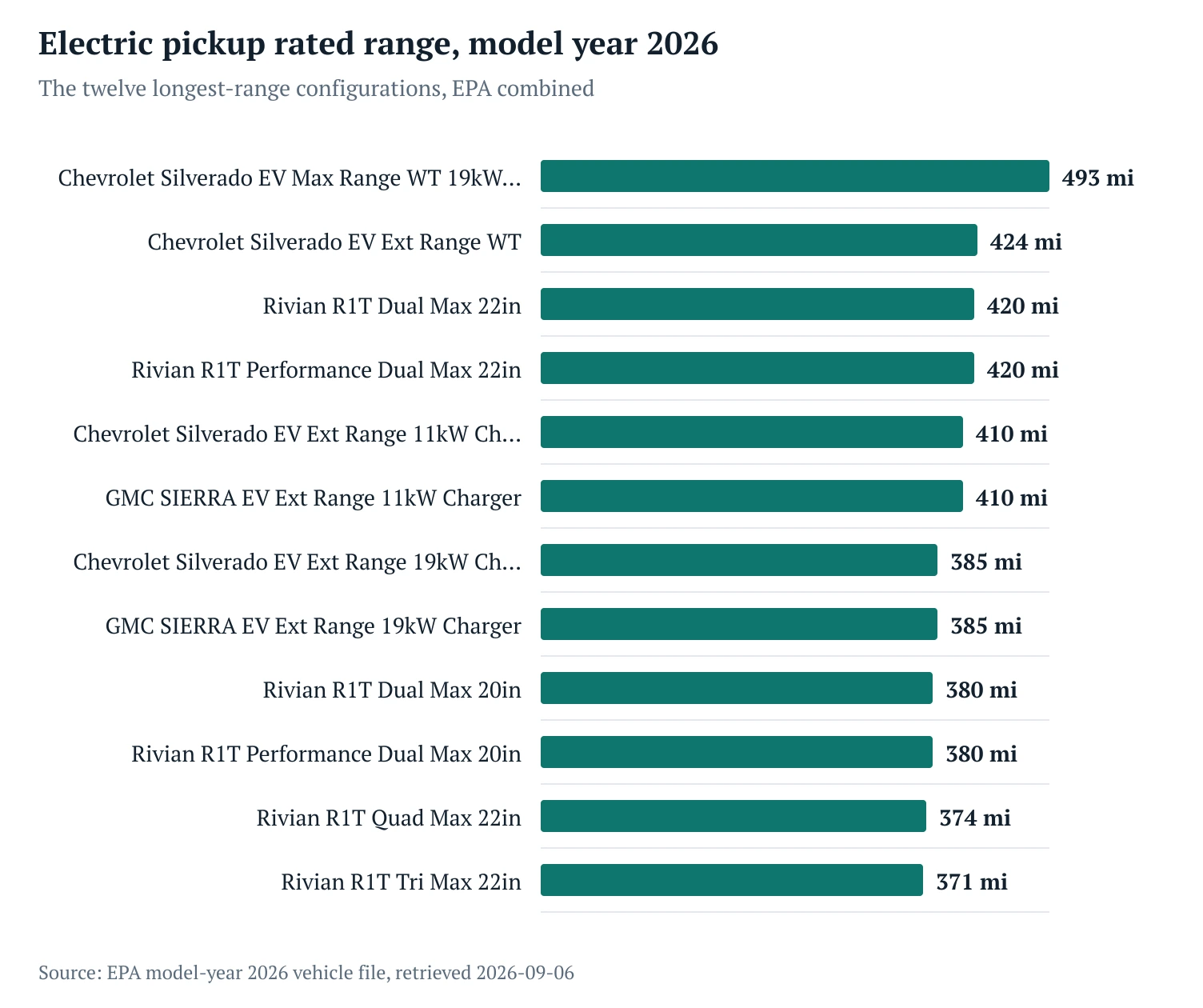
The chart shows rated range for the longest-range configuration of each nameplate and the spread within them. The headline number for the segment sits just under 500 miles; the bottom of the range is around 260. Both are EPA combined ratings, measured the same way for every vehicle, which makes them fair for comparison and optimistic for a loaded truck on a motorway in winter.
The within-nameplate spread is the part buyers underestimate. Choosing a different battery and wheel combination on the same truck can change rated range by more than 200 miles, which is a bigger difference than exists between most competing models.
What does an electric truck cost to run against a petrol one?
Electric pickups are inefficient by EV standards and cheap to run by pickup standards, and both things are true for the same reason: they are heavy, but electricity is far cheaper per unit of energy than petrol. The table compares the median electric pickup in the 2026 file against the median petrol pickup, at the prices the US Energy Information Administration published this week.
This is the segment where the fuel argument is strongest. A petrol full-size pickup is among the most expensive vehicles to fuel on the American market, so the same percentage saving is a much larger number of dollars than it is on a compact crossover.
| Vehicle | Consumption | Fuel per year (12,000 mi) | Over five years |
|---|---|---|---|
| Median electric pickup (2026) | 43.4 kWh/100 mi | $954 | $4,771 |
| Most efficient electric pickup | 38.8 kWh/100 mi | $855 | $4,274 |
| Median petrol pickup (2026) | 19.0 mpg | $2,625 | $13,127 |
| Thirstiest petrol pickup (2026) | 12.0 mpg | $4,157 | $20,785 |
How long does it take to earn back a price premium?
That is the question the fuel table cannot answer on its own, because it depends on what you pay for the truck. The calculator takes the price gap between the two trucks you are actually choosing between — your number, from your dealer, after whatever incentives you qualify for — and reports how long the fuel saving takes to cover it.
One structural point to feed into that number: the federal clean-vehicle purchase credits ended on 30 September 2025, so a comparison that still assumes a $7,500 federal discount on the electric side is describing a market that no longer exists. State and utility programmes may still apply where you live.
Electric pickup break-even calculator
How long the fuel saving takes to cover a price difference you enter yourself.
Defaults: the median 2026 electric pickup at 43.4 kWh/100 mi against the median petrol pickup at 19.0 mpg, at EIA prices (18.34 cents/kWh, June 2026; $4.157/gal, week of 09/07/26). The price difference is your number — this calculator has no view on what either truck costs. Fuel only: insurance, maintenance and depreciation are not included.
What about towing and payload?
Towing reduces range sharply on any vehicle, and proportionally more on an electric one because there is no cheap way to carry extra energy. The physics is straightforward: a trailer adds mass to accelerate and a great deal of frontal area to push, and aerodynamic drag grows with the square of speed, so a tall trailer at motorway speed is the worst case.
This page does not print a percentage for that loss. The EPA does not test towing, and there is no primary source covering these specific trucks that we can cite. Treat any single towing-range figure you read elsewhere with suspicion unless it names its test conditions: trailer, weight, frontal area, speed, temperature and terrain all move it, and a figure without them is not a measurement.
| Factor | In the EPA rating? | What it does to real range |
|---|---|---|
| Vehicle weight and aerodynamics | Yes — measured | Already reflected in the rating |
| Charging losses | Yes — measured at the wall | Already inside the kWh/100 mi figure |
| Towing a trailer | No — EPA does not test towing | Reduces range substantially; depends on weight, frontal area and speed |
| Payload in the bed | No | Reduces range with added mass |
| Cold weather and cabin heating | No | Reduces range; heating draws energy that does not move the truck |
| Sustained motorway speed | Partly — the test cycle is not a constant 75 mph | Reduces range; drag grows with the square of speed |
Is charging a problem for a work truck?
It depends entirely on the duty cycle. A truck that returns to the same yard every night and charges there is the easiest case there is, and the running-cost advantage lands in full. A truck that tows long distances between sites is the hardest, because it combines the highest consumption with the greatest dependence on public fast charging — which is also the most expensive electricity a driver buys.
Why is a big battery not the answer to everything?
Because it is heavy, and mass costs energy. The largest-battery configurations in the table go furthest, but they are also rated less efficient per mile than the smaller-battery versions of the same truck. You are buying range, not economy, and the two are separate purchases.
Frequently asked questions
How far can an electric truck go on a charge?
In the EPA model-year 2026 file, rated range for electric pickups runs from roughly 260 miles to just under 500 miles depending on battery and wheel choice. These are EPA combined ratings from a standard test; a loaded truck towing at motorway speed in cold weather will do considerably less.
Are electric trucks cheaper to run than petrol trucks?
On fuel, substantially. The median electric pickup in the 2026 file costs roughly a third of what the median petrol pickup costs to fuel at current US average prices, and because petrol pickups are among the most expensive vehicles to fuel, that percentage is a large number of dollars.
Which electric truck is the most efficient?
The Rivian R1T configurations lead the electric pickups on efficiency in the EPA 2026 file, with the GM trucks using more energy per mile. Even the most efficient electric pickup uses noticeably more than the median electric car, because a full-size pickup is heavy and not aerodynamic.
How much range do you lose towing an electric truck?
Enough to plan around, but this page will not give you a number. The EPA does not test towing and there is no primary source covering these trucks, so any single percentage is somebody’s estimate under unstated conditions. Trailer weight, frontal area, speed, temperature and terrain all move it.
Do electric trucks still qualify for a federal tax credit?
No. The federal clean-vehicle credits ended on 30 September 2025, and the 30C charging-property credit does not apply to equipment placed in service after 30 June 2026. State and utility programmes may still apply depending on where you live.
Is a bigger battery always better in an electric truck?
It goes further and it costs more energy per mile, because the extra weight has to be moved. In the EPA file the largest-battery configurations have both the longest range and a worse efficiency rating than the smaller-battery versions of the same truck.
Sources
- US EPA / DOE fueleconomy.gov vehicle web service, model year 2026, retrieved 2026-09-06
- US EPA — Understanding the electric vehicle fuel economy label, retrieved 2026-09-11
- EIA Electric Power Monthly, Table 5.6.A, residential, U.S. total, June 2026, retrieved 2026-09-11
- EIA Gasoline and Diesel Fuel Update, U.S. regular, week of 09/07/26, retrieved 2026-09-11
Related guides: longest-range electric cars · EV efficiency ratings · EV vs petrol running costs · megawatt charging for heavy trucks.
Every figure on this page is dated and linked to its source. How we verify · Editorial policy · Report a correction
Related Posts


Leave a Comment
Your comment will be published after it has been approved. Please send comments that do not contain slang words.