
Carbon Footprint of Construction Materials: The Real Numbers
Updated September 2, 2026 · 2 min read
The carbon footprint of construction materials is dominated by a small number of high-volume materials — cement (specifically) and steel together account for a large share of global industrial emissions, since both require energy-intensive, high-temperature processes and, in cement’s case, release CO2 from the chemical reaction itself, not just the fuel burned to make it.
- Cement production alone is estimated to account for roughly 7-8% of global CO2 emissions, more than most countries.
- Steel’s footprint comes primarily from traditional blast-furnace production using coal as both fuel and chemical reducing agent.
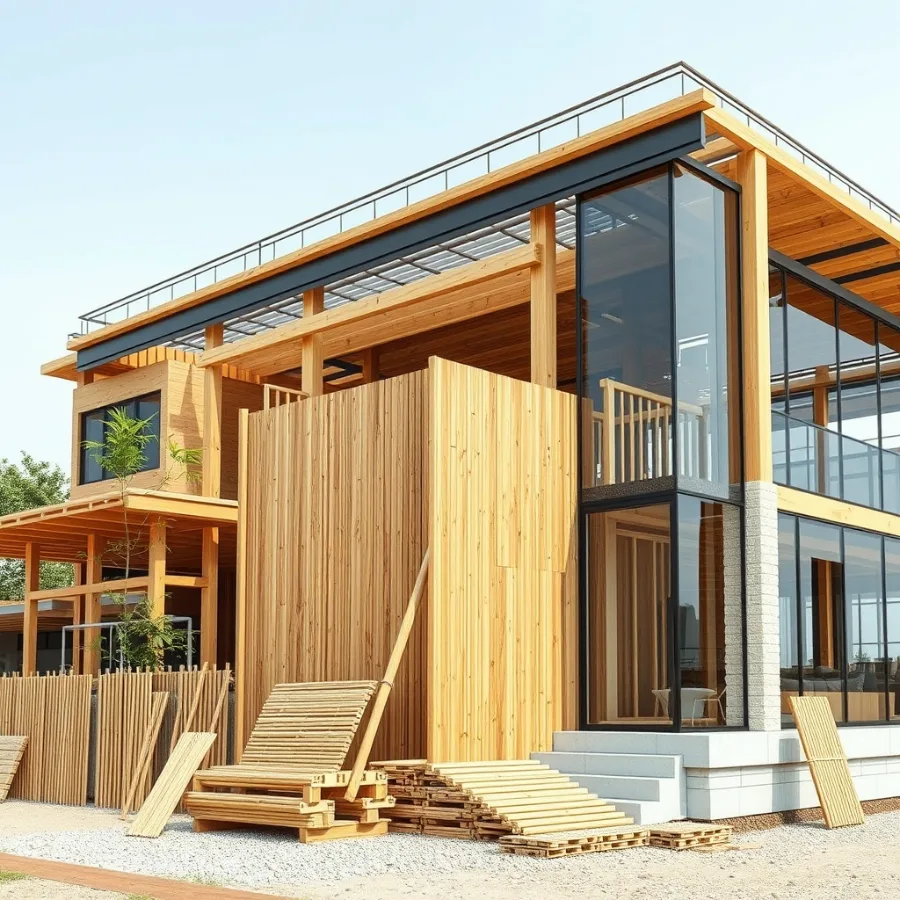
- Timber, when sustainably sourced, can have a much lower embodied carbon footprint than concrete or steel for comparable structural applications.
- “Embodied carbon” — emissions from material production and construction — is increasingly tracked alongside a building’s operational energy use, not just as an afterthought.
The Carbon Footprint of Construction Materials, Compared
| Material | Relative embodied carbon | Main emissions source |
|---|---|---|
| Cement/concrete | Very high | Chemical process emissions + high-temperature kiln energy |
| Steel | High | Coal used as fuel and chemical reducing agent |
| Aluminum | High | Extremely energy-intensive smelting process |
| Timber (sustainably sourced) | Low, can be carbon-negative | Processing/transport only; wood itself stores carbon |
Why cement’s footprint is uniquely hard to solve
Cement production releases CO2 through two separate mechanisms: burning fuel to reach the extremely high kiln temperatures the process requires, and a direct chemical reaction (calcination) that releases CO2 as limestone converts to clinker — meaning even a cement plant running on 100% renewable electricity would still have significant process emissions to address. This structural challenge is why cement decarbonization increasingly focuses on alternative binders and carbon capture rather than energy-source switching alone.
Why steel’s traditional process is so carbon-intensive
Traditional blast-furnace steelmaking uses coal not just as an energy source but as the chemical agent that strips oxygen from iron ore — a role electricity alone can’t fill without a fundamentally different process. This is why green steel efforts center on hydrogen-based direct reduction, replacing coal’s chemical role with hydrogen, rather than simply electrifying the existing blast-furnace approach, which wouldn’t address the core emissions source.
Why timber is gaining attention as a structural alternative
Sustainably sourced timber has a fundamentally different carbon profile than cement or steel: growing trees actively absorb and store CO2, so using wood as a structural material effectively locks that carbon into the building for its lifespan, rather than releasing CO2 during production the way cement and steel do. Mass timber construction techniques, using engineered wood products strong enough for mid-rise and even some high-rise buildings, have gained real traction as architects and developers look for lower-embodied-carbon alternatives to conventional structural materials.
Sources and Further Reading
Zooming out to the full industrial picture, see the main industrial carbon emissions sources by sector.
nature-inspired building design is worth a closer look for the full picture.
sustainable building performance is worth a closer look for the full picture.
Which construction material has the highest carbon footprint?
Cement and steel dominate construction’s carbon footprint. Cement production alone is estimated at roughly 7-8% of global CO2 emissions, more than most individual countries, due to both fuel use and direct chemical process emissions.
Why can’t cement’s emissions be fixed with renewable electricity alone?
Cement releases CO2 through both fuel combustion and a direct chemical reaction (calcination) as limestone converts to clinker, meaning even a fully renewable-powered plant would still have significant process emissions to address.
Why is steel production so carbon-intensive?
Traditional blast-furnace steelmaking uses coal not just as fuel but as the chemical agent that strips oxygen from iron ore, a role electricity alone can’t fill, which is why green steel focuses on hydrogen-based alternatives instead.
Is timber actually better for the climate than concrete?
Sustainably sourced timber can have a much lower, even carbon-negative embodied footprint compared to concrete or steel, since growing trees absorb and store CO2 that stays locked into the building for its lifespan.
What is embodied carbon in construction?
Embodied carbon refers to emissions from producing and constructing a building’s materials, distinct from its operational energy use, and is increasingly tracked as a significant part of a building’s total lifecycle footprint.
Can mass timber replace steel and concrete in buildings?
For many mid-rise and even some high-rise applications, yes — engineered mass timber products have gained real traction as a lower-embodied-carbon structural alternative, though it doesn’t yet replace steel and concrete in every application.
Related Posts


1 Comment
Reduced my carbon footprint with eco-friendly materials! Great info on sustainability.
Leave a Comment
Your comment will be published after it has been approved. Please send comments that do not contain slang words.