
Was Your Car Assembled in the US? A Final Assembly VIN Check

Updated September 12, 2026 · 6 min read
Last updated: 5 September 2026
The car loan interest deduction turns on where your vehicle was finally assembled, not on the badge. A final assembly VIN check settles it in about two minutes — but the first character of the VIN is only a rule of thumb, and one of the shortcuts circulating online is simply wrong.
Key takeaways
- Assembly location decides it. A Japanese brand built in Tennessee qualifies; an American brand built in Mexico does not.
- The most authoritative source is the window sticker. Federal law requires every new car sold in the US to disclose its final assembly point on that label.
- The first VIN character shows where the manufacturer registered its identifier, not necessarily where your specific car was built.
- A VIN starting with 7 is New Zealand, not the United States — despite what several published guides claim. The US blocks are 1, 4 and 5.
- Published lists of qualifying models go stale immediately, because two trims of the same model can come off lines in different countries.
Three ways to run a final assembly VIN check, ranked by reliability
| Method | How good is it | What to do |
|---|---|---|
| The window sticker | Definitive. It is a legal disclosure, specific to your car. | Find the line for final assembly point on the Monroney label. Required under the American Automobile Labeling Act, 49 U.S.C. 32304, implemented at 49 CFR Part 583. Photograph it before it comes off the glass. |
| NHTSA VIN decoder | Reliable. Decodes your actual VIN, including plant information. | Enter the full 17-character VIN at the NHTSA decoder and read the plant country field. Free, no account. |
| First VIN character | Indicative only. Tells you about the manufacturer identifier, not this car. | Use it as a sanity check, never as your answer — and never as your evidence if the IRS asks. |
Why the first VIN digit is not the test
The first three characters of a VIN are the World Manufacturer Identifier, assigned under ISO 3780. In the United States, NHTSA contracts SAE International to issue them. The first character marks the region where the manufacturer registered that identifier — which usually tracks where the car was built, but is not the same statement.
| First character | Region |
|---|---|
| 1, 4, 5 | United States |
| 2 | Canada |
| 3 | Mexico |
| 6 | Australia |
| 7 | New Zealand |
| 8, 9 | South America, including Brazil |
| J / K / L / M | Japan / South Korea / China / India |
| S / V / W / Y / Z | United Kingdom / Austria / Germany / Sweden / Italy |
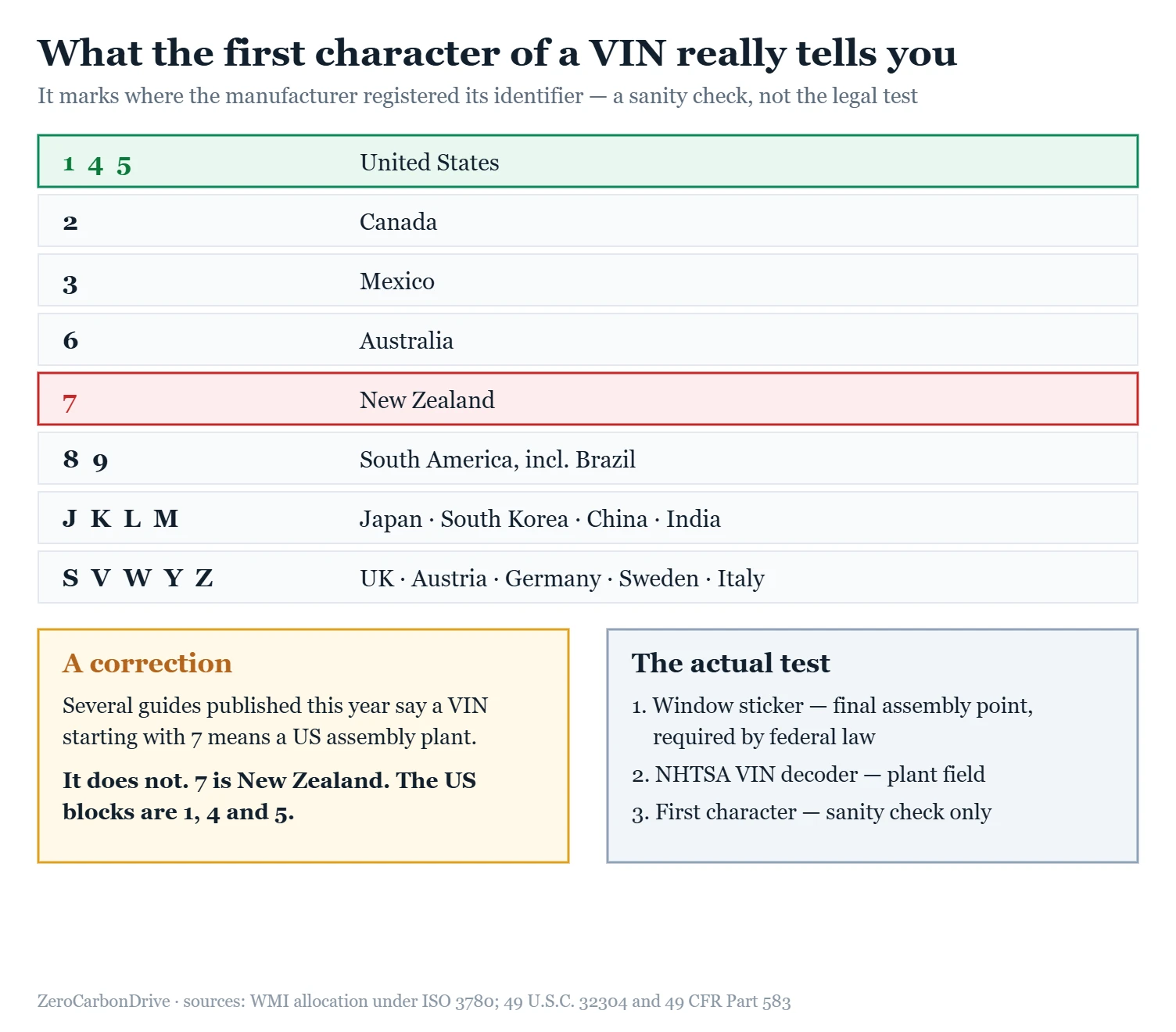
A correction worth making. Several guides published this year tell readers that a VIN beginning with 7 indicates a US assembly plant. It does not. Under the standard WMI allocation, 7 is New Zealand. The United States blocks are 1, 4 and 5. If you have been reassured by a page that told you otherwise, run a proper final assembly VIN check before you rely on it.
Why a list of qualifying models cannot be trusted
Search for this subject and you will find pages promising a definitive list of qualifying vehicles. Treat all of them as out of date the day they were published, for two reasons.
Trims split across plants. The same nameplate can be built in more than one country, with the base trim on one line and the performance version on another. A list that names the model rather than the trim cannot capture that.
Plants get rebalanced. Manufacturers move production between facilities across model years to manage capacity, tariffs and demand. A car that qualified in 2025 may be built elsewhere for 2027.
This is why the IRS asks for a VIN on Schedule 1-A rather than a model name. The VIN identifies one specific car. A model name identifies a marketing decision.
How to run a final assembly VIN check, step by step
- Find your VIN. Base of the windscreen on the driver’s side, the driver’s door jamb sticker, your insurance card, or the title.
- Check the window sticker first if you still have it. The final assembly point is stated on it by law. This is the strongest evidence you can hold, and it is specific to your car.
- Otherwise run the VIN through the NHTSA decoder and read the plant fields. It is free and needs no account.
- Sanity-check the first character. If the decoder says a US plant and the VIN starts with 1, 4 or 5, the two agree. If they disagree, trust the decoder and the sticker, not the digit.
- Save the evidence. A screenshot of the decoder result or a photograph of the sticker, filed with your loan statement.
One caution about buying: if the deduction is part of why you are choosing a particular car, do the final assembly VIN check on the specific vehicle before you sign, not on the model. Ask the salesperson to show you the final assembly line on that car’s window sticker. It takes thirty seconds and it is the only version of the answer that applies to the car you are about to own.
What this check does not tell you
Assembly location is one of six tests the vehicle has to pass. It also has to be new to you, built for public roads, have at least two wheels, be a car, minivan, van, SUV, pickup or motorcycle, and have a gross vehicle weight rating under 14,000 pounds. The loan itself has separate conditions — originated after 31 December 2024, for personal use, secured by a first lien. A car can be assembled in Ohio and still fail on the loan side.
It also says nothing about how much of the car is American. The window sticker reports US and Canadian parts content as a separate percentage. That figure matters if you care about domestic content; it has no bearing on this deduction, which asks only where final assembly happened.
Related guides
- Form 1098-VLI, the vehicle loan interest statement — the form your lender sends, box by box, and why box 1 is smaller than you expect.
- State EV incentives in 2026 — what survived the federal purchase credits ending.
- The cheapest electric cars on sale — verified prices, several of them US-assembled.
Sources
- 49 U.S.C. 32304 and 49 CFR Part 583 — the labelling requirement that puts the final assembly point on every new car’s window sticker.
- NHTSA VIN decoder — free VIN lookup including plant information.
- World Manufacturer Identifier allocation table — the first-character region blocks, including 7 for New Zealand.
- IRS, Instructions for Form 1098-VLI (Rev. December 2026) — the six vehicle tests, including final assembly in the United States.
Frequently asked questions
How do I check if my car was assembled in the United States?
Look at the window sticker first: federal law requires it to state the final assembly point. If you no longer have it, run the 17-character VIN through the free NHTSA VIN decoder and read the plant country field. Treat the first VIN character as a sanity check only.
Does a VIN starting with 7 mean a US-built car?
No. Under the standard World Manufacturer Identifier allocation, 7 is New Zealand. The United States blocks are 1, 4 and 5. Several guides published this year get this wrong, so verify with the NHTSA decoder rather than the digit.
Can the same model qualify in one trim and not another?
Yes, and this is the main reason published model lists mislead. Manufacturers build different trims of the same nameplate on lines in different countries, and move production between plants across model years. A final assembly VIN check applies to one specific car.
Does the badge on the car matter?
Not at all. The test is where final assembly happened. A Japanese or Korean brand built at a US plant qualifies; a US brand built in Mexico or Canada does not.
Where do I find my VIN?
At the base of the windscreen on the driver’s side, on the sticker in the driver’s door jamb, on your insurance card, or on the title.
Is US and Canadian parts content the same as final assembly?
No. The window sticker reports parts content as a separate percentage. The deduction asks only where final assembly took place, so a car with modest domestic parts content can still qualify.
What should I keep as evidence?
A photograph of the window sticker showing the final assembly point, or a screenshot of the NHTSA decoder result, filed alongside your lender interest statement. You will need the VIN itself on Schedule 1-A.
Every figure on this page is dated and linked to its source. How we verify · Editorial policy · Report a correction
Related Posts


Leave a Comment
Your comment will be published after it has been approved. Please send comments that do not contain slang words.