
Solid-State Batteries in Electric Aviation: 2026 Guide
Updated September 18, 2026 · 5 min read
Table of Contents
- 1. Physics Problem Solved by Solid-State Batteries in Electric Aviation
- 2. Thermal Safety and Structural Integration in Aerospace
- 3. Global Ecosystem, Research Centers, and Market Players
- 4. Regional Impacts and Flight Economics
- 5. Key Technological Challenges Remaining
- 6. Regulatory Pathways, Certification, and Future Outlook
- Strategic References
The global aviation industry contributes approximately 2.5% of global carbon dioxide (CO2) emissions and over 3.5% of total climate warming when accounting for non-CO2 effects such as contrails and nitrogen oxides (NOx). As nations target net-zero emissions by 2050 under the Paris Agreement and initiatives like the ICAO CORSIA framework, traditional jet fuel must be replaced with clean alternatives. The transition toward solid-state batteries in electric aviation offers a transformative solution for short and regional routes in 2026 and beyond.
While Sustainable Aviation Fuel (SAF) provides a transitional solution for long-haul routes, pure electrification offers the ultimate zero-operational-emission pathway for regional and urban aerial mobility. Deploying high-density cells provides the energy storage breakthrough necessary to replace liquid-fueled engines. However, classical liquid-electrolyte lithium-ion (Li-ion) batteries face significant physical barriers, primarily low gravimetric energy density and thermal runaway hazards.
The development of solid-state technology has emerged as the definitive requirement to make commercial zero-emission flight viable. By replacing volatile organic liquid electrolytes with solid ion-conducting materials, solid-state batteries offer higher energy density, faster charging, and an unmatched safety profile compared to legacy systems.
1. Physics Problem Solved by Solid-State Batteries in Electric Aviation
The fundamental challenge of flight electrification is gravimetric energy density—the amount of energy stored per unit of mass, typically expressed in Watt-hours per kilogram (Wh/kg). Integrating solid-state cells solves the physical limitations of current chemical storage technologies.
Jet A-1 fuel delivers an effective energy density of approximately 12,000 Wh/kg. Even when factoring in the high thermal efficiency of electric motors (~90–95%) compared to internal combustion jet engines (~35–40%), implementing solid-state batteries in electric aviation requires a minimum battery-level energy density of 400 to 500 Wh/kg to support 500-mile commercial flights with mandatory reserves.
Liquid Li-ion vs Solid-State Mechanics
Conventional lithium-ion batteries rely on a liquid organic electrolyte (such as LiPF6 dissolved in ethylene carbonate) separating a graphite or silicon-composite anode and a nickel-manganese-cobalt (NMC) cathode.
- Gravimetric Limits: Liquid Li-ion cells hit a theoretical ceiling near 300–350 Wh/kg. Next-gen chemistry surpasses this limitation through enhanced electrochemistry.
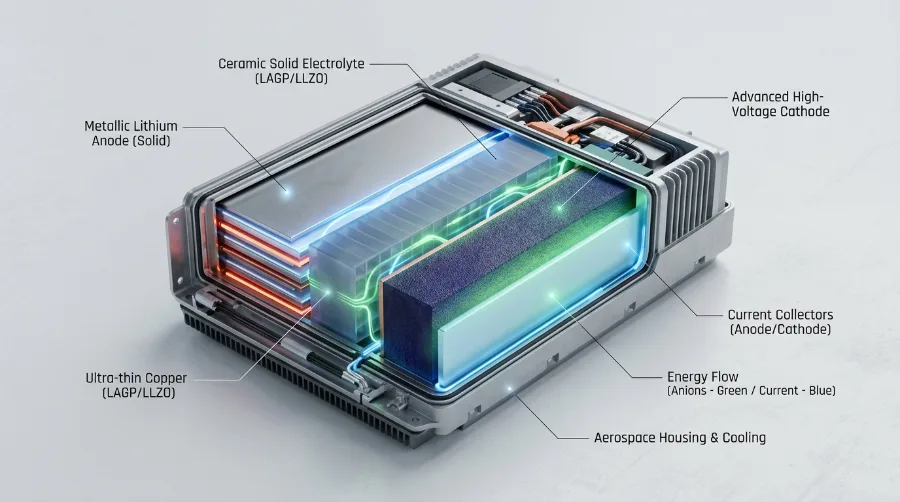
- Lithium Metal Anodes: Modern solid-state cells utilize pure metallic lithium anodes with a theoretical capacity of 3,860 mAh/g, compared to graphite’s 372 mAh/g.
- Solid Electrolyte Interphase: Ceramic, sulfide, and polymer electrolytes conduct lithium ions (Li+) efficiently while eliminating liquid leakage risks.
| Battery Metric | Traditional Liquid Li-Ion | Advanced Solid-State (SSB) | Aviation Target (2030+) |
|---|---|---|---|
| Cell Energy Density | 250 – 300 Wh/kg | 450 – 600 Wh/kg | > 500 Wh/kg |
| Volumetric Density | 600 – 700 Wh/L | 1,000 – 1,200 Wh/L | > 1,100 Wh/L |
| Electrolyte Type | Liquid Organic Solvents | Ceramic / Sulfide / Polymer | Solid Ceramic / Sulfide |
| Thermal Runaway Risk | High (Flammable liquid) | Extremely Low (Incombustible) | Near Zero |
| Cycle Life (C/3 rate) | 1,000 – 1,500 cycles | 2,000 – 4,000+ cycles | > 2,500 cycles |
| Fast Charge Capability | 20–80% in 30–45 mins | 20–80% in 10–15 mins | < 15 mins |
2. Thermal Safety and Structural Integration in Aerospace
In commercial aviation, safety parameters are non-negotiable. Standard FAA (Federal Aviation Administration) and EASA (European Union Aviation Safety Agency) certification frameworks dictate that safe energy storage systems must guarantee zero thermal runaway propagation between cells.
Eliminating Thermal Runaway Hazards
Liquid electrolytes contain volatile hydrocarbon solvents that vaporize and ignite at elevated temperatures (~130°C – 150°C), leading to uncontrollable thermal runaway. Solid ceramic and sulfide materials remain non-flammable up to 500°C.
- Reduced Parasitic Cooling Mass: The high thermal tolerance of solid-state batteries in electric aviation eliminates heavy liquid cooling pumps, saving critical aircraft takeoff weight.
- Structural Battery Enclosures: Modules can be integrated directly into airframes via Cell-to-Wing (CTW) and Cell-to-Body (CTB) architectures.
3. Global Ecosystem, Research Centers, and Market Players
Global aerospace entities are pouring capital into developing commercial platforms across key industrial regions.
North America
- NASA (SABERS Initiative): NASA’s research into advanced cells has verified energy densities exceeding 500 Wh/kg under simulated flight pressures.
- QuantumScape & Solid Power: Leading U.S. developers manufacturing cell formats tailored to aircraft performance requirements.
Europe
- EASA & EU Clean Aviation: European regulators are actively drafting airworthiness standards specifically for solid-state batteries in electric aviation systems.
- Airbus & Lilium: Next-generation aircraft architectures are being designed explicitly around high-C-rate cell specs.
Asia-Pacific
- CATL Innovations: CATL’s high-density condensed-matter cells demonstrate how advanced storage will enter commercial operation.
4. Regional Impacts and Flight Economics
Adopting zero-emission propulsion provides unmatched operating cost advantages for regional passenger flights.
United States: Regional Air Mobility (RAM) Revival
Deploying solid-state batteries in electric aviation on short 200-to-500-mile commuter routes reduces direct operating costs by 40–60% per seat-mile.
European Union: Regional Flight Bans and Grid Alignment
Strict European emission policies position clean aircraft as the primary replacement for banned short-haul domestic flights.
Asia-Pacific: Island Hopping and Megacity eVTOL Corridors
Inter-island transport networks in the Pacific benefit directly from high efficiency due to lower maintenance logistics.
5. Key Technological Challenges Remaining
Engineering teams optimizing solid-state batteries in electric aviation must resolve dendrite growth, stack pressure stability, and 100% mass manufacturing yields before scaling production globally.
6. Regulatory Pathways, Certification, and Future Outlook
Airworthiness bodies are adapting certification protocols like FAA Part 23 and RTCA DO-311A to safely govern flight operations.
Summary: The widespread adoption of zero-emission tech will redefine clean air transport, creating 100% sustainable alternatives for short-haul passenger routes.
For the ground-vehicle side of this technology, see the full solid state battery vs lithium-ion EV guide.
External & Internal Strategic References
- Explore more on global transportation decarbonization at ZeroCarbonDrive.
- Read our detailed breakdown on Electric Aircraft Battery Technology to compare chemical compositions.
- Examine operational emissions comparisons in our analysis of Diesel vs Electric Emissions.
- Review international aviation emissions standards via the International Civil Aviation Organization (ICAO).
- Learn about federal aerospace airworthiness frameworks at the Federal Aviation Administration (FAA).
- Track European aviation safety and certification protocols via the European Union Aviation Safety Agency (EASA).
Related guides: Hydrogen Fuel Cells vs Solid-State Batteries in Aviation: 2026, Are Solid-State Batteries the Future of EVs? and Sustainable aviation fuels versus batteries.
Every figure on this page is dated and linked to its source. How we verify · Editorial policy · Report a correction
Related Posts



Leave a Comment
Your comment will be published after it has been approved. Please send comments that do not contain slang words.