
EV Charging Connector Types Explained
Updated September 2, 2026 · 3 min read
Table of Contents
- Introduction
- Types of EV Charging Connectors
- Charging Speeds and Power Levels
- Compatibility
- Applications
- Region-Specific Considerations
- Frequently Asked Questions
Introduction
Electric vehicles are becoming increasingly popular due to their environmental benefits and cost savings. As more EVs hit the roads, the need for a robust charging infrastructure becomes paramount. One crucial aspect of this infrastructure is the variety of EV charging connectors available, each designed to meet specific needs and standards.
Types of EV Charging Connectors
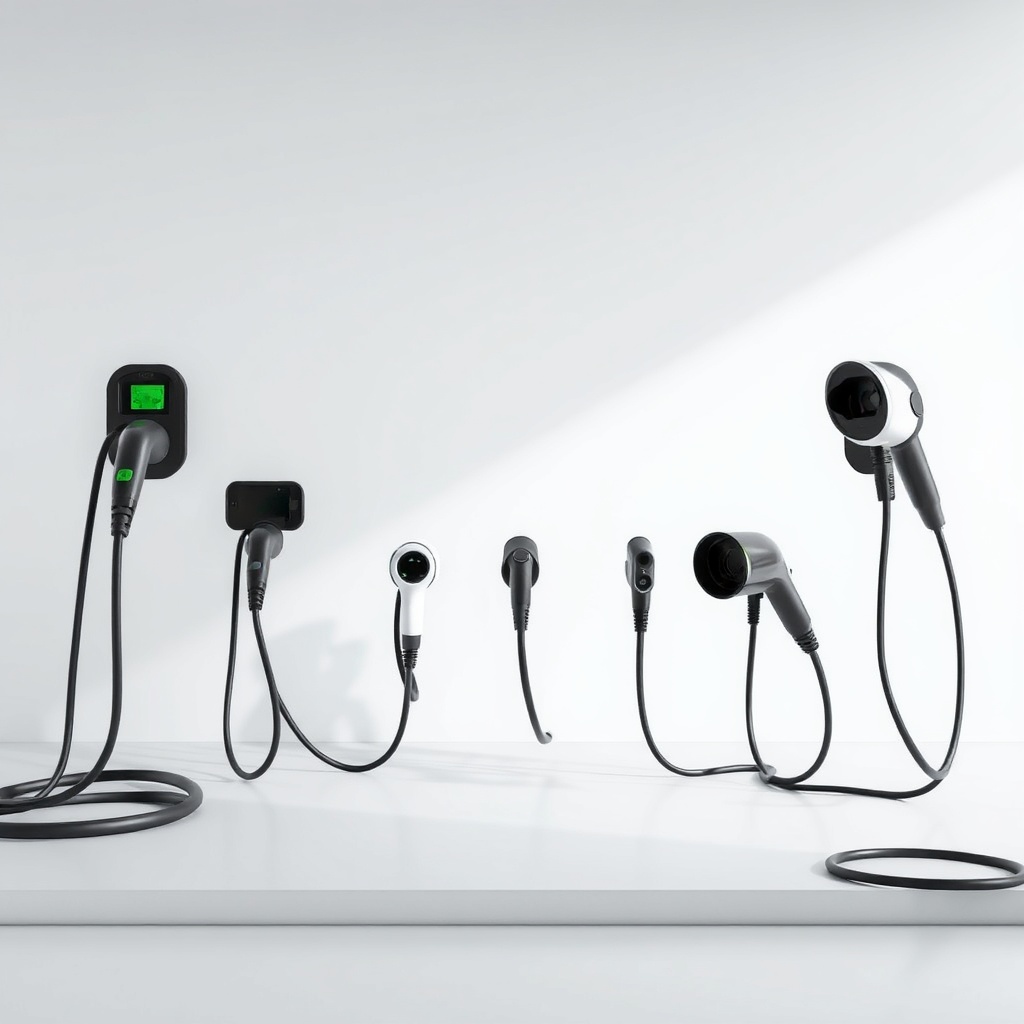
There are several common types of EV charging connectors, each with its unique design and functionality. The most prevalent connector types include:
- SAE J1772 (Type 1)
- IEC 62196 (Type 2)
- CHAdeMO
- CCS (Combined Charging System)
| Connector Type | Compatibility | Charging Speed |
|---|---|---|
| SAE J1772 (Type 1) | Mainly used in the US and Japan | Up to 19 kW |
| IEC 62196 (Type 2) | Common in Europe | Up to 43 kW |
| CHAdeMO | Primarily used by Japanese automakers | Up to 100 kW |
| CCS | Adopted in Europe and North America | Up to 350 kW |
Charging Speeds and Power Levels
The charging speed of an EV is determined by the power output of the charging station and the compatible connector. Different connectors support varying power levels, which affect the time required to charge an EV fully.
- Level 1 Charging: Typically uses a standard household outlet and provides a slow charging rate.
- Level 2 Charging: Utilizes dedicated charging stations with higher power output for faster charging.
- DC Fast Charging: Enables rapid charging at public stations, ideal for long-distance travel.
Compatibility
Ensuring compatibility between the EV, charging station, and connector is crucial for a seamless charging experience. Most EV manufacturers provide information on the compatible charging connectors for their vehicles, simplifying the selection process for users.
Applications
The choice of EV charging connector depends on the intended application and usage scenario. For residential charging, a Level 2 connector may suffice, while commercial installations and public charging networks often require DC fast charging capabilities.
Region-Specific Considerations
- US: The SAE J1772 connector is prevalent, with an emphasis on CCS for fast charging networks.
- EU: IEC 62196 Type 2 connectors dominate, especially for public charging infrastructure.
- China: Unique charging standards exist, with a focus on developing fast-charging technologies.
- India: Emerging EV market with evolving charging infrastructure, adopting international standards for compatibility.
Related guides: Electric vehicle motor types, Megawatt Charging For Trucks and Is EV Charging Cheaper Than Gas.
Frequently Asked Questions
What are the most common EV charging connector types?
The most common EV charging connector types include SAE J1772 (Type 1), IEC 62196 (Type 2), CHAdeMO, and CCS (Combined Charging System).
How do I know which connector type is compatible with my EV?
EV manufacturers provide information on the compatible charging connectors for their vehicles. Refer to the vehicle manual or contact the manufacturer for guidance.
What factors determine the charging speed of an EV?
The charging speed of an EV is influenced by the power output of the charging station, the capacity of the vehicle’s battery, and the compatibility of the charging connector.
Can I use different charging connectors with adapters?
While adapters exist to enable cross-compatibility between certain connector types, it is essential to follow manufacturer recommendations to avoid damage to the vehicle or charging equipment.
TAGS: ev charging, electric vehicles, charging connectors, charging infrastructure, ev charging standards, connector compatibility
Sources and Further Reading
Related Posts
1 Comment
The article explained EV charging connector types clearly. It helped me understand the differences and choose the right one for my electric vehicle.
Leave a Comment
Your comment will be published after it has been approved. Please send comments that do not contain slang words.