Carbon Footprint Labeling: 4 Facts Shoppers Should Know
Updated September 2, 2026 · 2 min read
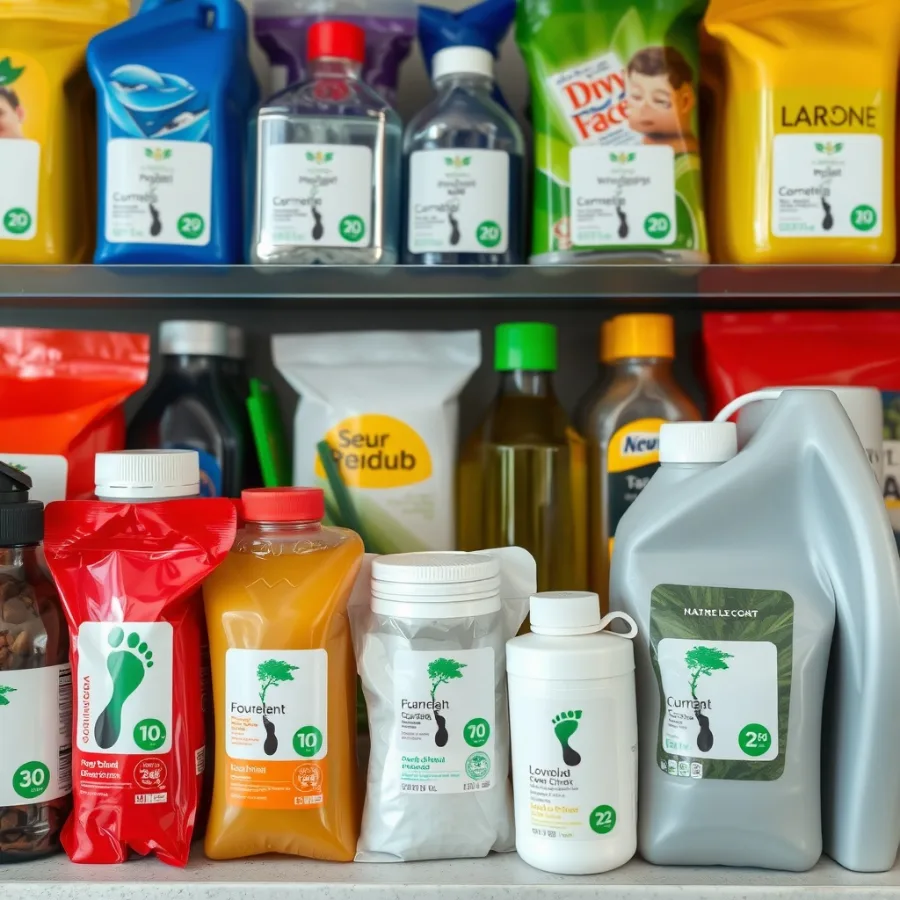
Carbon footprint labeling puts a product’s estimated greenhouse gas emissions — usually expressed as CO2-equivalent per unit — directly on its packaging, similar to how nutrition labels work for food. The goal is letting shoppers compare the climate impact of similar products at a glance, though the practice is still far from standardized, and label accuracy varies a lot depending on how rigorously the underlying emissions were calculated.
- No single global standard exists yet — several competing labeling schemes (like the Carbon Trust label and various retailer-specific systems) use different methodologies.
- A credible label is based on a full lifecycle assessment (LCA): raw materials, manufacturing, transport, use, and disposal — not just the factory’s direct emissions.
- The EU is moving toward mandatory carbon labeling requirements for some product categories, ahead of most other markets.
- Label accuracy varies significantly — third-party verified labels carry far more credibility than self-reported, unverified claims.
How credible carbon footprint labeling actually works
| Component | What it measures | Why it matters |
|---|---|---|
| Raw material sourcing | Emissions from extracting/growing inputs | Often the largest share for food and textiles |
| Manufacturing | Direct factory energy and process emissions | The most commonly measured component alone |
| Transport/distribution | Shipping from factory to shelf | Varies enormously by product origin |
| Use phase | Emissions from using the product (e.g. appliance energy use) | Can dominate for energy-using products |
| End of life | Disposal, recycling, or decomposition emissions | Often the least-measured component |
Why there’s no single standard yet
Unlike nutrition labeling, which most countries have standardized around similar formats, carbon footprint labeling has developed through a patchwork of voluntary industry schemes, retailer-specific pilot programs, and national initiatives — each with somewhat different measurement boundaries and verification requirements. This makes direct comparison between products carrying different labeling schemes difficult, and it’s a major reason regulators in some markets are moving toward mandatory, standardized requirements.
The EU’s move toward mandatory labeling
The European Union has been the most aggressive major market in pushing toward mandatory carbon labeling for specific product categories, building on its broader push for environmental product disclosures. This regulatory direction is likely to influence global labeling practices over time, the way EU chemical and food safety regulations have often set a de facto global standard that multinational companies adopt everywhere rather than maintaining separate labels per market.
What to actually trust on a label
Not all carbon labels carry equal weight. Third-party verified labels — where an independent auditor has checked the underlying lifecycle assessment methodology — are meaningfully more trustworthy than a company’s own unverified claim. Shoppers looking to actually compare products should check whether a label cites a recognized standard (like the Carbon Trust label or a Type III Environmental Product Declaration) rather than a vague, self-designed “eco” claim with no methodology disclosed.
Sources and Further Reading
- Carbon Trust: Product Carbon Footprint Label
- European Commission: Green Claims and Environmental Labeling
Fashion is one of the categories where this matters most \u2014 see our look at the fast fashion carbon footprint.
Tracking your own footprint is a natural next step \u2014 see which carbon footprint reduction apps actually work.
What is carbon footprint labeling?
Carbon footprint labeling puts a product’s estimated greenhouse gas emissions, usually as CO2-equivalent per unit, directly on packaging so shoppers can compare the climate impact of similar products at a glance.
Is there one global standard for carbon labeling?
No — several competing schemes exist, including the Carbon Trust label and various retailer-specific systems, each with somewhat different measurement boundaries, which makes direct comparison between differently-labeled products difficult.
What does a credible carbon label actually measure?
A credible label is based on a full lifecycle assessment covering raw material sourcing, manufacturing, transport, product use, and end-of-life disposal — not just a factory’s direct emissions.
Is carbon footprint labeling becoming mandatory anywhere?
The EU is moving toward mandatory carbon labeling requirements for some product categories, ahead of most other major markets, building on its broader environmental product disclosure regulations.
How can I tell if a carbon label is trustworthy?
Look for third-party verification and a recognized standard, like the Carbon Trust label or a Type III Environmental Product Declaration, rather than a vague self-designed eco-claim with no disclosed methodology.
Which part of a product’s lifecycle usually has the biggest carbon footprint?
It varies by product category — raw material sourcing often dominates for food and textiles, while the use phase (like energy consumption) can dominate for appliances and electronics.
Related Posts

Leave a Comment
Your comment will be published after it has been approved. Please send comments that do not contain slang words.