
EV Charging Idle Fees: What Tesla, Electrify America and EVgo Actually Publish
Updated September 12, 2026 · 11 min read
Last updated: 5 September 2026. Every figure below on idle fees was read from that company’s own page on that date and is quoted in the wording they use.
The short answer. Idle fees are not published as a national rate by any of the three largest US fast-charging networks. Tesla, Electrify America and EVgo each say, in their own words, that the rate is set per station and shown in the app or on the charger screen before you plug in. The per-minute figures repeated across the web are not published by the companies they are attributed to. The charges you can check in advance — and the fixed per-session fees that quietly cost small-top-up drivers the most — are set out below.
Key takeaways
- No network publishes a flat idle fee. All three point you at the app or the charger screen for the rate at that specific station.
- Tesla no longer calls it an idle fee. Its support page describes a congestion fee that can begin at 80 percent charge while a busy site is still charging your car, not only once the session ends.
- Free Supercharging does not exempt you. Tesla states congestion fees still apply to cars charging on free credits.
- The fee that catches most people is not the idle fee. EVgo lists a $0.99 session fee on Pay As You Go, and a separate $2.99 transaction fee for any session started with a credit card.
- Fixed fees hurt small charges most. On a 10 kWh top-up, a $2.99 card fee adds about 30¢ per kWh — more than the gap between a cheap and an expensive station.
What each network actually publishes about ev charging idle fees
This is the whole picture as published on 3 September 2026. The empty cells are not an oversight on our part — they are what the networks decline to state centrally.
| Network | Published idle or congestion fee | What they say instead | Fixed per-session charge |
|---|---|---|---|
| Tesla Supercharger | No figure published | “The rate structure for each site can be found on the site’s pop-up in the vehicle touchscreen or in the Tesla app.” | None stated |
| Electrify America | No figure published | “Please refer to the charger screen for the most up-to-date information concerning pricing, power levels, and idle fees for your session.” | None stated |
| EVgo | No figure published | “Station specific pricing by plan is available within the EVgo app.” | $0.99 session fee on Pay As You Go; $2.99 transaction fee for credit-card sessions |
Why does Tesla call it a congestion fee now?
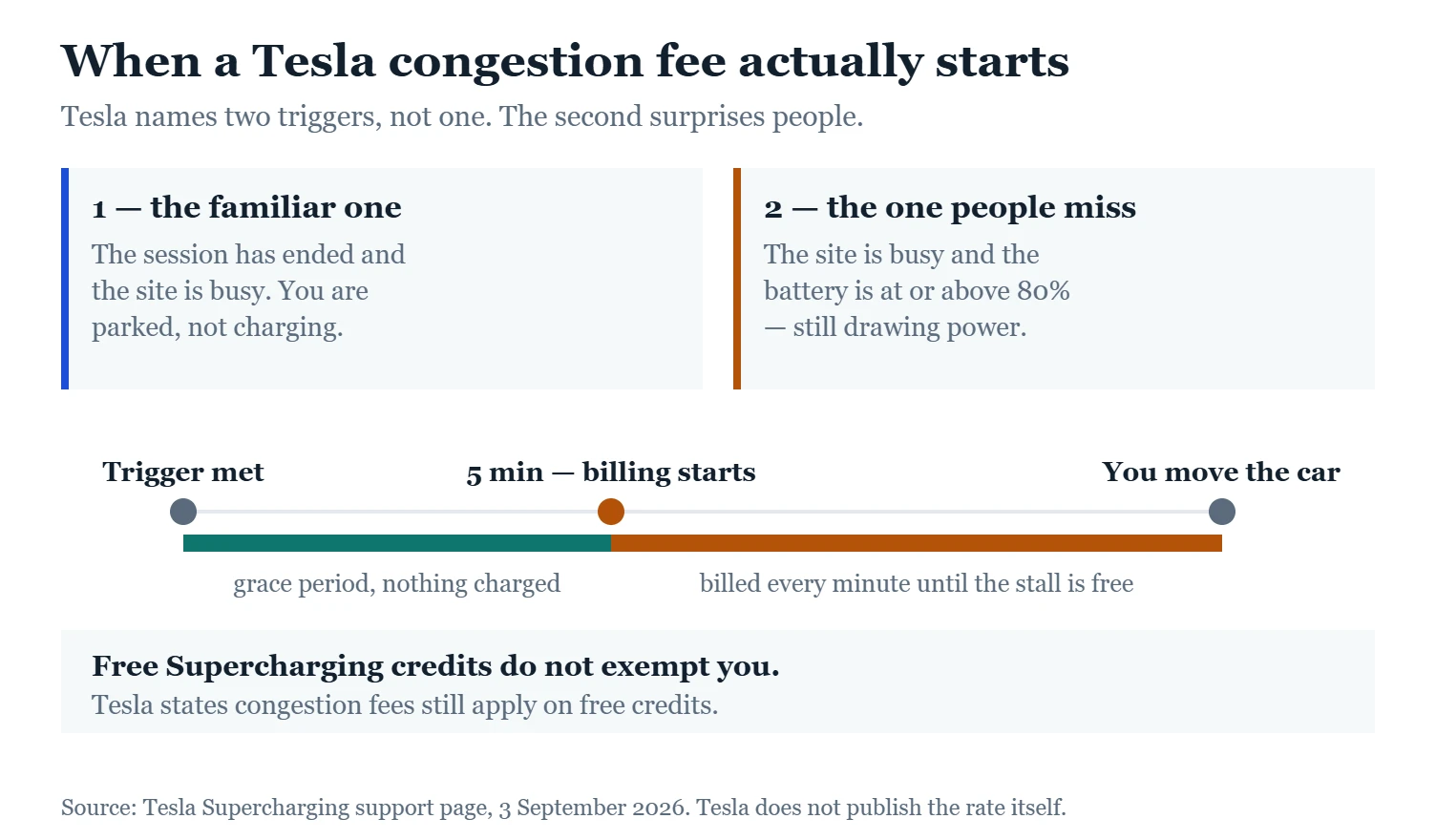
The change matters more than the name. Tesla’s Supercharging support page describes congestion fees this way: they accrue when a Supercharger site is busy and your vehicle’s battery is already at or above the congestion fee level of 80 percent charge, or your charging session has ended. Fees are waived for the first five minutes, then billed until the vehicle is moved.
Read that carefully. The old mental model — finish charging, then a clock starts — is only half of it. At a busy site the clock can start while you are still plugged in and still drawing power, simply because you crossed 80 percent. Tesla also notes that at high-use Superchargers your charge limit may be automatically adjusted to 80 percent, and that you can raise it manually after plugging in. Raising it at a busy site is exactly the situation the fee exists to price.
Two further details from the same page are worth knowing. Free Supercharging credits do not exempt you: Tesla states that Supercharging-related fees including congestion fees still apply. And congestion fees are separate from time-of-use pricing, which some Supercharger sites also run, with peak and off-peak rates shown in the vehicle and in the app.
What Electrify America and EVgo publish
Electrify America’s pricing page mentions idle fees twice and gives a number neither time. It says idle fees “may be imposed for parking time after your charging session has ended”, then directs drivers to the charger screen for current pricing, power levels and idle fees. Its published pricing structure is about membership rather than penalties: Pass+ costs a monthly fee and saves “about 25%” on charging.
EVgo is the most specific of the three, and the specifics are not about idling at all. Its published plans are Pay As You Go at $0/month with a $0.99 session fee, EVgo Plus at $6.99/month with no session fee, and EVgo PlusMax at $12.99/month with no session fee. A footnote adds the charge that is easiest to miss: a $2.99 transaction fee applies for all sessions initiated by credit card. Station-specific pricing, EVgo says, lives in the app.
The fee that actually costs you money
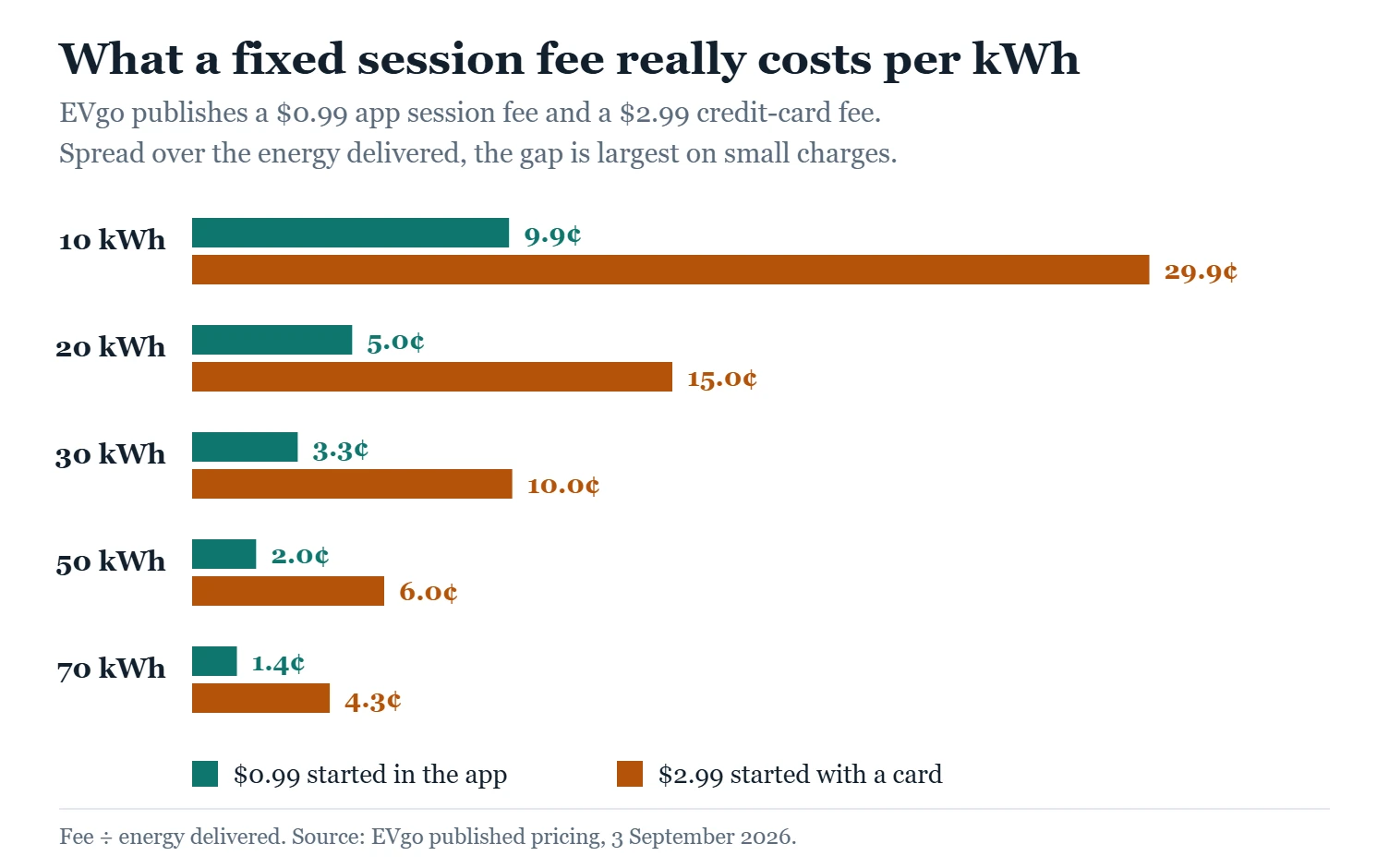
Idle fees are avoidable: move the car. Fixed per-session fees are not, and they behave in a way that per-kWh thinking hides. A flat fee is a large surcharge on a small charge and a rounding error on a big one. Here are EVgo’s two fixed fees expressed as an effective cost per kWh.
| Energy added | $0.99 app session fee | $2.99 credit-card session | Difference |
|---|---|---|---|
| 10 kWh (roughly 35–40 miles) | 9.9¢/kWh | 29.9¢/kWh | 20.0¢/kWh |
| 20 kWh | 5.0¢/kWh | 15.0¢/kWh | 10.0¢/kWh |
| 30 kWh | 3.3¢/kWh | 10.0¢/kWh | 6.7¢/kWh |
| 50 kWh | 2.0¢/kWh | 6.0¢/kWh | 4.0¢/kWh |
| 70 kWh (a large pack, near empty) | 1.4¢/kWh | 4.3¢/kWh | 2.9¢/kWh |
The practical reading: on a 10 kWh splash-and-dash, starting the session with a tapped credit card instead of the app costs about 20¢ per kWh more. That is larger than the spread between a cheap station and an expensive one. It is also the exact situation in which a driver is least likely to stop and open an app — a short stop, in a hurry, at an unfamiliar site.
The same arithmetic explains why stacking small top-ups is expensive on any network with a session fee. Three 15 kWh stops carry three fees; one 45 kWh stop carries one. If you want to see how that interacts with route planning, our EV road trip calculator models the stops rather than dividing two numbers, and our EV charging cost calculator compares home charging against public rates.
Per-minute billing: the cost trap nobody calls a fee
Tesla states that owners are billed per kWh “whenever possible”, and per minute in some areas. Where billing is per minute, Tesla publishes four tiers based on the speed your car is actually pulling:
| Tier | Charging speed | Price per minute |
|---|---|---|
| Tier 1 | At or below 60 kW | Lowest |
| Tier 2 | Above 60 kW, at or below 100 kW | Second lowest |
| Tier 3 | Above 100 kW, at or below 180 kW | Second highest |
| Tier 4 | Above 180 kW | Highest |
The tiers are designed to be fair — you pay more per minute when you are receiving more energy per minute. But they only track speed in bands, and your car does not charge at a constant rate. A cold battery, a pack already above 60 percent, or a shared cabinet with another car on it all slow you down. Under per-minute billing, every one of those situations raises your cost per kWh without anything appearing on your bill labelled as a fee.
This is the strongest practical argument for charging cold-weather sessions after preconditioning, and for stopping at 70–80 percent rather than pushing to full: past that point the car tapers hard, the minutes keep counting, and at a busy Tesla site the congestion clock may be running as well.
When does an EVgo plan pay for itself?
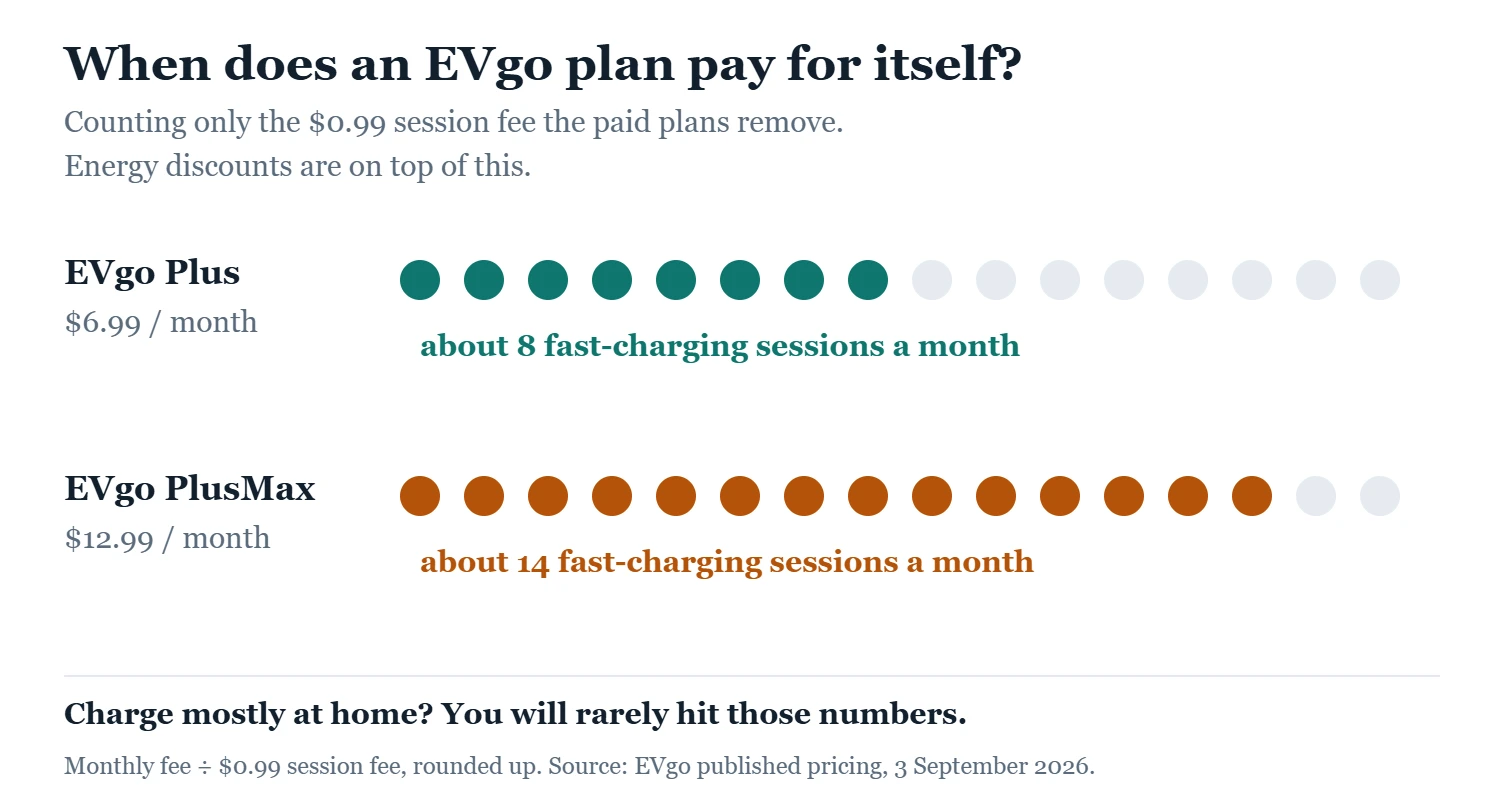
Because EVgo publishes both its monthly fees and its session fee, the break-even is arithmetic rather than opinion. Ignore the energy discounts for a moment and count only the $0.99 session fee that the paid plans remove:
| Plan | Monthly fee | Session fee | Sessions per month to break even on session fees alone |
|---|---|---|---|
| Pay As You Go | $0 | $0.99 | — |
| EVgo Plus | $6.99 | None | About 8 sessions |
| EVgo PlusMax | $12.99 | None | About 14 sessions |
Eight fast-charging sessions a month is a lot for someone who charges at home and uses public chargers on trips. For that driver the paid plans have to earn their keep on the energy discount — which EVgo describes as “up to” 15 or 30 percent, with actual savings varying by time of use, location, frequency and session length. For a driver without home charging, doing several public sessions a week, the session fee alone justifies a plan before any discount is counted. If you are in the first group, our state-by-state charging cost comparison is the better place to start.
How to see ev charging idle fees before you plug in
Every network gives the same instruction, and it is the only method that returns your actual number rather than someone else’s:
- Tesla: select the site in the vehicle touchscreen or the Tesla app and open its pop-up card. The rate structure for that site, including congestion fees and any peak/off-peak pricing, is shown there.
- Electrify America: select the station in the app for real-time pricing, or read the charger screen at the station. Electrify America explicitly names the charger screen as the most up-to-date source for idle fees.
- EVgo: station-specific pricing by plan is in the EVgo app. Start the session in the app rather than with a card and you avoid the $2.99 transaction fee.
If you are about to leave the car at a stall, the five-minute question is worth asking before you walk away rather than after: is this site busy, and am I above 80 percent? Those are the two conditions Tesla names.
Why the numbers you have read do not match
The figures circulating for idle fees are not invented. They are almost certainly accurate readings from particular stations at particular times. The failure happens one step later, when a site-specific rate is written up as network-wide policy, then cited by the next article, and the one after that.
That is worth naming plainly, because it is the same pattern we found when we checked utility EV charger rebate lists against the utilities’ own pages: widely repeated numbers that no longer matched the source, because nobody had gone back to the source. A rate that is set per station and changed at will cannot honestly be reported as a constant. The accurate version of this article is the table above, empty cells and all.
Frequently asked questions
How much are ev charging idle fees?
There is no single national figure. Tesla, Electrify America and EVgo each state that the rate is set per station and shown in the app or on the charger screen before you start. The per-minute numbers quoted around the web are not published by the networks they are attributed to, so treat them as reports from individual sites rather than as a rate card.
Does Tesla still charge idle fees?
Tesla’s Supercharging support page now describes congestion fees rather than idle fees. It says they accrue when a site is busy and your battery is at or above 80 percent, or your session has ended, with the first five minutes waived and billing continuing until the vehicle is moved. So the meter can start while you are still charging, not only after you finish.
Do free Supercharging credits cover congestion fees?
No. Tesla states that free Supercharging credits can only be used at Supercharger sites Tesla owns, and that Supercharging-related fees including congestion fees still apply. Free charging does not mean free parking at the stall.
What is the EVgo session fee?
EVgo’s pricing page lists a 0.99 dollar session fee on its Pay As You Go plan, with no session fee on the paid Plus and PlusMax plans. Separately, a footnote states that a 2.99 dollar transaction fee applies to all sessions initiated by credit card. Those are two different charges and the second one is easy to miss.
Is it cheaper to use the app than to tap a credit card?
At EVgo, yes, and the gap is largest on small top-ups. The difference between the 0.99 dollar app session fee and the 2.99 dollar credit-card transaction fee is two dollars. Spread over a 10 kWh top-up that is 20 cents per kWh, which is more than the price difference between many cheap and expensive stations.
How do I see the idle fee before I plug in?
All three networks say the same thing: check the station in the app, or read the charger screen. Tesla shows the rate structure on the site’s pop-up card in the vehicle or the app. Electrify America directs you to the charger screen or app. EVgo publishes station-specific pricing by plan in its app. This is the only reliable way to know your number.
Why do articles quote figures the networks do not publish?
Because the figures are real observations from particular stations that then get copied as if they were network-wide policy. A driver reports a rate, an article repeats it, and later articles cite that article. Nothing is fabricated at the start; it just stops being true once it is presented as a national rate.
Sources
- Tesla — Supercharging support page (congestion fees, free-credit exclusion, time-of-use pricing, per-minute tiers). Read 3 September 2026.
- Electrify America — Pricing and Plans (idle fees, charger-screen guidance, Pass+ savings). Read 3 September 2026.
- EVgo — Pricing and Plans (plan tiers, $0.99 session fee, $2.99 credit-card transaction fee). Read 3 September 2026.
Fees and plan structures change without notice. This page records what each network published on 3 September 2026; before relying on any figure, check the station in the relevant app. If you find something here that no longer matches the source, tell us and we will correct it.
Every figure on this page is dated and linked to its source. How we verify · Editorial policy · Report a correction
Related Posts

Leave a Comment
Your comment will be published after it has been approved. Please send comments that do not contain slang words.