
Form 1098-VLI: The Vehicle Loan Interest Statement, Explained

Updated September 12, 2026 · 10 min read
Last updated: 5 September 2026
Form 1098-VLI is the vehicle loan interest statement your lender sends you when you paid $600 or more of interest during the year on a qualifying car loan. Box 1 is the number you carry to Schedule 1-A, Part IV of your tax return. For the 2025 tax year the IRS granted lenders transition relief, so many borrowers will not receive an actual form and must pull the figure from their loan statement instead.
Key takeaways
- The vehicle loan interest statement reports interest on a specified passenger vehicle loan — a loan taken out after 2024, for a new personal-use vehicle finally assembled in the United States, secured by a first lien.
- Box 1 will usually be smaller than the total interest you paid. Interest on trade-in negative equity, gap or collision insurance, and any trailer or boat rolled into the same loan is excluded by law.
- The $600 threshold applies per loan, not per borrower. Two loans at $400 each produce no forms at all.
- No form does not mean no deduction. If your interest fell under $600, or your lender used the 2025 transition relief, you can still claim what you actually paid.
- The deduction is capped at $10,000 a year, runs for tax years 2025 through 2028, and phases out by $200 for every $1,000 of modified adjusted gross income above $100,000 (single) or $200,000 (joint).
What the vehicle loan interest statement is
The One Big Beautiful Bill Act created a deduction for interest paid on certain car loans. To let the IRS check the claims, it also created a new information return: Form 1098-VLI, Vehicle Loan Interest Statement. It works the way Form 1098 works for a mortgage — the lender files a copy with the IRS and sends you a copy.
A lender must file one if, in the course of a trade or business, it received $600 or more of interest on any single qualifying loan during the calendar year. The IRS calls that loan a specified passenger vehicle loan, or SPVL, and it has a precise definition: debt incurred after 2024, used to buy an applicable passenger vehicle for personal use, and secured by a first lien on that vehicle.
The vehicle itself has to clear six tests. It must be new to you, built for public roads, have at least two wheels, be a car, minivan, van, SUV, pickup or motorcycle, have a gross vehicle weight rating under 14,000 pounds, and have undergone final assembly in the United States. That last test is about the assembly plant, not the badge on the bonnet — a Japanese brand built in Kentucky qualifies and an American brand built in Mexico does not.
Why you may not receive a form for 2025
This is the part that catches people out, and most published guides skip it. In Notice 2025-57 the IRS gave lenders transition relief for the 2025 calendar year. For 2025 only, a lender is treated as having met its reporting obligation if it simply makes the total interest available to you — on an online portal, in a regular monthly statement, on an annual statement, or by similar means. The IRS also said it would not impose penalties on lenders who took that route.
The practical consequence: for the 2025 tax year, waiting for a form in the post may mean waiting for something that never arrives. Log into your loan servicer, find the year-end interest total, and keep a copy. Proper Form 1098-VLI reporting begins with the 2026 calendar year, with those statements due to you by 31 January 2027.
What every box on Form 1098-VLI means
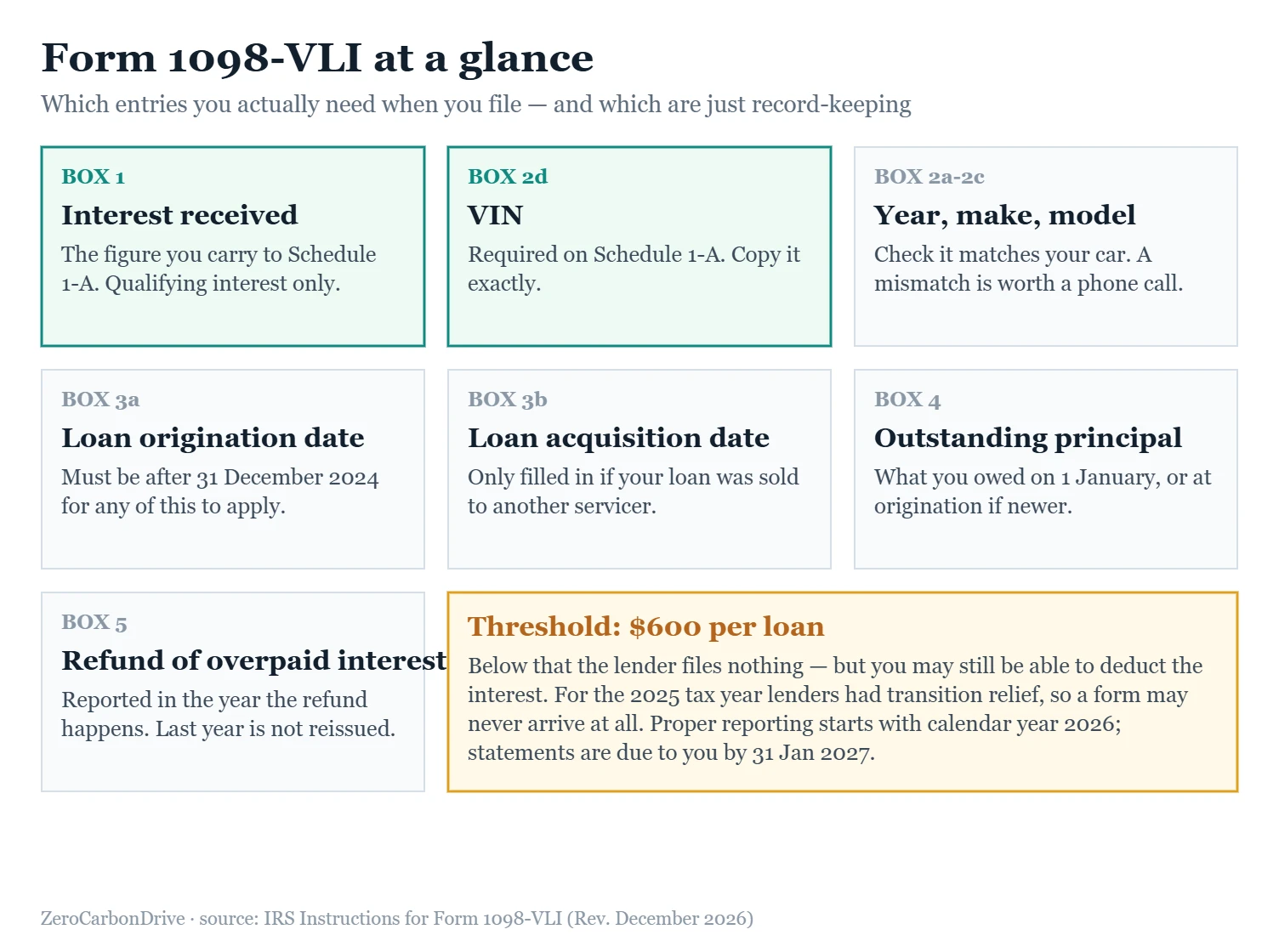
The form is short. Here is what each entry holds, taken from the IRS instructions for the December 2026 revision.
| Box | Label | What it holds, and why it matters to you |
|---|---|---|
| — | Recipient’s / Lender’s details | Name, address, phone and TIN of whoever filed. If your loan was sold, this is the current servicer, not the dealer you signed with. |
| — | Payer of record | Your name and address. On a joint loan only one borrower is named, and only that person gets a form. |
| 1 | Vehicle loan interest received by lender | The number you actually use. Interest the lender received from you during the calendar year — but only the qualifying portion. See the next section. |
| 2a / 2b / 2c | Year, make, model | Identifies the vehicle. Check it — a mismatch here is worth a phone call before you file. |
| 2d | VIN | You must copy this onto Schedule 1-A. If the car was replaced under warranty by a substitute vehicle, the lender reports the substitute’s VIN. |
| 3a | Loan origination date | The date the loan was first made. It must be after 31 December 2024 for any of this to apply. |
| 3b | Loan acquisition date | Only filled in if the servicer bought your loan from someone else. Blank otherwise. |
| 4 | Outstanding principal | What you owed on 1 January of that year — or on the origination date if the loan started mid-year. |
| 5 | Refund of overpaid interest | A refund or credit of interest you overpaid in an earlier year. It is reported in the year the refund happens; last year’s form is not reissued. |
Why box 1 is smaller than the interest you paid
Most car loans are not purely car loans. Dealers routinely roll other things into the same financing, and the law splits them apart. Only the qualifying slice generates deductible interest, so the lender has to allocate your payments and report only that share.
| Rolled into your loan | Counts toward the qualifying loan? |
|---|---|
| The vehicle purchase price | Yes |
| Sales tax and vehicle-related fees | Yes — customarily financed with the purchase |
| Extended warranty or vehicle service plan | Yes |
| Negative equity from a trade-in | No |
| Collision, liability or gap insurance | No |
| A trailer, boat or other unrelated property | No |
If you rolled $6,000 of negative equity into a $40,000 deal, roughly 13 per cent of your interest is not deductible and box 1 will reflect that. This is not an error on the form. It is the single most common reason the number on the vehicle loan interest statement is lower than the total your banking app shows for the year.
How the number gets onto your tax return
- Take the interest figure — box 1 of the vehicle loan interest statement, or your year-end statement total for 2025.
- Complete Schedule 1-A (Additional Deductions), Part IV, headed “No Tax on Car Loan Interest”.
- Enter the VIN from box 2d. The IRS states plainly that the vehicle identification number of the purchased vehicle must be reported on Schedule 1-A.
- Apply the income phaseout to reach your allowable amount.
- Carry the Schedule 1-A total to Form 1040, line 13b.
One detail worth knowing: this is not an itemised deduction. The IRS confirms taxpayers can deduct qualified passenger vehicle loan interest whether they claim the standard deduction or itemise. Most car buyers take the standard deduction, so without that rule the provision would have been nearly worthless.
What the deduction is actually worth
A deduction lowers taxable income; it is not a credit. Deducting $3,000 of interest in the 22 per cent bracket saves $660, not $3,000. The cap is $10,000 of interest a year, which almost nobody reaches — you would need a very large balance at a high rate.
Then income cuts it further. The allowable amount drops by $200 for every $1,000 of modified adjusted gross income above the threshold, which zeroes the full $10,000 out across a $50,000 band.
| Filing status | Phaseout starts | Fully gone at |
|---|---|---|
| Single, estates and trusts | $100,000 MAGI | $150,000 MAGI |
| Married filing jointly | $200,000 MAGI | $250,000 MAGI |
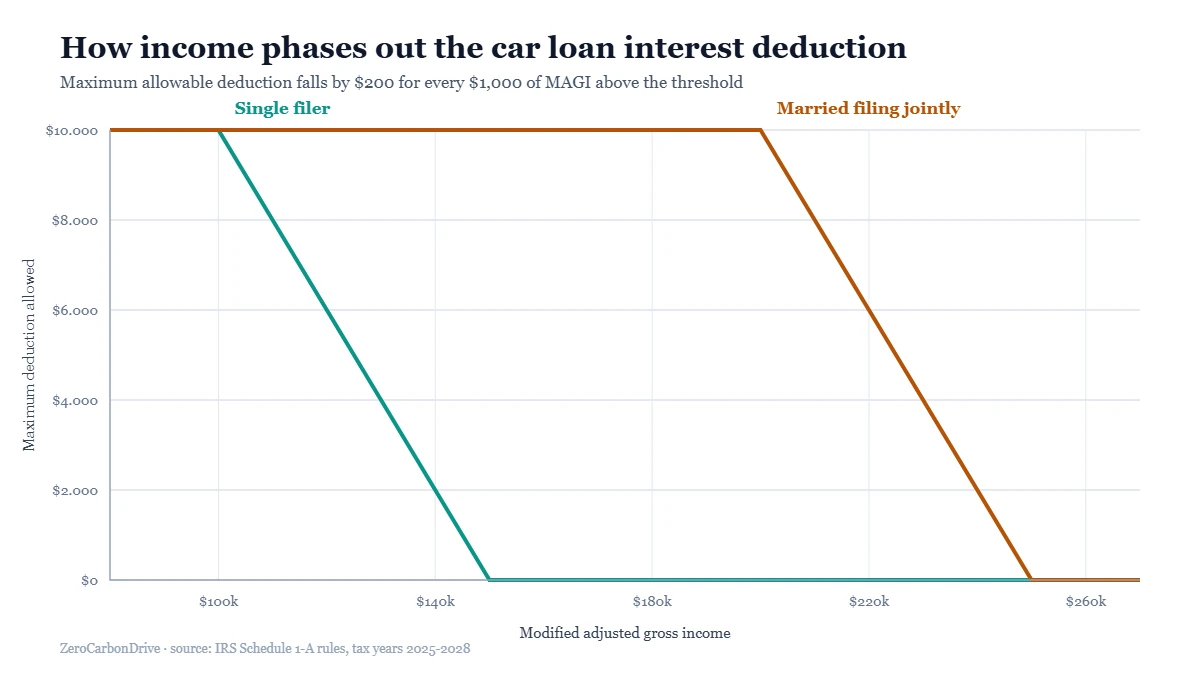
A worked example. A $45,000 loan at 8 per cent over 72 months produces roughly $3,400 of interest in its first full year. A single filer with $110,000 MAGI is $10,000 over the threshold, so the reduction is $2,000. Allowable interest becomes $1,400, and at a 22 per cent marginal rate that is about $308 of tax saved. Useful, but not the headline number the phrase “$10,000 deduction” suggests.
When a loan quietly stops qualifying
Several ordinary events end eligibility, and none of them announce themselves on the vehicle loan interest statement — the form simply stops arriving, or the figure changes.
- You refinance. The new loan still qualifies if it is secured by a first lien on the same vehicle, but only up to the balance outstanding on the day you refinanced. Cash taken out above that is not deductible and must be allocated pro rata.
- The borrower changes. If someone else takes over as obligor, the loan stops qualifying from that point. Death of the original borrower is the only exception.
- You borrowed from family. Loans from a related party under sections 267(b) or 707(b)(1) are excluded outright.
- You leased. Lease payments never qualified, and no amount of paperwork changes that.
- You returned the car within 30 days. Original use then never began with you, so the vehicle test fails.
No form arrived. Can you still claim it?
Usually, yes. The $600 figure is a lender filing threshold, not an eligibility threshold, and it applies separately to each loan. Pay $450 of interest and the lender files nothing — but the interest was still paid on a qualifying loan, and the deduction rules do not contain a $600 floor.
What you need is evidence and a VIN. Pull the year-end interest total from your servicer, confirm the loan originated after 31 December 2024 and is secured by a first lien, check the VIN decodes to a US assembly plant, and keep the statement. If anything was rolled into the loan that does not qualify, work out the qualifying share yourself rather than claiming the whole figure — that allocation is exactly what the lender would have done for you in box 1.
Anything genuinely uncertain here — allocation across mixed financing, a mid-year refinance, a change in obligor — is worth a conversation with a tax professional. This page explains what the form says; it is not tax advice for your situation.
Related guides
- State EV incentives in 2026 — what survived after the federal purchase credits ended.
- The home EV charger tax credit — the 30C credit and its June 2026 expiry.
- How fast EVs lose value — the other half of what an EV really costs you.
- The cheapest electric cars on sale — verified prices, and which are US-assembled.
- Was your car assembled in the US? — how to check your own VIN properly, and why the first digit is not the test.
Sources
- IRS, Instructions for Form 1098-VLI (Rev. December 2026) — box definitions, the SPVL and APV tests, the $600 threshold, refinancing and obligor rules.
- IRS, Schedule 1-A: what to know about the new form — the VIN requirement, loan conditions and Form 1040 line 13b.
- IRS newsroom, Schedule 1-A published — confirmation the deduction is available alongside the standard deduction.
- IRS Notice 2025-57, 2025-45 I.R.B. 692 — transition relief for lenders for the 2025 calendar year.
Frequently asked questions
What is Form 1098-VLI?
It is the Vehicle Loan Interest Statement. A lender files it with the IRS and sends you a copy when it received $600 or more of interest during the year on a qualifying car loan — one taken out after 2024, for a new personal-use vehicle assembled in the United States, secured by a first lien.
Which box do I use for my tax return?
Box 1, vehicle loan interest received by lender. You also need the VIN from box 2d, because the IRS requires the vehicle identification number to be reported on Schedule 1-A.
Why is box 1 lower than the interest I paid?
Because interest on anything rolled into the loan that does not qualify is stripped out. Trade-in negative equity, collision or gap insurance, and unrelated property such as a trailer or boat are all excluded, so the lender allocates your payments and reports only the qualifying share.
I did not get a form for 2025. What now?
That is expected. IRS Notice 2025-57 gave lenders transition relief for the 2025 calendar year, letting them satisfy the requirement by making the interest total available on a portal or statement instead of filing a form. Get the year-end total from your servicer and keep a copy.
Can I claim the deduction if I paid less than $600 of interest?
Yes. The $600 figure is the threshold for the lender to file a form, not a minimum for the deduction. You still need records showing the interest paid, the loan terms and the VIN.
Does refinancing my car loan break the deduction?
Not necessarily. The new loan still qualifies if it is secured by a first lien on the same vehicle, but only up to the balance outstanding on the day you refinanced. Any extra borrowed above that must be allocated out.
How much tax will this actually save me?
Less than the headline suggests. It is a deduction, not a credit, so a $3,000 deduction in the 22 per cent bracket saves about $660 — and the allowable amount falls by $200 for every $1,000 of MAGI above $100,000 single or $200,000 joint.
Which tax years does the deduction cover?
Tax years 2025 through 2028, for loans originated after 31 December 2024. Proper Form 1098-VLI reporting starts with the 2026 calendar year, with statements due to borrowers by 31 January 2027.
Every figure on this page is dated and linked to its source. How we verify · Editorial policy · Report a correction
Related Posts


Leave a Comment
Your comment will be published after it has been approved. Please send comments that do not contain slang words.