
What counts as a zero-emission vehicle — and what still comes off the car
Updated September 16, 2026 · 5 min read
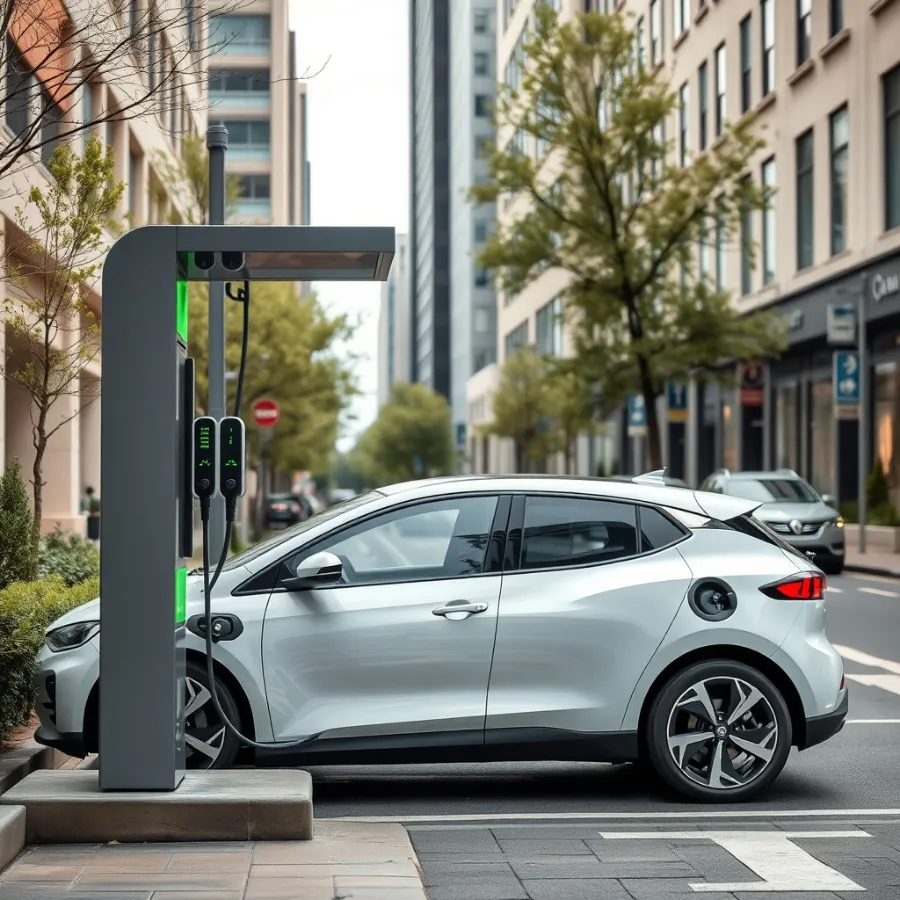
“Zero-emission vehicle” is a statement about the tailpipe, not about the whole car. A battery-electric or hydrogen fuel-cell vehicle emits nothing where an exhaust pipe would be, which is exactly what the regulations that use the term measure. Everything else — the power station that charged it, the factory that built the battery, the tyres that wear on the road — sits outside that boundary and is where the real arguments are.
That is not a reason to distrust the label. It is a reason to know what it covers, because the answer changes what you should compare when you are choosing a car.
What the term actually measures
The US Environmental Protection Agency puts the boundary plainly: electric vehicles have no tailpipe emissions, but generating the electricity used to charge them may create carbon pollution, and the amount “varies widely based on how local power is generated” — coal and natural gas emit, wind and solar do not.
So the same electric car is a different proposition in two different places, and the difference is not small. The EPA publishes two tools that turn this into a number for your own address rather than a national average: Power Profiler, which shows the generation mix in your grid region from a zip code, and the Beyond Tailpipe Emissions Calculator, which estimates the greenhouse gases behind charging a specific model where you live. If you want the honest figure for your car rather than the label on it, those are the two links that matter on this page.
The efficiency gap is the part that does not depend on the grid
One number explains why electrifying a car changes its energy footprint even before the grid is counted. According to the EPA, electric vehicles use approximately 87% to 91% of the energy from the battery and regenerative braking to move the car. Gasoline vehicles convert about 16% to 25% of the energy in the fuel into movement, averaged across city and highway driving.
Most of the energy in a tank of petrol leaves as heat. That ratio is a property of the machine, not of the electricity behind it, and it is the reason an electric car can still come out ahead on a grid that is far from clean. How the arithmetic works over a whole fuel chain is set out in our explainer on well-to-wheel emissions.
Where an electric car starts behind
Manufacturing is the part of the story the label leaves out, and it genuinely counts against the electric car at the start of its life. The EPA’s summary of the research is direct: making a typical EV can create more carbon pollution than making a gasoline car, because of the energy required to manufacture the battery. Its illustration uses Argonne National Laboratory estimates for a gasoline car and an EV with a 300-mile range, in which emissions from EV manufacturing and end-of-life are higher — and the lifetime total is still lower, because the driving years that follow are so much cleaner.
That is the shape of the whole question: an EV begins with a debt and pays it back with use. Where the break-even falls depends on the battery, the grid and how far the car is driven, and we work through it with the numbers in EV vs gas car lifecycle emissions.
The emissions no electric car removes
There is one category that survives electrification entirely, and it is growing. Tyres, brakes and the road surface itself shed particles as a vehicle drives, and those are counted separately from anything that leaves an exhaust. The European Environment Agency’s 2025 assessment of Europe’s mobility systems records that overall particulate matter emissions fell 53% between 1990 and 2023, while non-exhaust emissions from road transport — tyre, brake and road abrasion — rose by 63.1% over the same period.
Every car produces them, electric ones included. Regenerative braking takes work away from the friction brakes, which helps on one of the three sources; the tyres and the road are unaffected by what turns the wheels. A car that emits nothing from a tailpipe is still a heavy object being dragged across asphalt, and “zero emission” was never a claim about that.
So is the term marketing?
No — it is a regulatory category, and it is used to write rules rather than adverts. Fleet mandates and vehicle standards need a definition that can be tested on a rolling road, and tailpipe output is one that can. The interesting question is not whether the definition is complete but what the rules built on it require and when; we track that in zero-emission vehicle rules for 2035.
For a buyer, the practical translation is short. Compare cars on the energy they use per mile, on the grid you will actually charge from, and on how long you will keep the car — not on whether the badge says zero. And if the charging side is the part you have not worked out yet, start with our Level 2 charger guide.
Frequently asked questions
Does a zero-emission vehicle really emit nothing?
Nothing from a tailpipe, which is what the term measures. Charging it may produce emissions at the power station, building it produces emissions at the factory, and its tyres and brakes shed particles as it drives. The label is precise about a narrow thing rather than vague about a broad one.
Do electric cars beat petrol cars once the power station is counted?
Typically yes, according to the EPA, which states that even accounting for electricity emissions an EV is usually responsible for lower greenhouse gases than an average new gasoline car — and that the gap widens as more wind and solar enter the grid. How much depends on where you charge, which is why the Power Profiler figure for your own region is worth two minutes.
What about the battery?
Battery manufacturing is the reason an EV starts its life with a higher emissions total than a comparable petrol car. The EPA’s own illustration, using Argonne National Laboratory estimates, shows exactly that — and shows the lifetime total ending up lower anyway.
Which vehicles count as zero emission?
Battery-electric vehicles and hydrogen fuel-cell vehicles: the two drivetrains with no exhaust. Plug-in hybrids have a tailpipe and are treated as a separate category in the rules, however far they travel on electricity alone.
Sources
US Environmental Protection Agency, Electric Vehicle Myths — tailpipe and grid emissions, the 87-91% versus 16-25% efficiency comparison, and the Argonne National Laboratory lifecycle illustration (GREET 2 2021, model year 2020), retrieved 17 September 2026. European Environment Agency, Sustainability of Europe’s mobility systems 2025: air pollution — the 53% fall in particulate matter and the 63.1% rise in non-exhaust road transport emissions, 1990 to 2023, retrieved 17 September 2026.
Every figure on this page is dated and linked to its source. How we verify · Editorial policy · Report a correction
Related Posts
Leave a Comment
Your comment will be published after it has been approved. Please send comments that do not contain slang words.