
Commercial EV Charging Station Cost (2026): Hardware, Install and the Demand-Charge Math
Updated September 14, 2026 · 7 min read
Last updated: 7 September 2026. Equipment and installation figures are US Department of Energy published ranges; electricity prices are pulled live from EIA on the day this page was last built.
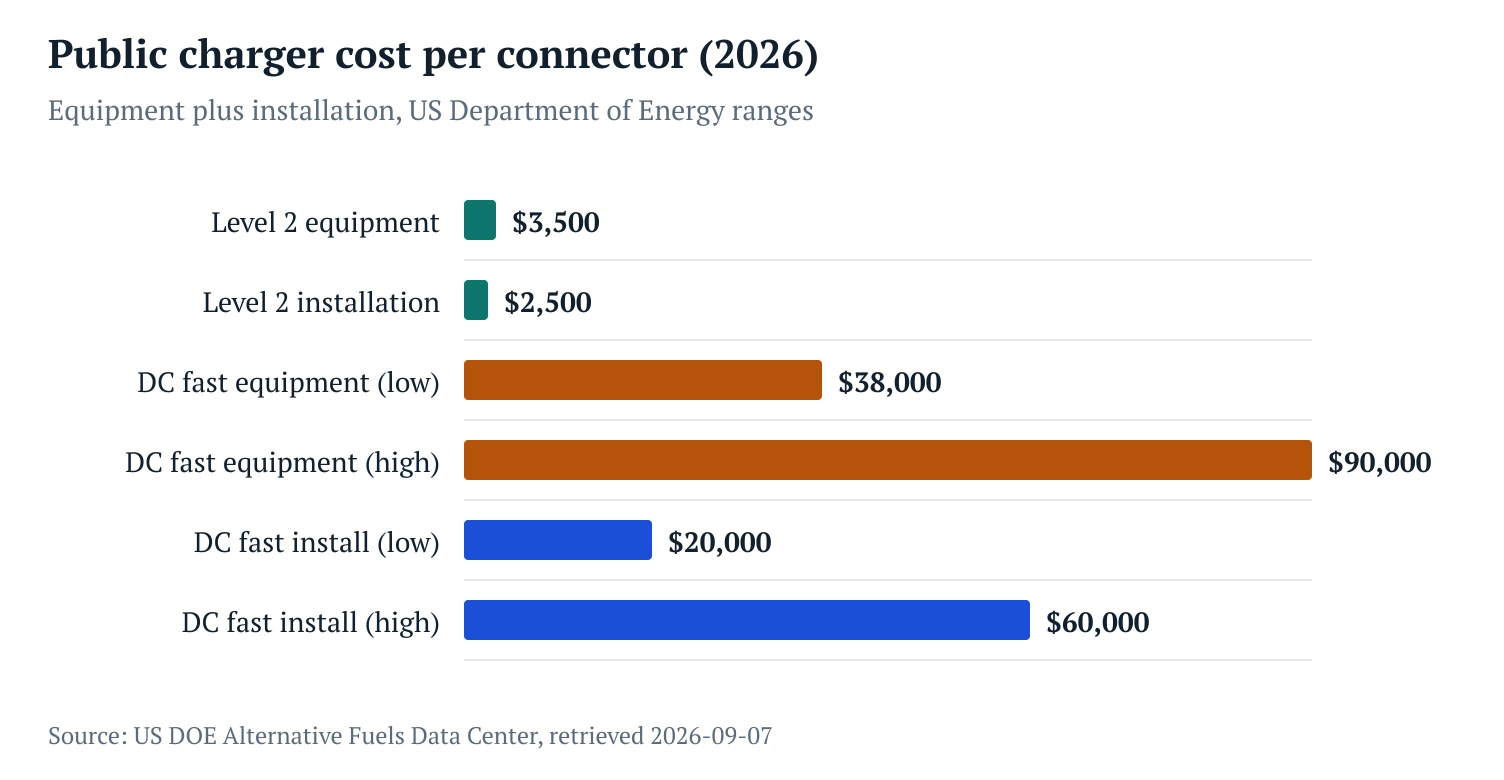
A public Level 2 connector costs roughly $3,500 in hardware plus about $2,500 to install, while a DC fast connector runs $38,000–$90,000 in hardware plus $20,000–$60,000 to install, according to the US Department of Energy. But the number that decides whether a site makes money is not the install cost — it is the demand charge, which is billed on your highest 15-minute power draw and barely moves when utilisation is low.
Key takeaways
- DOE puts public Level 2 at about $3,500 per connector for equipment and $2,500 per connector to install.
- DOE puts DC fast at $38,000–$90,000 per connector for equipment and $20,000–$60,000 to install, depending on power output.
- Labour, not hardware, is the largest single line item in a typical installation.
- Demand charges are billed on peak kW, not energy used, so a lightly-used fast charger pays nearly the same demand bill as a busy one — this is what kills early-stage sites.
- The federal 30C refuelling-property credit is gone: it does not apply to charging property placed in service after 30 June 2026.
What does a commercial EV charging station cost per connector?
Costs are quoted per connector, not per unit, because a single pedestal often serves two cars. The US Department of Energy publishes ranges for public and workplace installations, and they are wide for a reason: the charger itself is frequently the smallest line on the invoice.
The figures below are DOE’s published ranges for public and workplace charging. They exclude the site work that dominates most real projects — trenching, a new service, transformer upgrades, permitting and traffic control.
| Charger type | Equipment per connector | Installation per connector |
|---|---|---|
| Public Level 2 | ~$3,500 | ~$2,500 |
| DC fast | $38,000–$90,000 | $20,000–$60,000 |
| Residential Level 2 (for contrast) | $380–$690 | $400–$600 (Level 1) |
Why is installation more expensive than the charger?
DOE states plainly that labour is the largest expense in a typical installation. A Level 2 unit on an existing panel a few metres from the parking bay is a day of electrical work. The same unit 60 metres away, across a drive aisle, on a panel with no spare capacity, is trenching, conduit, a sub-panel and a utility coordination process measured in months.
DC fast charging changes the problem category. At 150 kW and above you are usually adding a service, sometimes a transformer, and the utility’s make-ready timeline — not your electrician’s — sets the schedule. This is why the same nominal charger can land anywhere in a $20,000–$60,000 installation band.
How do demand charges work, and why do they decide profitability?
Commercial electricity bills have two parts. The energy charge bills what you consumed, in kWh. The demand charge bills your highest sustained draw during the billing period — typically the peak 15-minute average — in dollars per kW, and it is levied whether that peak happened once or a thousand times.
For a fast charger this is brutal arithmetic. A single 150 kW session sets your demand for the whole month. If that charger is used eight times a day it spreads that fixed cost over a decent volume of kWh; if it is used twice a day, the same demand bill lands on a quarter of the energy. Cost per kWh delivered is therefore not a property of your tariff — it is a property of your utilisation.
Demand charges vary enormously between utilities and rate schedules, which is why this page does not print a single “typical” figure. Take the $/kW number from your own tariff sheet and put it into the calculator below; that is the only version of this calculation that is true for your site.
DC fast charging payback calculator
Enter your site assumptions to see cost per kWh delivered and monthly margin.
Defaults are illustrative: a 150 kW site at 30 kWh per session. Replace the energy rate and demand charge with the figures from your own utility tariff sheet — those two fields dominate the result.
What does that mean in practice?
Run the default numbers above and the point becomes obvious. At eight sessions a day of 30 kWh each, a 150 kW charger sells 7,200 kWh a month and sits at under 7% utilisation. Even at a modest demand charge, the fixed monthly demand bill is larger than the entire energy bill — the electricity you actually sold is the minority of your electricity cost.
Halve the sessions and the cost per kWh delivered does not halve; it climbs, because the demand charge did not move. This is the mechanism behind the finding that low-utilisation stations pay dramatically more per kWh than average ones, and it is why operators chase siting and dwell time rather than cheaper hardware.
| Sessions/day | kWh sold per month | Utilisation | All-in cost per kWh |
|---|---|---|---|
| 2 | 1,800 | 1.7% | $1.370 |
| 4 | 3,600 | 3.3% | $0.745 |
| 6 | 5,400 | 5.0% | $0.537 |
| 8 | 7,200 | 6.7% | $0.432 |
| 12 | 10,800 | 10.0% | $0.328 |
| 20 | 18,000 | 16.7% | $0.245 |
What do drivers pay, and what does that leave you?
For reference on the revenue side: an NREL review of prices posted by AeroVironment, Blink, EVgo and Tesla found DC fast charging priced to drivers anywhere from under $0.10/kWh to more than $1/kWh, averaging about $0.35/kWh. That review dates from 2019, so treat it as a spread rather than a current price — but the spread itself is the useful part, because it shows how differently operators solve the same cost problem.
Your own margin is the price you set minus the all-in cost per kWh the calculator shows. If that margin is negative at your expected utilisation, no amount of hardware discounting fixes it; the fix is more sessions per charger, a rate schedule with a lower demand component, or on-site storage to shave the peak.
What changed for 2026?
The federal incentive picture is materially worse than most published guidance still says. The 30C Alternative Fuel Vehicle Refueling Property Credit does not apply to charging property placed in service after 30 June 2026. A great many pages still describe it in the present tense; if you are modelling a project today, model it without 30C.
State, utility and make-ready programmes still exist and are frequently more valuable than 30C ever was for commercial sites, but they are local and time-limited. Check your own utility’s make-ready programme before you price the electrical work, because a programme that covers the service upgrade changes the project economics more than any hardware choice.
| Programme | Status for 2026 |
|---|---|
| 30C refuelling property credit | Does not apply to property placed in service after 30 June 2026 |
| State / utility make-ready | Varies by territory; check before pricing electrical work |
Frequently asked questions
How much does a commercial EV charging station cost?
The US Department of Energy puts public Level 2 at about $3,500 per connector for equipment plus roughly $2,500 per connector to install, and DC fast charging at $38,000–$90,000 per connector for equipment plus $20,000–$60,000 to install. Site conditions move the installation figure far more than the choice of charger.
Why is my cost per kWh so high on a new charger?
Almost always the demand charge. It is billed on your highest 15-minute power draw, not on energy consumed, so it barely changes between a busy month and a quiet one. At low utilisation that fixed cost is spread over very few kWh, which is why a lightly used fast charger can cost several times more per kWh delivered than a busy one.
Is the 30C tax credit still available for charging stations?
No. The 30C Alternative Fuel Vehicle Refueling Property Credit does not apply to charging property placed in service after 30 June 2026. Model new projects without it, and check state and utility make-ready programmes instead.
Is Level 2 or DC fast charging the better investment?
It depends on dwell time. Level 2 suits places cars sit for hours — workplaces, hotels, apartments — where cheap hardware and a small demand footprint work in your favour. DC fast charging suits places cars stop for minutes, and only pays back if the site can generate enough sessions to spread the demand charge.
How many sessions per day does a fast charger need to break even?
There is no universal number because it depends on your demand charge, your energy rate and the price you set. Use the calculator on this page with your own tariff: raise sessions per day until gross margin turns positive, and that is your break-even for that site.
Can battery storage reduce demand charges?
Yes, that is its main commercial rationale at charging sites. A battery supplies part of the peak so the meter never sees the full draw, lowering the billed kW. Whether it pays depends on the size of your demand charge relative to the cost of the storage.
Sources
- US DOE Alternative Fuels Data Center — Electricity infrastructure development, retrieved 2026-09-07
- NREL, Electricity Cost for Electric Vehicle Fast Charging (2019), retrieved 2026-09-07
- EIA Electric Power Monthly, Table 5.6.A, residential, U.S. total, June 2026, retrieved 2026-09-07
- IRS — Alternative Fuel Vehicle Refueling Property Credit (30C), retrieved 2026-09-07
Related guides: EV charger installation costs · EV charging cost by state · Level 2 charger guide · all calculators and reference tables.
Every figure on this page is dated and linked to its source. How we verify · Editorial policy · Report a correction
Related Posts


Leave a Comment
Your comment will be published after it has been approved. Please send comments that do not contain slang words.