
Utility EV Charger Rebates in 2026: Why the Lists Are Wrong
Updated September 12, 2026 · 6 min read
Last updated: 5 September 2026
With the federal 30C charger credit gone since 30 June 2026, utility ev charger rebates are the main money left on the table for home charging. The catch is that almost every published list of them is wrong — we checked two of the most widely cited entries against the utilities’ own pages and both were misstated.
Key takeaways
- The federal credit for home charging equipment expired on 30 June 2026. Utility and state programmes are what remain.
- Do not trust round-up lists, including this one, as your final answer. Programmes change mid-year, run out of budget and close to new applications without much notice.
- Two commonly repeated figures we checked were wrong: one understated a California programme by thousands of dollars, and one described a New York rewards scheme as an installation rebate.
- Many of the largest amounts are income or location gated, not open to every customer.
- Several programmes pay for the electrical work — panel upgrade, dedicated circuit — rather than the charger, which is usually where the real cost sits anyway.
Two utility ev charger rebates the lists get wrong
Southern California Edison: understated, and gated
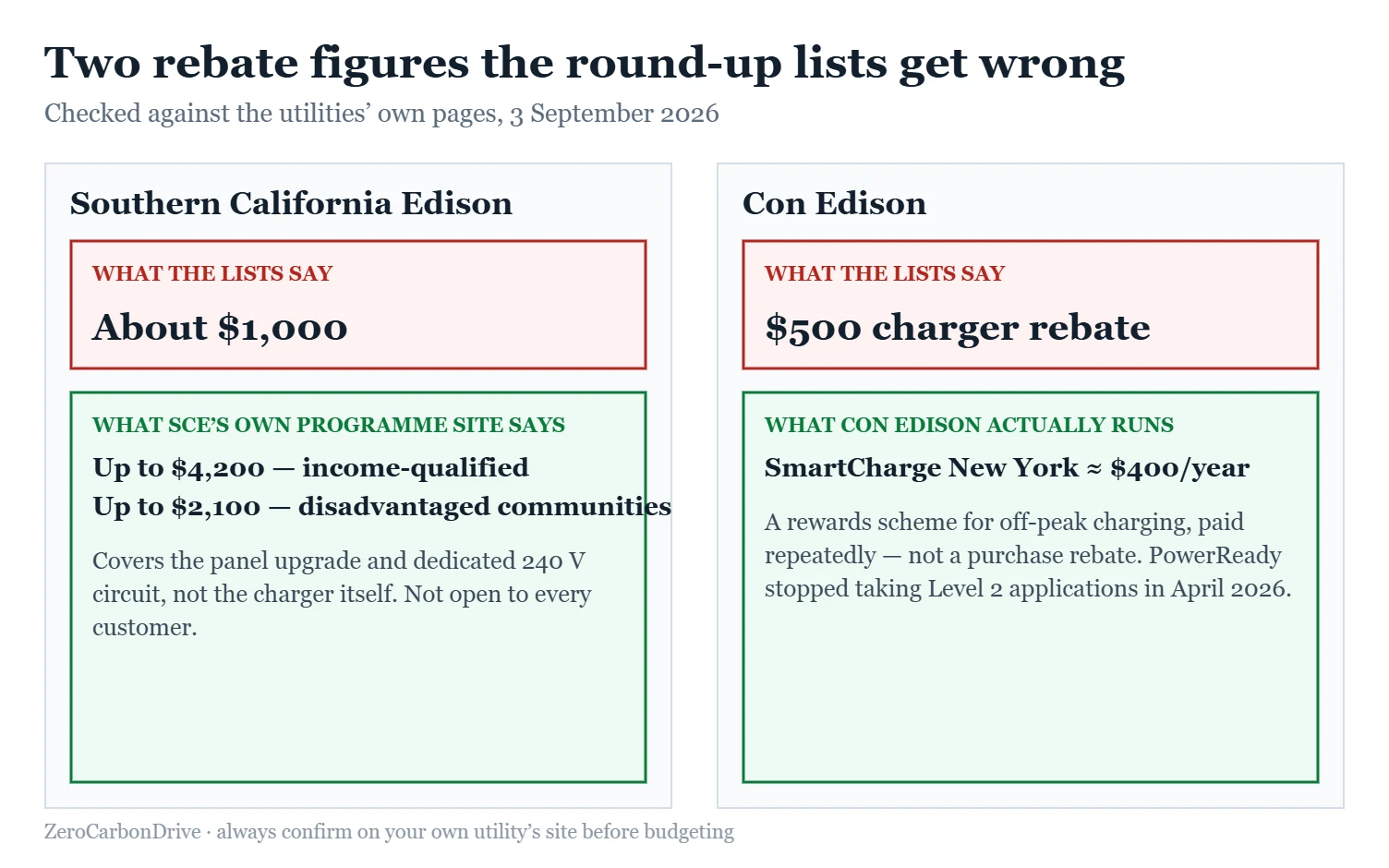
Aggregator pages routinely list SCE’s Charge Ready Home programme at around $1,000. SCE’s own programme site describes rebates of up to $4,200 for income-qualified households — defined as earning under 80 per cent of area median income, or enrolled in a qualifying assistance programme — and up to $2,100 for residents of disadvantaged communities, covering an upgrade to a 200 amp panel and a dedicated 240 volt circuit for a Level 2 charger.
So the round-up figure is wrong in both directions at once. It is far too low for those who qualify, and misleading for everyone else, because the headline amount is not open to all customers. Note also what is being paid for: the electrical work, not the charger.
Con Edison: not the kind of programme it is described as
Lists frequently show a $500 Con Edison rebate for buying and installing a Level 2 charger. What Con Edison actually runs for residential drivers is SmartCharge New York, a rewards programme that pays you for charging off-peak — the utility says participants earn about $400 a year on average. That is recurring behaviour money, not a one-off purchase rebate, and it changes how you should plan for it.
Separately, Con Edison’s PowerReady infrastructure programme stopped accepting Level 2 project applications in April 2026, with DC fast charging applications paused. A list compiled before then and never revisited would still be showing it as open.
How to find your own utility ev charger rebates in ten minutes
- Get the name off your bill, not off a map. In many areas a municipal utility, a co-op and an investor-owned utility all operate nearby, and only your actual supplier can pay you.
- Search the utility’s own domain for terms like electric vehicle rebate, EV charger rebate, or charging incentive. Go to the utility page itself rather than a blog describing it.
- Read the eligibility box before the headline number. Ask three questions: is it income gated, is it location gated, and does it pay for the charger or for the electrical work?
- Check whether the programme is still open. Look for a closing date, a waiting list, or a note that applications are paused. Budgets run out.
- Check the sequence. Several programmes require pre-approval before the work starts, or an installation by an approved contractor. Doing it in the wrong order disqualifies you, and no appeal will fix it.
- Check your state energy office too, and look at whether a time-of-use rate is a better deal than the rebate. A cheaper overnight rate can be worth more over five years than a one-off payment.
What to look for, and what usually disqualifies people
| Question to ask | Why it matters |
|---|---|
| Rebate or rewards programme? | A rebate is one payment for buying equipment. A rewards scheme pays repeatedly for charging at chosen times. They are not interchangeable, and lists mix them up constantly. |
| Charger or electrical work? | The charger is often the cheaper half. Programmes covering panel upgrades and circuits are usually worth more. |
| Income or location gated? | The largest advertised figures are frequently reserved for low-income households or designated disadvantaged communities. |
| Pre-approval required? | Many programmes will not pay retroactively. Applying after the electrician has left is the most common way people lose the money. |
| Approved equipment list? | Some require a networked charger, or one from a specific list. A cheaper unit can cost you the rebate. |
| Still funded? | Annual budgets are exhausted mid-year more often than you would expect. Confirm the programme is accepting applications today. |
Why we are not publishing a fifty-state table
We could, and a table of utility ev charger rebates would rank well. It would also be wrong within weeks, in the same way the two entries above are wrong now. There are over three thousand electric utilities in the United States, their programmes open and close on their own budget cycles, and the eligibility rules are where the real detail sits — none of which survives compression into a single cell of a table.
What travels well is the method, and the warning. If you take one thing from this page: the number in any round-up, including the two we quoted, is a starting point for a search, not a figure to budget against. Ten minutes on your own utility’s site beats any list, and it is the only version that reflects what you are actually eligible for.
Related guides
- The home EV charger tax credit — the 30C credit, who can still claim it for earlier work, and exactly when it ended.
- State EV incentives in 2026 — the vehicle side, after the federal purchase credits ended.
- What charger installation actually costs — itemised, including the panel upgrade decision these rebates often target.
- EV charging costs by state — the running-cost side, where a time-of-use rate may beat a one-off rebate.
Sources
- SCE Charge Ready Home programme site — rebate tiers and eligibility as described by the utility.
- Con Edison, SmartCharge New York — the residential rewards programme and its average annual earnings.
- Con Edison PowerReady — the April 2026 pause on Level 2 applications.
- Federal 30C credit expiry: see our home charger tax credit guide, sourced to the IRS and AFDC.
Frequently asked questions
Are there still utility ev charger rebates in 2026?
Yes. The federal 30C credit for home charging equipment expired on 30 June 2026, but many utilities and states still run their own programmes. Amounts, eligibility and whether a programme is open change constantly, so check your own utility rather than a round-up list.
Why do rebate lists disagree with each other?
Because they are copied from each other and rarely rechecked. We compared two widely repeated entries with the utilities’ own pages: one understated a California programme by thousands of dollars, and the other described a New York off-peak rewards scheme as if it were an installation rebate.
Do rebates pay for the charger or the wiring?
It varies, and the wiring is often the bigger prize. Several programmes pay toward a panel upgrade and a dedicated 240 volt circuit rather than the charger itself, which is usually where most of the installation cost sits.
Can anyone claim the largest advertised amounts?
Frequently not. The headline figures are often reserved for income-qualified households or residents of designated disadvantaged communities. Read the eligibility box before you budget against the number.
What is the most common reason people miss out?
Applying after the work is done. Many programmes require pre-approval before installation begins, or an installer from an approved list. Doing the steps in the wrong order usually cannot be fixed afterwards.
Is a time-of-use rate better than a rebate?
Sometimes. A one-off rebate is paid once; a cheaper overnight rate keeps paying every time you charge. Over five years the rate can be worth more, and in most places you can have both.
How do I know which utility to check?
Take the name from your electricity bill. Municipal utilities, co-ops and investor-owned utilities often serve neighbouring areas, and only your actual supplier can pay you.
Every figure on this page is dated and linked to its source. How we verify · Editorial policy · Report a correction
Related Posts

Leave a Comment
Your comment will be published after it has been approved. Please send comments that do not contain slang words.