
Electric vehicle motor types
Updated September 2, 2026 · 3 min read
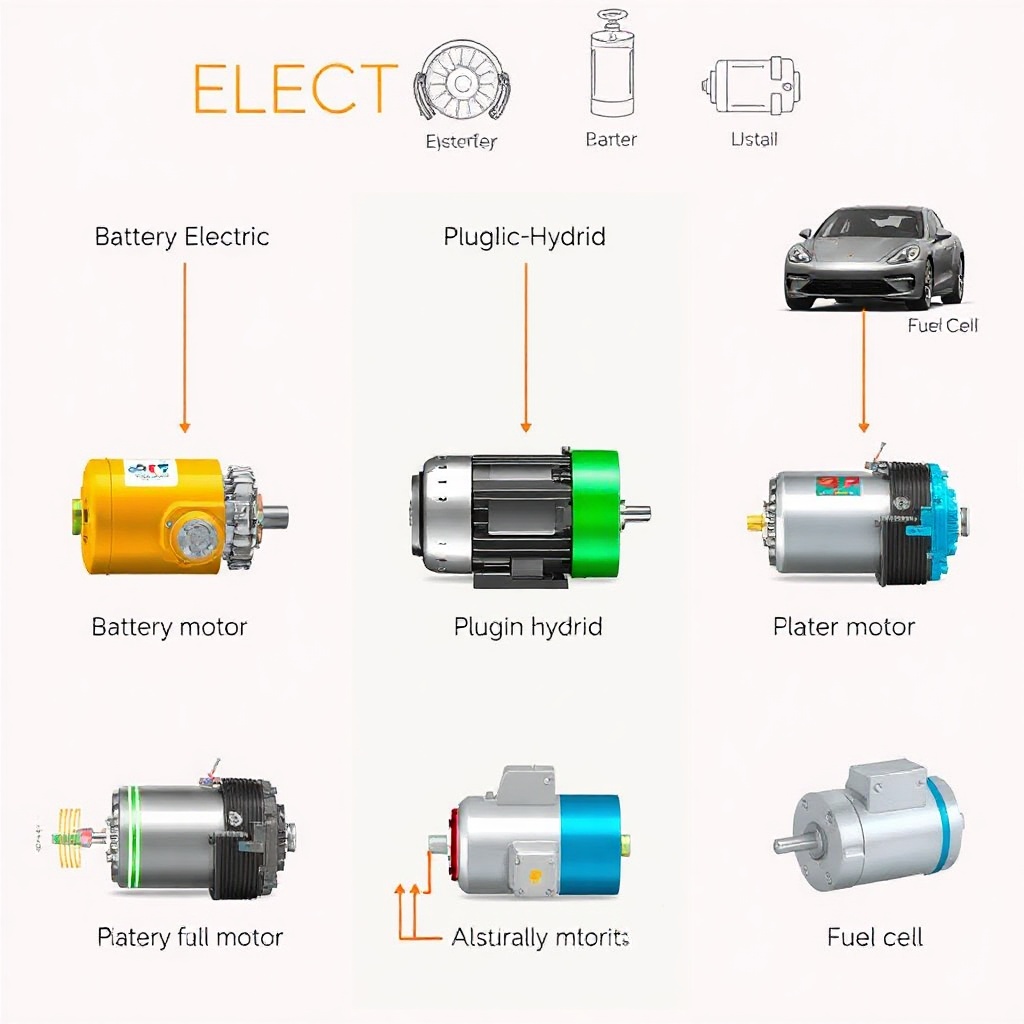
- Electric vehicle motor types boil down to three main options: permanent magnet synchronous (most common), induction, and switched reluctance motors.
- Permanent magnet motors are more efficient and compact but rely on rare-earth magnets, which carries supply-chain and cost exposure.
- Induction motors (used in some Tesla models) skip rare earths entirely and handle high-speed operation well, at a small efficiency cost.
- Motor choice affects range, cost, and NVH (noise/vibration/harshness) — not just raw horsepower.
Understanding electric vehicle motor types explains why different EVs feel and perform differently despite all being “electric.” The three dominant options — permanent magnet synchronous, induction, and switched reluctance — trade off efficiency, cost, rare-earth dependence, and high-speed behavior in different ways.

The Three Main Motor Types
| Motor type | How it works | Used by |
|---|---|---|
| Permanent Magnet Synchronous (PMSM) | Rotor has embedded rare-earth magnets, highly efficient across most speeds | Most mainstream EVs (Nissan Leaf, many VW/Hyundai/Kia models) |
| Induction (AC induction) | Rotor has no magnets — current is induced electromagnetically | Some Tesla models (rear motor in dual-motor configs) |
| Switched Reluctance (SRM) | Simplest, no magnets or rotor windings, relies on magnetic reluctance | Emerging in some commercial/industrial EVs |
Why Rare Earths Matter for Motor Choice

Permanent magnet motors need neodymium and other rare-earth elements, whose supply is geographically concentrated and price-volatile — a real cost and supply-chain risk for automakers building at scale. Induction and switched reluctance motors avoid this entirely by not using magnets, at some cost to peak efficiency, which is why manufacturers sometimes mix motor types within the same vehicle (e.g., PM motor for efficient cruising, induction motor for high-speed/high-power boosts).
Efficiency and Performance Trade-offs
| Factor | PMSM | Induction | SRM |
|---|---|---|---|
| Efficiency at low-to-mid speed | Excellent | Good | Good |
| High-speed efficiency | Good | Excellent | Fair |
| Rare-earth dependence | High | None | None |
| Manufacturing complexity | Moderate | Moderate | Low (simplest design) |
| Typical cost | Higher (magnet cost) | Lower | Lowest |
Why Dual-Motor EVs Often Mix Types

Some dual-motor EVs deliberately pair a permanent magnet motor on one axle (for efficient daily cruising) with an induction motor on the other (for high-speed power and all-wheel-drive traction when needed but not always active). This hybrid approach captures PM efficiency during normal driving while avoiding constant rare-earth-motor engagement during high-power demands.
What This Means for Buyers

Motor type isn’t usually a headline spec, but it quietly affects three things a buyer notices: efficiency (and therefore real-world range), noise/vibration character, and — indirectly — cost, since rare-earth-dependent motors can be more expensive to manufacture at scale. Most buyers don’t need to choose based on motor type directly, but it explains real differences between models with similar battery sizes and power ratings.
One-Minute Recap
- Three main electric vehicle motor types: permanent magnet synchronous, induction, and switched reluctance.
- PM motors are most efficient but need rare-earth magnets; induction motors skip rare earths at a small efficiency cost.
- Some EVs mix motor types across axles to combine efficiency and high-speed power.
- Motor type quietly affects range, cost, and NVH even when power specs look similar.
What are the main electric vehicle motor types?
The three dominant types are permanent magnet synchronous motors (most common, most efficient, rare-earth dependent), induction motors (no rare earths, excellent high-speed efficiency), and switched reluctance motors (simplest design, emerging in commercial applications).
Which EV motor type is most efficient?
Permanent magnet synchronous motors are generally most efficient across typical driving speeds, while induction motors can be more efficient at very high speeds — which is why some EVs use both across different axles.
Why do some EVs avoid permanent magnet motors?
To avoid dependence on rare-earth elements like neodymium, whose supply is geographically concentrated and price-volatile, creating cost and supply-chain risk at scale.
Does motor type affect an EV’s range?
Yes, indirectly — motor efficiency affects how much of the battery’s energy converts to actual driving distance, so motor type is one of several factors (alongside aerodynamics and battery size) that determine real-world range.
Why do some dual-motor EVs use two different motor types?
To combine benefits: a permanent magnet motor handles efficient daily cruising on one axle, while an induction motor provides high-speed power and all-wheel-drive traction on the other axle without constant rare-earth-motor engagement.
Is motor type something EV buyers should care about?
Not usually as a primary decision factor, but it explains real-world differences in efficiency, noise character, and cost between EVs with similar battery and power specs.
Sources and Further Reading
Related Posts
Leave a Comment
Your comment will be published after it has been approved. Please send comments that do not contain slang words.